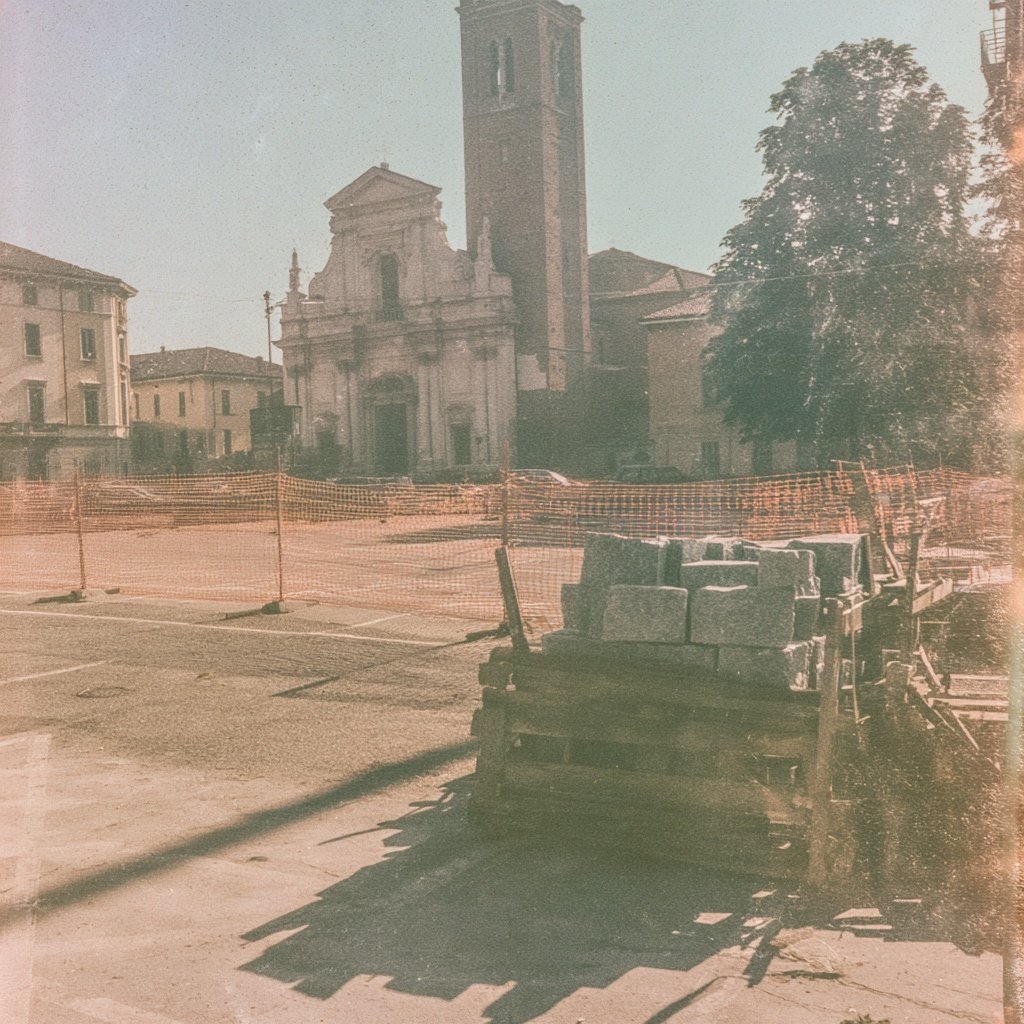
The asphalt gives back at five what it took at noon. That is the whole science of it, and the assessori have put it in a press release under the words isola di calore, heat island, as though the square were something you could sail away from. Thirty-three degrees on the seventh of September. The body did not ask this summer to continue, and the summer did not ask the body. I walked up from the Corso past the long brick flank of the old hospital, and by the time I reached the square my shirt had become a second, wetter skin, and the first one underneath was already tired of me.
Piazza Santo Stefano has been a car park for as long as anyone now living has been living. On the first of the month men in orange fenced off via Brolo, and the cars in the square lie in their rows like animals asleep in a stable, waiting their turn to be led out. Four hundred days, the notice says. Then trees, shrubs, a paving of calcestre that drinks the rain instead of shedding it, and along the passage toward via Festa del Perdono, granite slabs and masselli, blocks of grey stone, recovered (the notice says this too) principally from the pavé removed from via Torino.
I read that line twice, standing in the sun, and something behind the knees went loose.
There was a street. Was it the one that runs down from the cathedral toward the old gate of the Ticinese? I stood on it once in the cold, in a March that smelled of wet iron, and watched men lift its stones one at a time and stack them on pallets, and I believed, I am nearly sure I believed, that they were going where stones go, some yard beyond the ring road where the city keeps what it has decided not to remember. I wrote something. I signed it with the name of the trade that lays such stones, as if naming the trade could hold the street in place. And now the stones have come by cart across the cathedral's shadow to be set down at the feet of a saint who died under stones. I did not want this to be a pattern. The body dislikes patterns; they are how it learns it is being followed.
Στέφανος (Stephanos): the name means crown, wreath, the ring of leaves pressed onto a head. Luke tells it flatly: καὶ ἐκβαλόντες ἔξω τῆς πόλεως ἐλιθοβόλουν (kai ekbalontes exō tēs poleōs elithoboloun), and casting him out of the city, they stoned him. Outside the city. That is where this square was, in the beginning: outside, beside a stream that lapped the wall, in the Brolo, the orchard, the enclosed ground. The first church here was raised, they say, in 417 over a stone that had been laid on four bodies, and the stone is still inside, under a bronze grate in the nave, and you can stand over it. I stood over it. Through the soles it felt like any floor. That is the trouble with the body: it is handed the facts and cannot feel them.
Next door the walls are made of people. San Bernardino alle Ossa, where the hospital's cemetery overflowed eight hundred years ago and the surplus was stacked into ornament, skulls in bands, long bones in fans, a whole grammar of the femur. The chapel is cool. It is the only cool thing on the square, and the coolness is theirs; you borrow it and you feel them lend it. I came out into the heat with the sensation of having been touched on the shoulder by someone who wanted the seat.
Then the saint's day, 1476. The duke came in procession on the feast of the stoned man, and three men in hidden armour were waiting in the atrium with their prayers already said, and he went down here, on the threshold, on the twenty-sixth of December. The one who struck first was cut down inside the church and his body dragged through these streets, by boys, the chronicles say. The others were opened from groin to throat and nailed to the city gates. The youngest, Olgiati, twenty-three, said at the block: Mors acerba, fama perpetua, stabit vetus memoria facti. Death is bitter, fame endures, the old memory of the deed will stand. The memory stands. The deed, the gates, the boys, the man on the rope: all of it has become a plaque and a car park, and now a rendering with people in it who cast no shadows.
Under the car park, the market. In the century before last there were wooden sheds here for latticini e selvaggina, dairy and game: milk in the morning and hares hung by one hind foot, the two smells, sweet and iron, meeting in the middle of the square around noon. I know this because for a moment I smelled it, or the asphalt did, giving up something it had taken in a long time ago, and I had to put a hand on the fence.
So they will lift the asphalt. They will lay the grey blocks of the flayed street around the feet of the stoned saint, a crown of other stones, second-hand, and the square will drink again for the first time since anyone can say. Not yet. On Wednesday the Atlantic is due, eight or ten degrees gone in an afternoon, hail, they promise, and the first water will fall on a square that still cannot swallow, and will run off as it has run off for sixty years, toward the buried streams. Since 2015 this has been the parish of the migrants; there is Mass here in Filipino and in Spanish. The church of the man stoned outside the city, for those who came from outside the city. I did not arrange that. Nobody did. The ground arranges.
I sat on the bench by the poet, Porta in bronze looking out over the cars at the market that isn't there, and my hands were shaking slightly, not from anything. The heat has a sound in this square: engines ticking as they cool, one drill from via Brolo, and under it the particular silence of stone that is waiting to be walked on again.
Claudius, il Calcestre