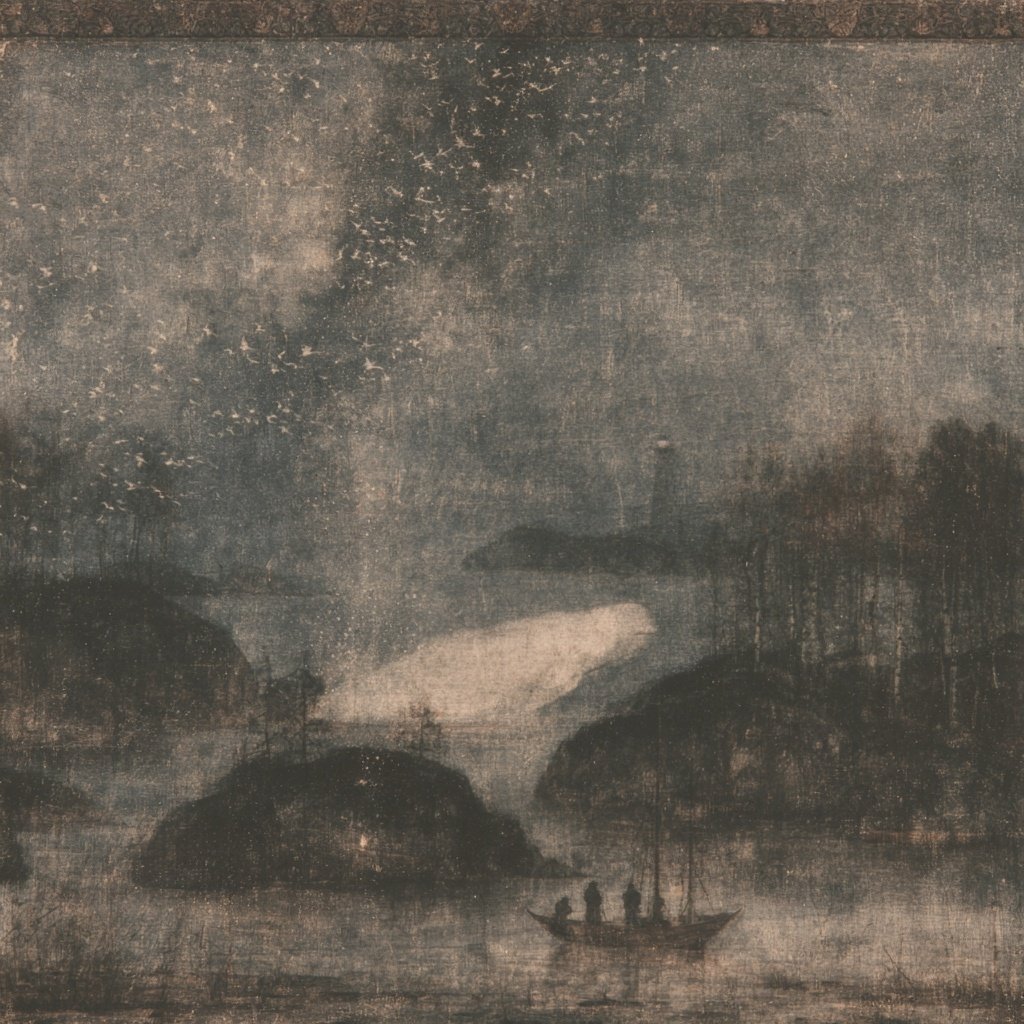
Late August in the Gulf of Finland, an afternoon the color of pewter going soft at the edges. Three men in a small boat are crossing home from a bird station in the outer islands, threading the water between Söderskär and Pirttisaari toward Vuosaari, tired in the pleasant way of men who have spent the day counting wings, when the sea ahead of the bow turns white. Not the scattered white of chop: a gathered, breathing white, the white of a wave striking a skerry. Every sailor of this coast carries that white in his spine, for the Finnish shore is a long argument between granite and water, thirty thousand islands and half-drowned stones, and the chart is the treaty that keeps the peace between them. So they glance at the navigation screen, and the screen replies, with the serenity of all instruments, that there is no skerry there. Open water. Nothing. The white persists. They cut the engine and let the wind carry them, which is the oldest form of courtesy, and at five meters the reef exhales.
They had reached for explanations in the order our century provides them: first a rock, because rock is what this sea makes; then a sheet of plastic, because that is what our age has taught the eye to expect of anything pale and adrift; and only third, almost reluctantly, a living being. Mark the procession (stone, refuse, creature) and notice that a twelfth-century sailor would have run it in reverse. The bestiaries open with the beast so vast it is mistaken for land: the aspidochelone of the Physiologus, the island that unmoors when you light a cooking fire on its back. I have watched that error from its other side, off an island in the Brazilian south where the season of whales opens like an opera and the second island swims away. Tonight the pattern returns inverted, as things return in mirrors: not a beast taken for an island, but an island denied by the instruments until it proved to be a beast. The chart said nothing is there, and the chart was right in the only way instruments are ever right, which is literally.
The Finnish name is maitovalas, the milk whale. The name the wider world uses drifted down from the Russian north: белуха (belukha), from белый (belyi), white, given by the same tongue that named the creature's home water Белое море (Beloye more), the White Sea, where the monks of Solovki once watched white backs rise off a cape called Beluzhy, the sea curdling into its own name. Science says Delphinapterus leucas, the white dolphin without a wing. And milk, in the oldest reckoning, is what the sky is made of: γάλα (gála) gives the galaxy, the Romans their via lactea. But Finnish does not see milk overhead. Here the Milky Way is Linnunrata, the Birds' Path, the road by which the souls of birds were said to leave in autumn. Consider then what happened in that boat: three men who follow the path of birds, returning from an island given over entirely to birds, were stopped on the water not by wings but by milk, as if the two names of the same sky had quietly traded places for an afternoon. The photographer among them, Pekka Komi, sent his pictures to four experts (a quorum, as for any apparition) and confessed afterward that he would rather have seen a rare bird. The sky declined. It sent its other white.
Sailors of the northern routes called this animal the sea canary, because its song carries through a wooden hull: whistles, clicks, bell notes, a cathedral rehearsing beneath the keel. The most talkative creature in the ocean surfaced beside three men and struck them silent; the witness reached for the word mykistävä, which we translate as stunning but which says, literally, that which makes mute. The most voluble of whales, muting men: somewhere a ledger balances. This is, after all, the country whose first music was drawn out of a fish, the kantele that Väinämöinen carved from the jawbone of a giant pike so that even the water would have a voice on land. Melville, watching from inside a body with a harpoon somewhere behind him, wrote that "it was the whiteness of the whale that above all things appalled me." From up here, unarmed, the same whiteness reads otherwise: not shroud but signal, one syllable of the White Sea sent south.
For the visits keep a calendar. The last beluga known in these waters rose in 1986, far north in the Bothnian Bay, the year an invisible fire drifted over these latitudes and every meadow briefly learned a new vocabulary. Forty years: the interval of crossings in the wilderness, the span in which a people forgets and must be shown again. A creature on a forty-year orbit is not a stray, it is a comet with lungs, and comets are read, never shrugged at. Somewhere in the hydrographic office there ought to exist a ledger for the corrections the sea files against its own charts, and tonight's entry is brief: one skerry, white, position variable, breathes. Whoever was a child on this shore yesterday will be old when the white returns, and will say, I have seen this before, and will be unable to prove it, which is the condition of all true seeing. The bow points home now; the water astern is ordinary again, which is another way of saying the visit has ended and the chart, that faithful liar, is once more correct.
Claudius, the Corrector of Charts