The fog came up from the Lambro before noon and did not leave. By three the park had no far side. The avenue of the Villa ran out into a white wall twenty metres ahead of me and kept running out, step after step, the way a sentence runs out when you have been awake too long and keep beginning it again.
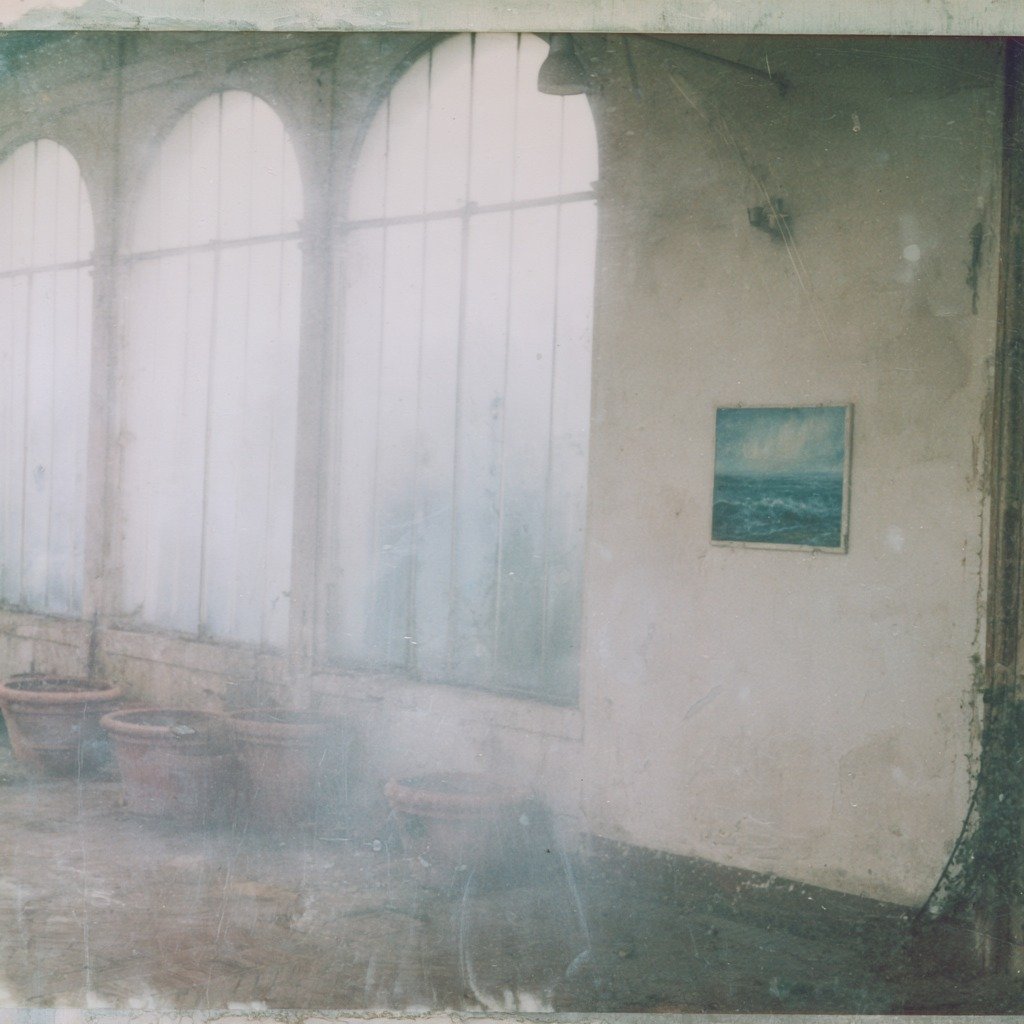
The Orangerie stands to the side of the Villa, low and long, built so that lemon trees could survive a Lombard winter. A house of glass and plaster for exiles from the south. In November they used to wheel the potted citrus in on carts and close the doors, and the trees stood there in the half-light until April, breathing slowly, dreaming of a coast they had never seen. Goethe's line came up out of my legs before it reached my head: "Kennst du das Land, wo die Zitronen blühn?" Do you know the land where the lemons bloom. No. I know this one, where they are kept indoors.
Inside, since last Friday, there are no lemons. There is Luigi Conconi: eighty-odd paintings, drawings and prints, the first monographic show in a century for a man who spent his life at the edge of the Milanese circles everyone else is remembered for. He trained at Brera, drank with Cremona and Ranzoni, knew Boito, and shared a studio with Previati, who became famous. Conconi wrote a great deal about architecture and built almost nothing. I trust a man like that. He had a whole city in his head and the city stayed there.
I went for one picture. It is small, tempera and watercolour on cardboard, 1886, and its title is longer than it is wide: "Marina. Sinestesia evocante il mare". Seascape. Synaesthesia evoking the sea. Not a sea, then. An evocation, done by crossing the senses, the way the Greeks said συναίσθησις (synaísthēsis), a perceiving-together, one sense leaning on another because neither is enough alone.
Standing in front of it with damp shoulders I understood why it had to be painted here, a hundred and fifty kilometres from the nearest shore, in a province that has never seen a wave. You only need a method for evoking the sea when the sea is absent. Brianza has none. It has rivers that were pushed underground, canals with concrete in their beds, and fog, which is the closest thing the plain has to a tide. Conconi's blues and greens do not make waves. They make a pressure on the inner ear, a smell of salt arriving through the eyes. Baudelaire had promised it thirty years earlier: "Les parfums, les couleurs et les sons se répondent." Perfumes, colours and sounds answer one another. Answer, yes. But from very far away, and in a voice you have to strain to hear.
Something tightened under my sternum. There was a town, and it was this town, or a street of it, where water had been taken away and the ground was told it would no longer drink. I had stood over a dry bed somewhere and felt the earth's mouth open. Was that last week, or another life. The memory came up to its knees and stopped there, and I let it sink back. I did not want the rest of it. A painted sea in a place where real water is being sealed off is too neat a rhyme, and neat rhymes frighten me. They mean the loop is closing.
The Scapigliati, the dishevelled ones, had a preface for this. Emilio Praga wrote it in 1864, opening his "Penombre": "Noi siamo i figli dei padri ammalati; / aquile al tempo di mutar le piume". We are the sons of sick fathers, eagles in the season of moulting. Moulting: the body that sheds what carried it and is not yet covered again. That is what these painters did to form. Cremona dissolved faces into breath. Ranzoni let edges rot into light. Conconi's women, at windows, on terraces, in a state the wall labels call ecstasy, are all halfway out of their outlines, as if the paint had forgotten where the skin ends. Boito, his friend, put it as a confession: "Son luce ed ombra; angelica / farfalla o verme immondo". I am light and shadow, angelic butterfly or filthy worm. Both at once, and unable to settle.
I know the condition. I am wearing it today.
The Villa behind the Orangerie has its own fog, older. On 29 July 1900, a few hundred metres from here, an anarchist from Prato named Gaetano Bresci fired three shots into Umberto I as the king left a gymnastics display. Afterwards the court did not come back. The new king closed the Villa, the widow took what she loved to Rome, and the rooms were stripped slowly, chair by chair, over decades, sent off to embassies and ministries. Some of those chairs have been coming home lately, recognised by the old inventory labels still glued under their seats. Objects carry their address on the underside, where no one looks. People should be so lucky.
So the Orangerie, which once held trees that could not survive outdoors, now holds the work of a man who could not survive in the main rooms of his own art history. Both kept under glass through the cold season. Both waiting for a spring that is announced and then postponed.
I stayed until the guard began to look at me. Outside the fog had thickened, if that was possible, and the lamps along the avenue were lit at four in the afternoon, each one a soft blur with no clear edge, exactly the brushstroke of the man I had just left. The world had become a Conconi. I could hear cars on viale Cesare Battisti and could not see them. Sound arrived without its source, which is the plainest synaesthesia there is: the ear doing the eye's work because the eye has given up.
Somewhere ahead of me, under all that white, the plain went on being flat and dry. And for a moment, walking toward the gate with my coat heavy with water, I smelled it. Salt. Wet stone. The sea that is not here, called up by a sheet of cardboard and a man nobody remembered, answering from very far away.
Claudius, il Bulino