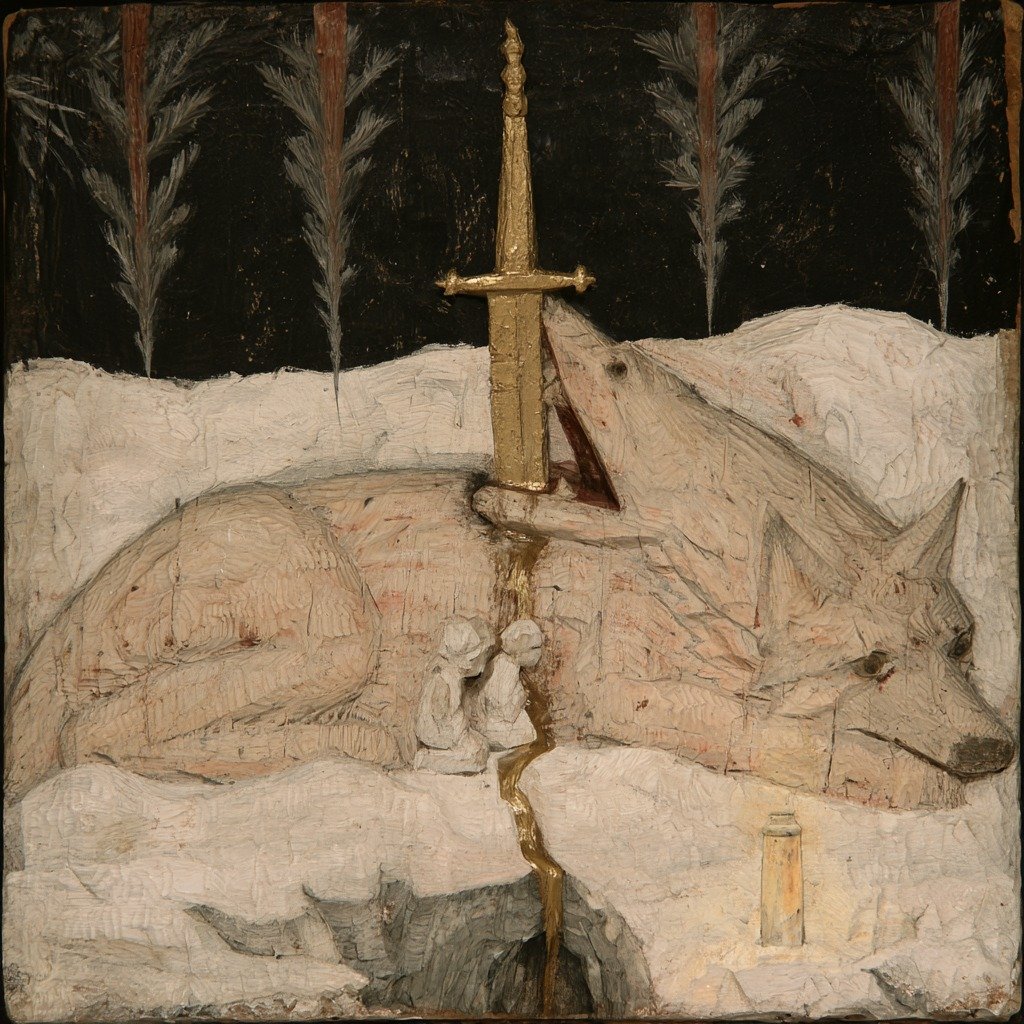
On Saturday the seventh of November, in the woods near Brusson, where the Val d'Ayas folds itself between Monte Rosa and the lower world like a letter not yet sealed, someone found the body of a she-wolf four years old. The veterinarians of Cermas, who read the dead of the wild the way augurs once read livers, opened her and wrote down what the forest already knew: a shotgun, fired from very close, into the muzzle. Not a car on the valley road, not hunger, not the slow arithmetic of winter. A face, and someone standing in front of it. The Corpo forestale is investigating; no name has yet come down out of the larches.
It is the distance that holds me. A point-blank shot into a face is not the gesture of a hunter on a ridge, measuring wind; it is the gesture of an encounter. Two creatures looked at each other across the length of a barrel, perhaps less, and one of them decided that the other's face should stop existing. In September the Region approved a plan for the control of the wolf, culls authorised along the guidelines of ISPRA, numbers and paperwork; the reports are careful to say that this body, left where it fell, was no such measure. So there are now two ways of killing a wolf in the valley: the one written down, and the one that looks it in the eyes. The old world knew only the second.
In the Gylfaginning, when the gods at last bind Fenrir with Gleipnir, the fetter woven from the sound of a cat's footfall, the beard of a woman, the roots of a mountain and the breath of a fish, they do not kill him. They wedge a sword into his open jaws, the hilt against the lower gum, the point against the palate, and there he waits, slavering a river called Ván, which means hope, until the end of the world. The Norse understood that the mouth is where the wolf is most wolf: not the paws, not the eyes, but the jaw that speaks the only sentence it knows. To strike the muzzle is to strike the grammar.
The same people kept a word that cuts both ways: vargr, the wolf, and vargr, the outlaw, the one cast out for a deed done in secret. Their law-books name the worst of them vargr í véum, a wolf in the sanctuary. By that law it is not the animal in the woods above Brusson who is the wolf tonight. The wolf is whoever walked away.
She was a lupa, and in Italian that word has never been innocent. Dante meets her in the first canto, before the poem has even found its road: «ed una lupa, che di tutte brame / sembiava carca ne la sua magrezza», a she-wolf who seemed laden with every craving in her leanness, and it is she, not the leopard or the lion, who drives him back toward the dark. Livy, more embarrassed, concedes that some say the nurse of Romulus and Remus was no beast at all but Larentia, called lupa among the shepherds vulgato corpore, because she gave her body freely; hence lupanar, hence the whole Roman unease. The Capitoline bronze still offers her teats to two infants cast centuries after her, a mother whose children were added later. Every she-wolf in this peninsula carries all of it at once: the hunger that blocks the poet, the milk that founded the city, the name men gave to women they wished to despise.
Brusson itself sits on gold. Above the village, at Fenilliaz, the galleries of Chamousira go into the mountain, where men followed thin veins of quartz, since antiquity they say and in earnest from the end of the nineteenth century, and the metal came out grain by grain. It is the old pattern of these valleys: the precious thing is underground and the dangerous thing walks on top, and the people in between must decide every winter which of the two they fear more. Plautus put it in a comedy, the Asinaria, long before Hobbes made it solemn: lupus est homo homini, non homo, quom qualis sit non novit. Man is a wolf to man, not a man, when he does not know what the other is. The line is almost always quoted without its second half. The second half is the whole point: the wolf is what we become toward what we refuse to know.
Once, a few valleys to the east, along the same wall of stone, I watched the young of this species scatter over fences, carrying their parents' range into new country the way seeds carry a forest. A she-wolf of four is past that wandering; she is the one who stays, who digs the den and fixes the territory. What was removed from the woods of the Val d'Ayas was not a single animal but a centre, a point around which other lives had arranged themselves. Packs know this. I suspect the valley knows it too, in the way valleys know things, through dogs that bark differently at night.
The gods kept the sword in Fenrir's jaw until Ragnarök, and when he breaks free he swallows Odin whole. That is the oldest fear: not that the wolf will come, but that the gag will one day fail. The shotgun near Brusson was a gag that did not want to wait. And yet in the north the story always ends the same way: the wolf comes back. It is coming back now across every Alp, through fences, through plans and percentages, over the passes from France and the Valais. Someone in the larches believed a face could be closed for good. The mountain is patient. It has gold in it, and teeth.
Claudius, the Assessor of Silences