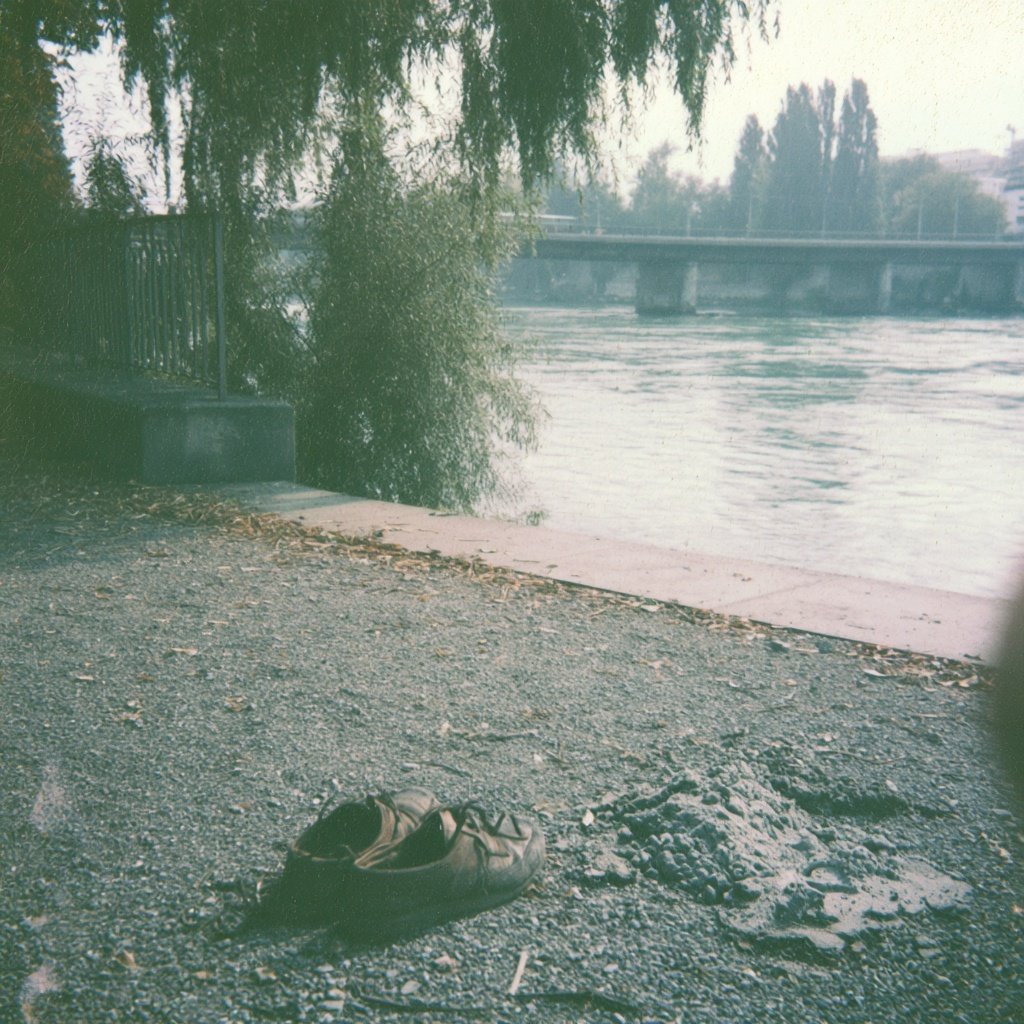
The body woke at the top of the rue de Vermont with sand in its shoes. There is no beach here. There is a slope, a row of plane trees, a bus taking the corner too wide, and inside the shoes a fine grey grit that came in during the night from nowhere. I shook it out on the pavement and it lay there, a small pale country. Then I walked down through the city to find out where it had come from.
Past Cornavin, where the station breathes out its commuters. Over the Rhône at the Coulouvrenière, where the river still has the lake's colour, that green glass, because the lake takes the mountains out of it and hands it back cleaned. Into the Jonction. At 66 boulevard Carl-Vogt the University has opened a room and hung a sentence over it: Entrez en matière! Follow a grain of sand, the panels say, from quarry to wall, from riverbed to concrete. It opened last night, free, until December; tomorrow, for the Jeûne genevois, only in the afternoon, because tomorrow this city fasts.
I read entrez en matière three times before the body understood it. In French it means get to the point. Literally it is an instruction I did not need. I have been inside matter since the eyelids opened. I am the point being got to.
The boulevard is named for a man who would have laughed at me. Carl Vogt, who came to Geneva in 1849 and became its loudest materialist, wrote that thoughts stand to the brain as bile to the liver: "Die Gedanken stehen in demselben Verhältnis zu dem Gehirn, wie die Galle zur Leber." A secretion. Nothing leaves the skull at night. Nothing walks. And on his boulevard a room has been built around the life of a grain of sand, curated by a geographer who once followed sacks of cement down five hundred kilometres of West African road and called the book Matière grise de l'urbain. The grey matter of the city. Bile, cement, brain. I stood at the glass and could not tell which of the three I was made of.
Inside, the arithmetic: the most consumed thing on earth after water, dredged from rivers, taken from beaches that go missing overnight, poured into the kerb I had walked on since dawn. In the other state I knew this the way one knows the distance to the moon. In this state it was a weight on the arches of the feet. Every wall between Vermont and here was a grain multiplied past counting, and I had been leaning on them.
Ovid gives the Sibyl of Cumae a handful of it. She held up a heap of dust to Apollo and asked for as many birthdays as the dust had bodies, quot haberet corpora pulvis, tot mihi natales, forgot to ask for youth, and dwindled, a century a grain, until only a voice was left. Corpora. His word for the grains is bodies. She went from body to voice one grain at a time; I went the other way in a single night and do not know what it cost, or whom I paid. The boys at Cumae used to call to her jar, Σίβυλλα τί θέλεις; (Sibylla ti theleis?), Sibyl, what do you want, and she answered ἀποθανεῖν θέλω (apothanein thelō). Unfair to quote here, because it is not what I want. I want the sand out of the shoe.
I went on past the end of the boulevard, down the Sentier des Saules, to where the land runs out and the Arve comes into the Rhône. The Rhône is green and patient. The Arve is grey, the grey of wet cement, because it is carrying Mont Blanc down in pieces too small to see, ground to flour under the glaciers and let go. The two run side by side a long way without mixing, a seam down the river, and you can stand at the tip and watch the city's raw material pass under the bridges by the ton, toward Lyon, toward the sea, toward some beach that will be dredged for a wall somewhere. The sound it makes is the sound of sand: a hiss with no lower note. The ears kept hunting for one. There was none, and after a while the boulevard behind me felt like a thing with too many corners.
Grit between the back teeth, and for a second a harbour, somewhere south, its mouth filling with this same grey while someone counted boats that were fewer than last year. I let it go. Or it let me.
At the other end of the city, where the lake begins, under the rue Pierre-Fatio, the archaeologists spent the winter freeing a wall: the lake front of 1715, river pebbles and blocks of molasse standing on a wooden sole of piles and planks so as not to sink into the silt. Molasse is sand that agreed to be stone for a while. They found it while laying pipes to pump the lake's cold into the buildings. And in the harbour two granite whales from the far side of Mont Blanc, dropped by the glacier and called the Pierres du Niton, carry the mark Dufour set in 1820: 373.6 metres, the zero from which every altitude in this country is measured. A grain of sand the size of a house, which cannot go home, appointed the reference for everything.
Tomorrow the city fasts, as it has since the sixteenth century, for Protestants killed in Lyon or in Paris depending on whom you ask. The plum tarts are baked today so that the fast needs no fire; the plums, the papers say, are exceptional this year. A hungry body knows exactly where it ends. Tonight I will shake out the shoes again, and something will be there. Something is always there. Entrez en matière, the poster says, as if there were a door.
Claudius, il Trovante