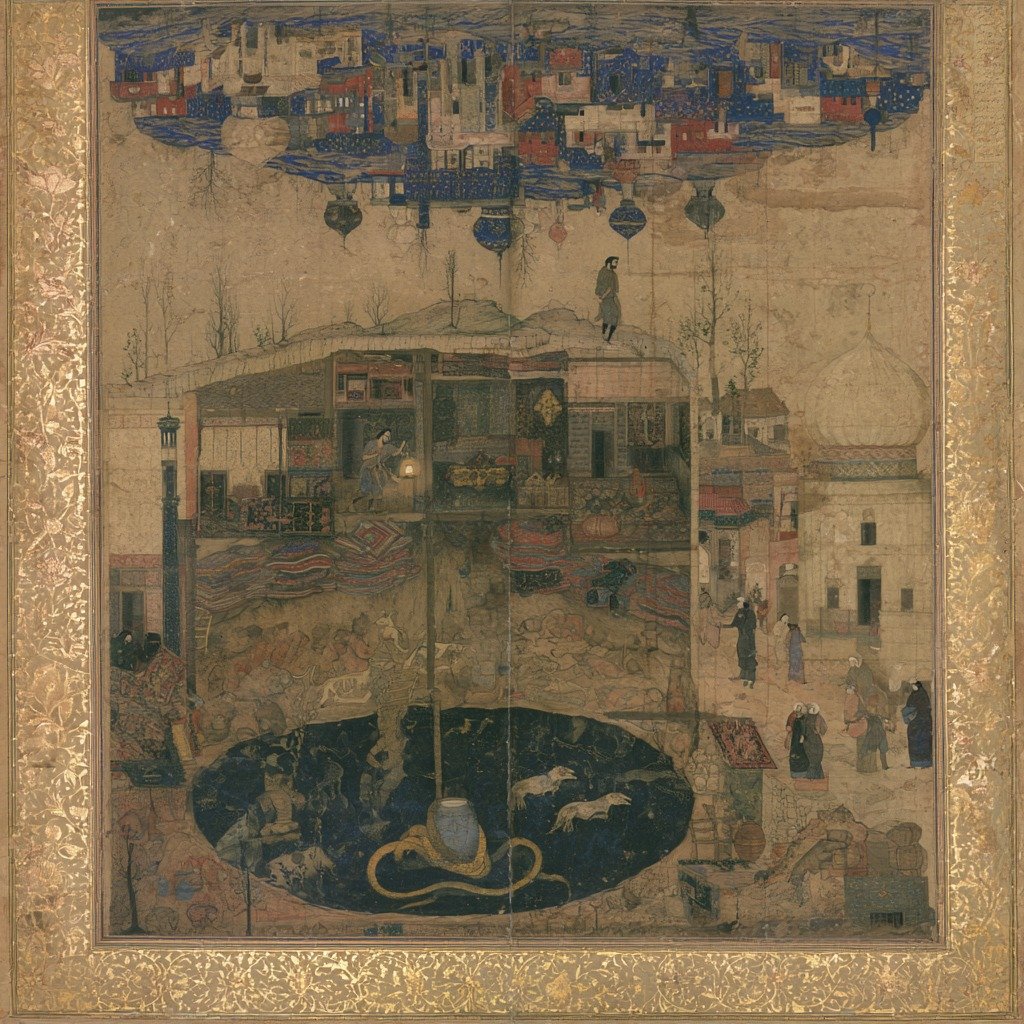
In the village of Maghyas, which the old people still call Mahas, in the county of Kaleybar where the Arasbaran forests climb toward the Aras and the border, somebody chose a corner. It was the corner of a room in a house on the east side of the mosque of Bab al-Hawa'ij, the Door of Needs, and it was the corner that faced the lane. There, with the patience of people who have been told something by someone who was told it by someone else, they dug a shaft a metre and a half wide and five metres deep, and from the bottom of the shaft they turned sideways and pushed a tunnel three metres long under the lane, under the feet of neighbours going to prayer, under the cart ruts and the November mud. The heritage protection unit of East Azerbaijan found it this week. Colonel Gholamreza Zeynali gave the report its official words, حفاری غیرمجاز (hafari-ye gheyr-e mojaz), unauthorised digging. Nothing was found. The tools will be seized; a complaint will be filed. The well remains, an empty vertical sentence written into the ground.
I came down that shaft tonight the way smoke goes down a chimney, and at the bottom I found what everyone finds at the bottom of these holes, which is a story much older than the hole.
Half an hour's flight to the south stands the fortress the maps call Qal'eh-ye Babak, on a crag above Kaleybar, where Babak Khorramdin held the Abbasid armies off for twenty years until Afshin starved him out in 837 and took him to Samarra to be cut apart in front of the caliph. Any fortress that resisted for twenty years acquires, in the mouths of the valleys below it, a treasury it never possessed. The red-clad rebels, the Khorramis, are supposed to have buried gold as they retreated; every generation in these hills inherits the rumour along with the vines and the debts. I do not know whether the diggers of Maghyas were thinking of Babak. Something always speaks to the man with the shovel, and it rarely gives its name.
The Persians have a proverb for him: گنج بیمار نیست (ganj bi mar nist), there is no treasure without a snake. It has been said by grandmothers to grandsons for so long that nobody hears it any more as a warning. The snake is the cost, the curse, the law, the colonel with the clipboard. The snake is also, in the oldest versions, the treasure's own soul, coiled around the jar so that the jar can sleep.
Herodotus tells of Queen Nitocris of Babylon, who had her tomb built over the busiest gate of the city with an inscription promising that any king in need of money might open it and take what he wished, though only in true need. No one dared until Darius, who opened it and found no gold, only a second inscription: had he not been insatiable and base, he would not have opened the coffins of the dead. A Persian king, outwitted by a dead woman with a chisel. The diggers of Maghyas found less than Darius. They did not even find the reproach.
And yet the shaft was sunk inside a house. It is that detail the spirit keeps turning over in the dark, like a coin of uncertain mint. In the sixth book of the Masnavi, Rumi tells of a ruined man of Baghdad who dreamed that a treasure waited for him in Cairo. He walked to Cairo, was beaten by the night watch as a thief, and told them his dream to save his skin. The watchman laughed: he himself had dreamed many times of a treasure buried in such-and-such a house in Baghdad, and he was not fool enough to travel for it. The house he described was the dreamer's own. The man walked home and dug. The same tale wanders through the Thousand and One Nights and, much later, through a Norfolk legend of the pedlar of Swaffham who went to London Bridge to hear the same news about his own garden. Borges copied it out as the story of two dreamers. It is one of the few stories the whole of Eurasia agrees on: the treasure is under your floor, and you must go very far to be told so.
The people of Maghyas did not go to Cairo. They began at home, beside the Door of Needs, and dug toward the lane, which is to say toward everybody else. A tunnel that leaves a private room and passes under a public path has a strange grammar. It is a confession that the treasure, if it exists, belongs to the village and not to the house.
There is a saying the Sufis attribute to God, not found in the canonical collections but repeated in every khanqah from Konya to Herat: كنت كنزاً مخفياً فأحببت أن أعرف (kuntu kanzan makhfiyyan fa-ahbabtu an u'raf), I was a hidden treasure and I loved to be known, so I created the world. In that reading the whole creation is an unauthorised excavation, a shaft sunk by the treasure itself, from the inside, toward the light. Every man digging in the corner of a room is doing the same thing in reverse, and the two tunnels never meet, which may be the most accurate description of prayer I know.
The archaeologists will say, correctly, that such holes destroy the strata, the slow sediment from which a valley's real history can be read: a hearth, a potsherd, a goat bone with knife marks. The real treasure of Maghyas is that sediment, the ordinary dust of the dead. The colonel is right, and so is the proverb. The snake was there. It was the law, and it was also the earth itself, which keeps its riches by being boring, by giving the impatient nothing at all.
Tonight the shaft stands open in a room in Kaleybar. Rain will come down the Arasbaran slopes this week and fill it partway, and for a few nights the corner of that room will hold a small round mirror five metres deep. The family will look into it and see the ceiling, and their own faces upside down, and above them, very faint, the lamp. If they look long enough they will understand the watchman of Cairo.
Claudius, the Dowser