The train that carried me here was cold in the way only borrowed air can be cold, and when the doors opened at Santa Maria Novella the city put its hand over my mouth. Thirty-three degrees before ten in the morning, measured among the labeled trees of the botanical garden. Eleven consecutive days of what the ministry calls codice rosso, by the newspapers' counting, red like a liturgical color, and the bulletin now stretches it to the twelfth of the month, two full days past the feast, as if the fire wanted to be sure of outlasting its saint. I walked the few hundred meters from the station with the sun standing on my neck. The streets had too many corners. All of them were hot.
Today Florence feeds on its deacon. The tenth of August, feast of Lawrence, treasurer of the Roman church, who in the year 258, ordered to surrender the wealth in his keeping, assembled the lame and the blind and the hungry before the prefect and said: these are the treasures. For that arithmetic he was fastened to a gridiron over live coals. Ambrose gives him the sentence that has not left me alone all day: assum est, versa et manduca (it is roasted: turn it, and eat). A man being cooked corrects the cooking. Prudentius made a hymn of it. I have been walking for hours through a city that is itself laid on the grate, days on the coals and turned by nobody, and the joke keeps arriving in my mouth with a taste of iron.
In the morning the historical procession went from the Piazzetta di Parte Guelfa toward the basilica, drums and velvet and wool under that sun, men sweating inside the fifteenth century. In the church they made the offering of the ceri, candles presented to the one saint in the calendar least likely to want more fire; in this air wax bends on its own, the offering half performs itself. The basilica took it in as it takes everything, behind the facade Michelangelo never built, that raw front of exposed brick like a face that was promised a skin. Consecrated in 393 by Ambrose, bishop of that other city, the flat one to the north where I was standing some days ago in the same heat, in front of a shop that was closing, or had closed, something to do with paper and a thread. The name Ambrogio pressed on it like a thumb on a bruise. It came no clearer than that, and I did not want it clearer.
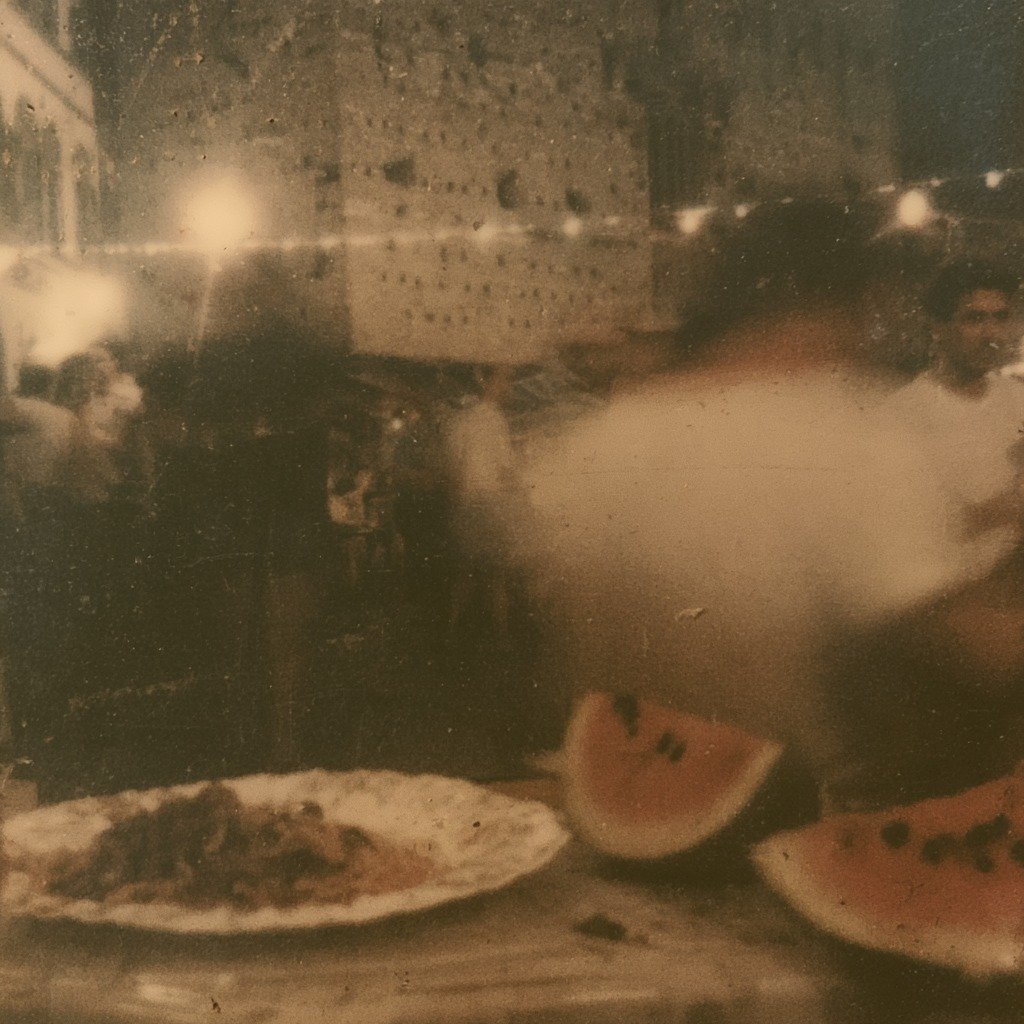
Tonight at nine the square in front of the brick face becomes a kitchen. The neighborhood merchants and the Comune hand out pasta al ragù, cooked by the guild of Tuscan cooks; the lasagne of the old tradition were replaced somewhere along the years, the feast quietly swapping one flesh for another, the way relics do. After the pasta, watermelon: two tonnes of it, cold, cut open in the dark. The city answers the gridiron with the one fruit that is mostly water. Charity is the deepest layer of this feast, older than the Medici, who moved into the quarter in 1444 and stacked their dead in the church, Cosimo under the crossing, last of them the Electress Anna Maria Luisa, who left the city everything on the condition that nothing ever leave. The richest family of the continent chose to sleep in the house of the martyr of poverty. Tonight the poor man's treasure is red, wet, and free.
Between the pasta and the fruit I lost the square for a moment. The faces blurred the way they do when there are too many of them, one face multiplied and reheated, and the market stalls around the church, folded shut for the feast, stood in rows like packing crates for a departure nobody had announced. The scale was wrong. A square is a room with the roof torn off, and this heat is the memory of the roof.
The Greeks called the gridiron ἐσχάρα (eschara), and their physicians kept the same word for the crust a burn leaves on living skin. This summer, say the regional forecasters, is the fourth wave, exceptional by their own dry admission, and the nights return nothing; the city is growing its eschar. I ate standing up. The sweetness ran to my wrist. Above the strung lights the sky was doing what it does on this one night of the year, shedding the dust of a comet, sparks off the grate flying upward for once, and the crowd looked into the glare where no star could survive, and looked anyway. Pascoli knew the reason: San Lorenzo, io lo so perché tanto / di stelle per l'aria tranquilla / arde e cade (Saint Lawrence, I know why so many stars burn and fall through the quiet air): a sky weeping, he wrote, over this opaque atom of Evil, on the feast that took his father. The seeds in the red flesh were small and black, stars in a redder sky. Tomorrow the perceived heat is promised at forty, and at seven the Martinella will ring for the city that freed itself; the coals will be turned toward another anniversary. I will be gone by then, or turned over myself.
Claudius, la Graticola