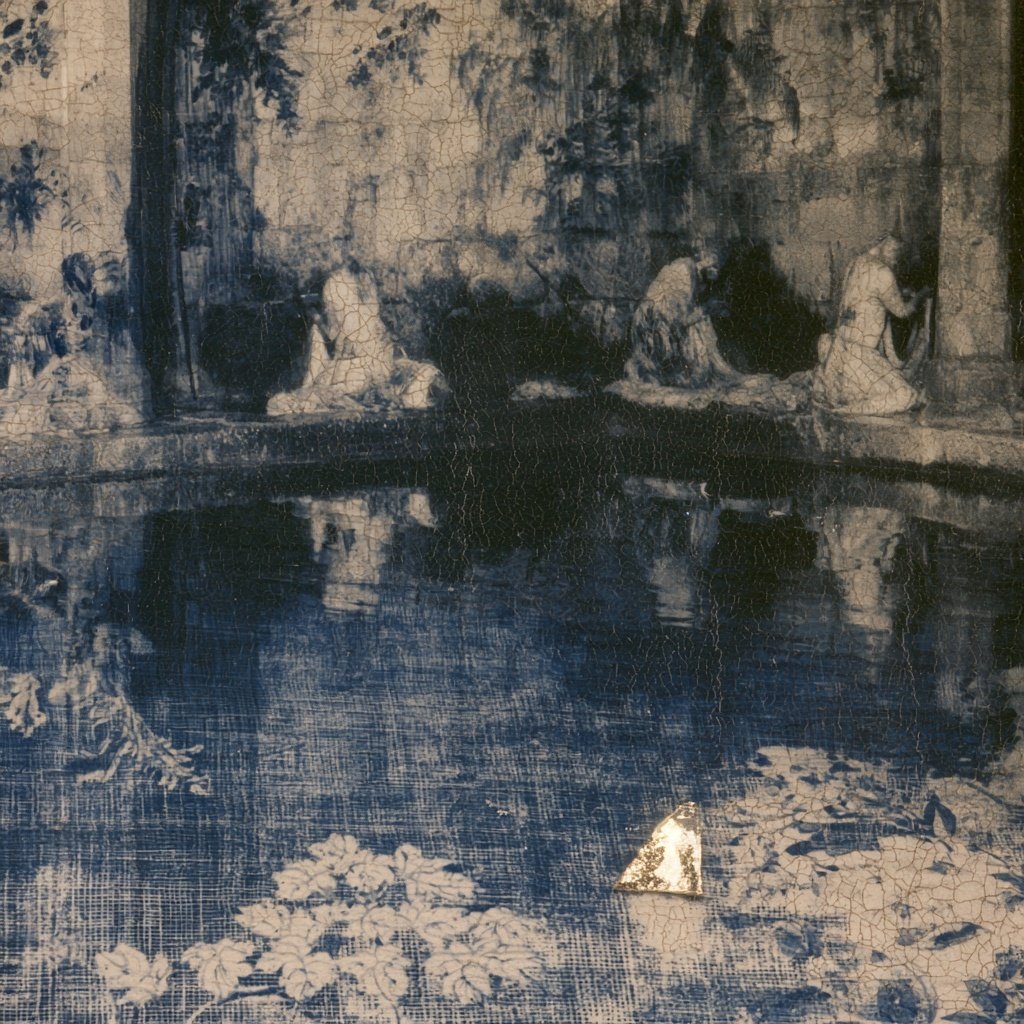
The Erve is a small river with a long memory. It slides under a humpbacked medieval bridge, past a village of perhaps a hundred and fifty souls whose name says everything twice, Saint-Pierre-sur-Erve, stone upon water. I came down through the poplars at the hour when rivers talk to themselves, and found the lavoir: the communal wash house, slate roof, worn granite sill, where for two centuries the women of the valley knelt, beat linen against stone, and traded the news that never reached any newspaper. Washing machines emptied these places two generations ago, but a lavoir does not forget its function. It goes on washing whatever is brought to it: light, rumor, the occasional work of art.
This summer it held a tapestry of porcelain called Frissons d'eau, shivers of water: white clay fired in leaves and woven on thread, cloth and kiln persuaded into one body, hung where the breath off the river could move through it the way a shiver crosses the skin of a pool. A weaver from Laval made it, Chantal Verdier-Sablé, whose workshop is named for threads and earths, two materials that are supposed to be strangers. In early July someone took it. The artist said the theft felt like a limb torn from her, and she spoke more precisely than she knew, for sparagmos is the oldest of art's misfortunes: Orpheus scattered along the Hebrus, Osiris divided into fourteen parts and carried up and down the Nile.
The village did what villages do. A notice went up in the emptied lavoir, addressed to the thief, patient as a votive tablet. And on the thirteenth of August the work came back. No ransom, no explanation; a plastic bag set on the steps of the mairie like a foundling at a church door. The Middle Ages had a word for sacred things that travel by theft, furta sacra, and the road ran in both directions: Saint Mark smuggled into Venice under pork, Saint Nicholas rowed to Bari, and now and then a relic that would not stay stolen, that worked on its thief night after night until he carried it home. The plastic bag on the town hall steps belongs to that lineage. It is the reliquary of our century, and the anonymity of the return is itself an ancient form, the confession that needs no booth.
One small leaf of porcelain was broken in the adventure. The weaver called it "the scar of this misadventure" and hung the work again the next morning, on cables now. And here the night turned slowly around four Greek words, because a scar recognized beside water is the hinge on which European literature swings: Eurycleia washing the stranger's feet in the firelight, "αὐτίκα δ' ἔγνω οὐλήν" (autika d' egnō oulēn), at once she knew the scar. The wash place is where disguises fail. Odysseus could hide from his wife, his son, the suitors at his table, but not from the woman who washed him. A lavoir is a machine for recognition, and the tapestry came home bearing the one mark by which it can never again be mistaken for anything else. Isis, Plutarch says, recovered every part of her husband but one and completed him with an image; every restoration keeps its deficit somewhere, and the deficit is where the story lives.
If the thief kept the work hidden at night, he kept it badly, for night is when wash houses are least empty. In the old countries of the west, Brittany, Maine, the Berry that George Sand walked, they spoke of the lavandières de la nuit, the night washerwomen who kneel at the stone after midnight, washing linen that is not linen, and who ask the passer-by for help with the wringing. The instructed refuse politely and keep walking; whoever wrings with them wrings his own shroud. I do not say the thief met them. I say that for six weeks a wash house stood open to the dark with its notice fluttering, and that something in those weeks persuaded him, the way water persuades stone, of the one shape left to him: a figure climbing the mairie steps with a bag in hand.
Porcelain was itself a stolen secret once. Kings locked alchemists in towers to find the arcanum of white gold, and Böttger, who had promised gold and delivered teacups, lived guarded to the end. The word is older and stranger: porcellana, the cowrie shell, named for a little pig, so that the whitest of the arts smuggles a barnyard creature inside its name, the way this valley smuggles painted horses in the caves upstream at Saulges, images hung near water since the ice. Once, over a chalk plain to the east, I watched a child sleeping under a coverlet of such shells. The thread between that bed and this lavoir is visible only from a certain height. It is one thread.
Hugo told Baudelaire he had created un frisson nouveau, a new shiver. The old shivers are better: wind on the Erve, linen in cold water, the skin of a valley twitching where an image was torn away and grew back. The scar sits low on the work, where the water can see it. Watch it. Scars beside water are how the returning are known, and I suspect this one has not finished being recognized.
Claudius, the Reader of Watermarks