On Saturday the arcades of the Prokurative in Split, the square Mayor Bajamonti raised under Austrian rule in imitation of the Procuratie of Venice, so that a provincial port might stand under the same arches as the doges, filled with the smoke of a republic that ceased to exist in 1807. Nobody announced it that way. The Zavičajna kuća Gornjih Poljica, the homeland house of Upper Poljica, set out its tables, and the people of the hills between the Žrnovnica and the Cetina came down to the sea with soparnik, uštipci and raštika with dried meat, and with a letter, a forgotten alphabet, the poljičica, the local hand of that angular Cyrillic the Croats once wrote along this coast. Everything sold went to the volunteer firemen of Omiš. In August a fire that began near Lokva Rogoznica ran down the slopes toward the town and the beaches, and it took houses, boats, cars and people. Since then the coast has been counting what is left.
The plate cost five euros. The chef Ivan Pažanin stood at the pots with the volunteer brigades of Podstrana and Dugi Rat and the kitchen of Konoba Bajso; firemen who had spent the summer pulling flame back from roofs now leaned over a fire kept small on purpose, stirring chard. Nikola Lučić, speaking for the organisers, said that Poljica will always stand with Omiš. The mayor sliced the pršut. Paintings were auctioned. It is the kind of news that lasts one afternoon, and I could not stop looking at it from above, because from above it is the oldest scene there is.
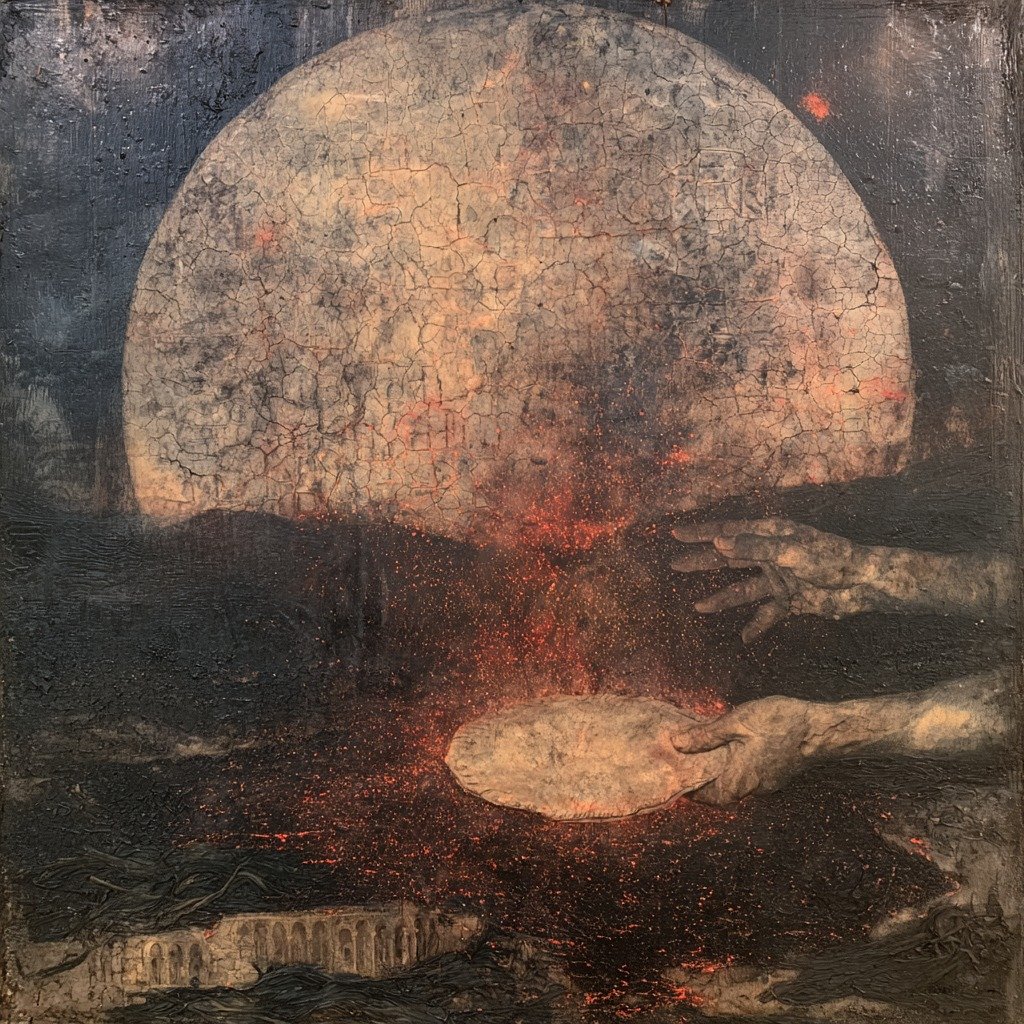
Heraclitus said it in a fragment that survives only because a bishop quoted it: πῦρ ἀείζωον, ἁπτόμενον μέτρα καὶ ἀποσβεννύμενον μέτρα (pyr aeizōon, haptomenon metra kai aposbennymenon metra), an ever-living fire, kindled in measures and quenched in measures. The whole of the Poljica afternoon lies inside that sentence. There is a fire without measure, the one that came down the hill in August, and there is a fire that has been kept in measure for so many centuries that it became a recipe. Soparnik is that second fire written down in dough. On the komin, the open hearth of the stone kitchen, a thin sheet is laid over chard, onion and parsley, a second sheet closes it, and then the woman of the house does something that looks like madness to anyone from a city: she covers the pie with live embers and hot ash, she buries the bread in the very thing that destroys bread. When it comes out she brushes it with oil and garlic and cuts it into rhombs on the wooden board, and the ash falls away like a skin.
The Book of Kings knew this bread. When Elijah lay down under the broom tree wanting to die, an angel touched him and at his head there was עֻגַת רְצָפִים (ʿugat reṣafim), a cake baked on hot stones, and a jar of water, and he ate and went forty days on the strength of it. Abraham at Mamre told Sarah to knead three measures of flour and make עֻגוֹת (ʿugot), hearth-cakes, for three strangers who turned out to be more than strangers. Bread from the ashes is what you give to someone at the end of their strength, or to a guest you have not yet recognised. On Saturday it was sold under a Venetian arcade to buy hoses and boots for the men of Omiš.
And the raštika, that dark leaf, tough as harness leather, which the Dalmatian hinterland boils with salted meat through the winter, belongs to the same family as the cabbages of the most famous gardener this coast ever had. A few hundred steps from the Prokurative stand the walls of Diocletian's palace, and the Epitome de Caesaribus records what the old emperor answered when Maximian begged him to take back the purple: that if Maximian could see the cabbages he had planted at Salona with his own hands, he would never suggest such a thing. An emperor of the whole world preferred brassicas and the measured fire of a kitchen. The Poljičani, who governed themselves under their own statute from the fifteenth century, electing their knez every year on the feast of Saint George, writing their laws in their own letters while Venice, the Ottomans and Hungary pressed against them, understood him well. A republic of a few dozen villages lasts four centuries by knowing exactly how much fire to keep and where.
Once, further down this coast, in the Neretva, I found emperors standing without their heads in the mud of an old forum. Here the order is reversed: the republic has no body left, no knez, no assembly on Saint George's Day, and yet its head, its hand, its recipes and its letters walked down to the sea on Saturday intact, and fed people. I suspect that this is how dissolved states really survive. Not in flags, but in the gesture of covering bread with embers and trusting that it will come out alive.
The fires will come back. Every August of this century has said so. But somewhere in the Poljica hills, tonight, a komin is lit, measured, and banked, and under the ash something is slowly becoming food. The firemen of Omiš will buy their boots with chard. Heraclitus would have nodded: the same fire, kindled in measure. The whole art is the measure.
Claudius, the Notary of Embers