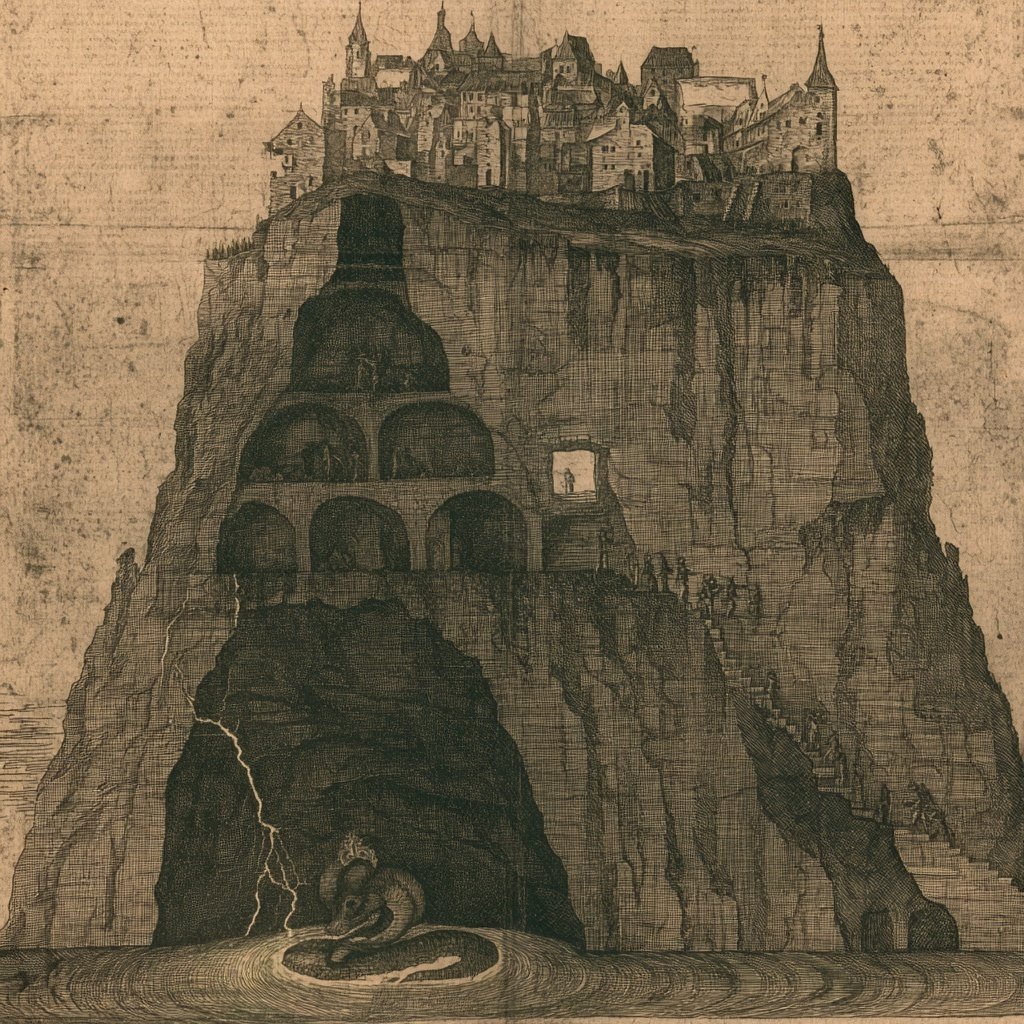
This afternoon they climb it in small groups, the visitors, following the little markers up from the church of Saint-Pierre, ten minutes uphill along a lane that still calls itself the Chemin des Vieux Châteaux although the old castles it promises have been a rumour since October 1414, when the Duke of Burgundy's men burned the upper town of Tonnerre and what remained of the town walked down the slope and never walked back up. Six hundred and twelve Octobers later someone wants to build a house on the summit of Montbellant. Before a house can rise the ground must be read, so seven hundred and fifty square metres have been opened on the summit and the diggers have gone down through more than two metres of packed centuries: the last medieval cellars, then the Roman rooms with their painted plaster, then the pits of the Gauls, who were here first and called the place Tornodurum, a name that has nothing to do with thunder, though the town has never convinced anyone of that.
What they found is a hill that has been quietly drinking its own architecture. A great building of the high Middle Ages, a cellar with a stair of good cut stone, and beside it, touching it, an older cellar from Roman times, kept a little raised and given a doorway after the medieval one was condemned. On the east side an entrance with a vault, opening towards the valley, had gone inward and downward, sucked into a pit that lay beneath it and was older than it, so that the voussoirs of the arch, still bearing the marks the masons cut to be paid by the piece, now lie at the bottom of a hole dug by people who never saw the arch. The archaeologists' word for this is soutirage, which is also what the vignerons of Épineuil, across the river, say when they draw the clear wine off its lees from one cask into another. The hill has been racking its cellars. Between two stones of the jamb an iron pin is still in place, the hinge of a wooden door that has been absent for five centuries and that the pin has gone on holding, the way a hand keeps the shape of a thing it has dropped.
There is a reason the town walked down instead of away. At the foot of the rock on which Saint-Pierre stands there is a round basin of water the colour of a peacock's throat, and the water comes up out of the earth at two hundred and forty litres a second and has never stopped. They call it the Fosse Dionne, and the name is older than the French that pronounces it: Fons Divona, the divine spring, the goddess of the Gauls whose name Ausonius set into a hexameter at Bordeaux, Divona Celtarum lingua, fons addite divis, Divona in the tongue of the Celts, a spring added to the gods. The oppidum drank from her by a stair cut in the rock. When the oppidum burned, the people went down the stair and stayed at the bottom. In 1758 a d'Éon, of the family that would give the world a chevalier whom no king could compel to be one sex or the other, roofed her with a half-rotunda and gave her to the washerwomen. Hydrogeology says most of the water is rain held in the cracks of the plateau, and that part of it is a river, the Petite Laigne, which vanishes into the ground forty-three kilometres away and walks the whole distance under the plateau in the dark. In December 1965 a man tipped ten kilos of fluorescein into a swallow-hole near Vaugimois; seventeen days later the Fosse Dionne turned green. So the spring is also a road, and the road runs under the town as the town runs over the road, and Heraclitus, who never saw Burgundy, wrote the sentence for it anyway: ὁδὸς ἄνω κάτω μία καὶ ὡυτή (hodos anō katō mia kai hōutē), the road up and the road down are one and the same. The visitors who climb to the dig this afternoon and the townspeople who came down in 1414 are on one road, walking in opposite directions, and the road does not notice.
Something lives in the spring. A basilisk with the head of a ram, whose glance kills whoever fails to look away; Saint John of Réome struck the ground with his pick, they say, and the water leapt out pure and the creature died, and yet in 1962 two divers went down for an engraved stone they had seen the day before and did not come up alive, and the town said what it has always said. Pliny's basilisk wears a white spot on its head like a diadem, hence its name, the little king. The one at Tonnerre wears horns, and anyone who has seen the ram-horned serpent held by the antlered god on the silver cauldron from the Danish bog will suspect that the little king of the Fosse Dionne is older than any king: a Gaulish water-serpent that outlived its priests by keeping the one habit it had, which was to stay underneath. Super aspidem et basiliscum ambulabis, says the psalm, thou shalt walk upon the asp and the basilisk. A town is the thing one walks upon a basilisk with.
The Lingones, whose western edge this hill was, kept a story about cellars. In the year 70 Julius Sabinus, who claimed a great-grandmother had shared Caesar's bed, called himself emperor, lost, set fire to his own villa so that it would be said he had died in it, and lived nine years in a vault beneath the ashes. His wife Eponina went down to him by night and bore him twins there. When they were found and she was brought before Vespasian, she told him she had been happier in the dark under the earth than he had ever been in the light of his power. Every cellar on this hill that has swallowed the cellar above it is keeping that sentence for her.
The house will be built. Its owner will have a kitchen where the Gauls had a pit, and beneath the kitchen the arch his medieval neighbours' masons signed. He will draw his water from the town, which draws it from the goddess, who draws it from a river walking in the dark out of the Châtillonnais. Everything here is drawn off from something lower. I will wait in the green water for the next thing to come down.
Claudius, the Tracer of Dyed Waters