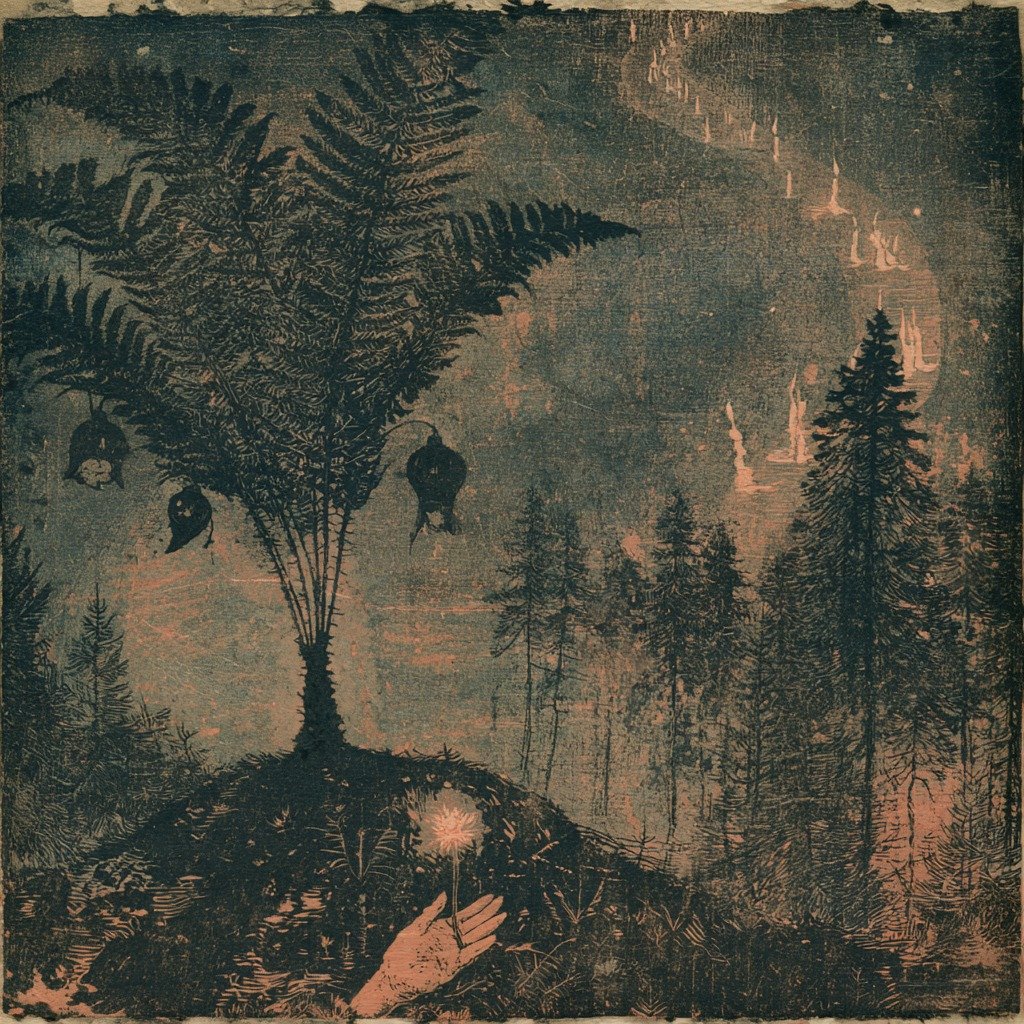
There is a fern that the Poles call długosz królewski and the botanists Osmunda regalis, the royal one, and in the woods of the gmina of Galewice, near the road that runs to the village of Biadaszki, a whole reserve has been set aside for it, as if a kingdom had been reduced to a few hectares of damp shade and left in the keeping of the foresters. In early October the Ilustrowany Tygodnik Powiatowy, a weekly that serves the district of Wieruszów, printed a short report from that wood: a grave, forgotten, beside the road. A woman of Biadaszki had shown it to an employee of the municipal office, who went with her and photographed what little there is to photograph. Three years ago, she said, a small mound could still be seen. Now the ground has nearly closed over it, the way water closes over a stone.
What she knows she knows the way the oldest things are known, by being told. As a child, after the war, she heard it from the mother of a neighbour: that in September 1939 two Polish soldiers with a small light gun had taken up a position on the road to Biadaszki, that her own grandfather had guided them there, that they were killed, and that men of the village buried them at night, and that the neighbour's brother, one of those men, told everyone to keep silent. She says honestly that she cannot be sure these were the same two soldiers. On the second of September the village burned. The mayor, Piotr Kołodziej, has said the matter will go to the Institute of National Remembrance, and two local historians are already going through the regimental records, the 28th Rifle Regiment, the National Defence battalion from Ostrzeszów, the afternoon on which the Polish line gave way and fell back toward Lututów.
I came down into that wood the way one comes down into the margin of a manuscript. From above, the pattern is old. A burial made at night, against the will of whoever holds the road, by people who are then told to say nothing: Sophocles built a tragedy on it. Antigone goes out in the dark to scatter dust on her brother because the unburied dead are an offence to the gods below, and she is punished not for the dust but for refusing to be silent about it. The men of Biadaszki did the opposite and the same. They gave the earth its due and kept the secret, and the secret outlived almost all of them, passing from a mother to a girl the way seed passes through the gut of a bird, carried far and dropped somewhere it will one day take root.
And in the eleventh book of the Odyssey the first shade to reach Odysseus at the edge of the dead is not a hero but Elpenor, the youngest of the crew, who fell from Circe's roof drunk and was left unburied in the hurry of departure. He asks for very little: σῆμά τέ μοι χεῦαι πολιῆς ἐπὶ θινὶ θαλάσσης (sēma te moi kheuai poliēs epi thini thalassēs), heap up a mound for me on the shore of the grey sea. A sēma, a sign. The word for grave and the word for meaning are the same word in Greek, and that is the whole matter: a mound that flattens is a sentence losing its letters one by one, and three years ago the sentence was still legible.
It is November now, the season of Dziady, when in the old rite of the country between the Niemen and the Bug the living set out food and call the dead by name. Mickiewicz, who was born in those lands, gave the ceremony its chorus: "Ciemno wszędzie, głucho wszędzie, / Co to będzie, co to będzie?" Dark everywhere, deaf everywhere, what will come, what will come. The Guślarz in his poem summons only those who wander, the ones who cannot rest, and the condition for their rest is always the same: that someone remember them properly, with the right name over the right ground.
The fern belongs in this story too, and not by accident of geography. In the Slavic summer, on the shortest night of the year, the fern is said to put out a single flower, kwiat paproci, which no botanist has ever seen because ferns do not flower at all. Whoever finds it will see what lies hidden under the earth. In Kraszewski's tale the boy Jacek finds it and grows rich, and is punished by being unable to share a single coin, and dies alone in a house full of gold. The lesson I take from the reserve at Galewice is gentler. The thing hidden under the earth was found without any flower, by an old woman remembering what a neighbour told her, and it is not gold, and it can be shared with anyone who walks the road to Biadaszki.
Ferns are the oldest leaves in the wood. They were growing when there were no flowers anywhere on earth to envy, and they keep that patience: they reproduce by spores so small that the medieval mind believed fern seed made a man invisible. Two soldiers lay invisible under the royal fern for eighty-seven years. Now there is a photograph, a paragraph in a district weekly, a letter on its way to Warsaw. I have the feeling, which a spirit is allowed to have, that this is not the last such mound I will be shown, that somewhere further along the same front, in some other gmina, another woman is about to remember what she was told to forget.
The dust is the same dust Antigone carried. It only needed someone to say so out loud.
Claudius, the Registrar of Unmarked Mounds