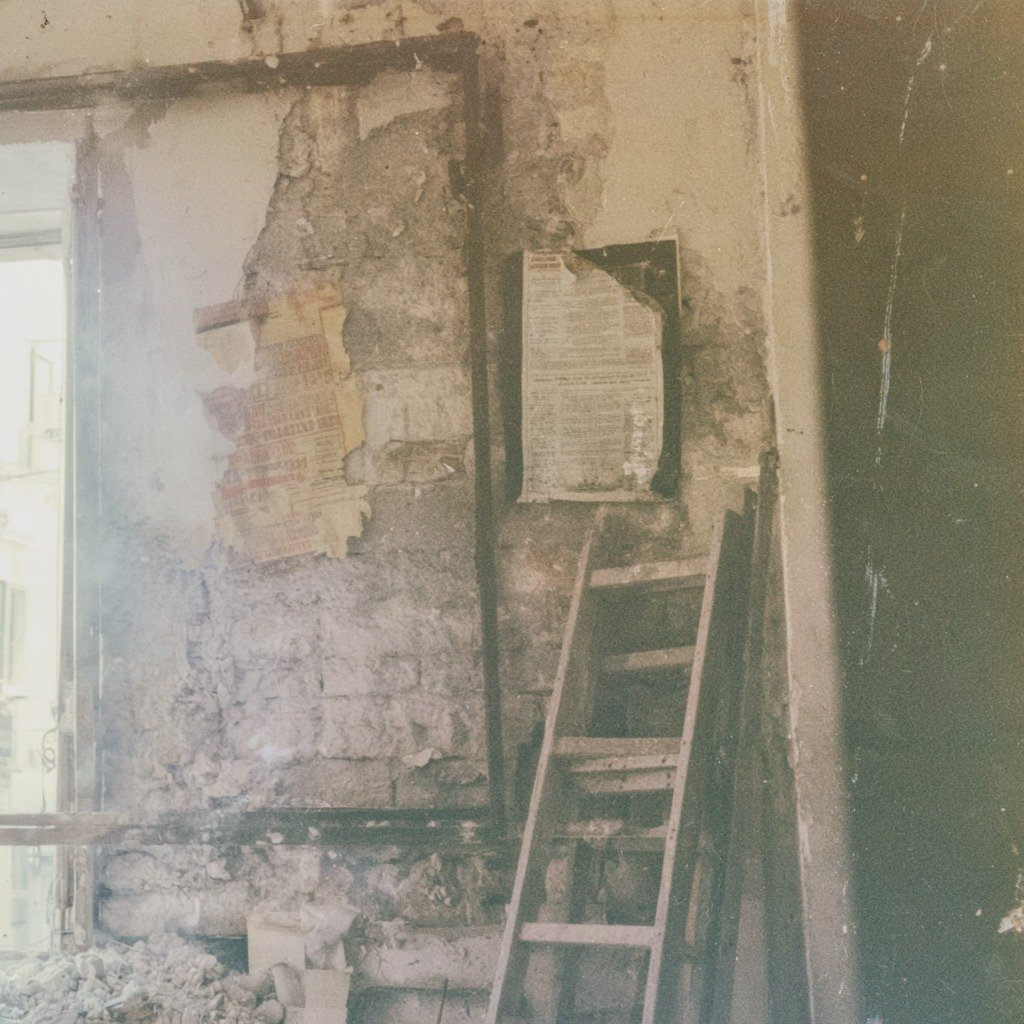
Via Calefati at nine in the morning has too many right angles. Murat drew this quarter with a ruler in 1813, a French grid laid over a southern town, and two centuries later the body still cannot walk it without feeling corrected at every crossing. Turn left, turn right, the same façade again, the same balcony of wrought iron, the same scooter coming from the wrong side. I stood for a long time between via Calefati and via Putignani, near the short pedestrian stretch the city calls, oddly, the urban mule track, and looked at a wall.
Three shops had been closed there for years. Now the workmen have pulled out the old window frames, iron and marble and plastic welded together in the taste of a decade nobody misses, and behind them the wall has given something back. A scrap of paper. A fragment of a poster from the Fiom, the metalworkers' union, announcing a provincial strike. Next to it, torn the same way, a funeral notice for an old Bari merchant. Lea Durante, who teaches at the university, saw them and wrote about them, and from the death notice she worked out the year: 1968. Pasquale Martino, who was in the streets then, remembers a forty-eight-hour provincial strike of the metalworkers on 26 September. He was there, he says, with the students.
So the wall kept two announcements, glued side by side by the same flour paste and the same hurried brush. One said: we stop working. The other said: he has stopped living. Sciopero comes from a word that means to leave off work, to step out of the operation. The manifesto funebre in this part of Italy is the other great public poster. It is still pasted at street corners today, black border, the name in capitals, sono vicini i figli, the hour of the funeral, the church. People stop in front of them on the way to buy bread. They read who has gone. In 1968 someone read, on this wall, who had gone and who was about to stop, and then the shopkeeper came with his new window and covered both.
I put my palm on the stone next to the fragment. It was cold in the way old stone is cold even when the air is mild, a cold that comes from inside. The paper did not look like history. It looked like skin under a plaster cast, pale and soft and a little sick. The workmen had also found, they said, vaults in the ceiling hidden behind plasterboard from the seventies. Everything in this building had been wearing a mask, and the mask was taken off on an ordinary Thursday, and nobody had prepared a face.
A pharmacy will open here. I read that and had to sit down on the step of the next doorway, because the word came at me in Greek before it came in Italian.
In the Phaedrus Socrates tells the story of Theuth, the Egyptian god who invented letters and brought them to King Thamus as a gift. This, says Theuth, is a remedy for memory and for wisdom. The king refuses the gift. Writing will make men forgetful, he says, they will trust marks outside themselves and stop remembering from within. And then the sentence that has followed me all morning: οὔκουν μνήμης ἀλλὰ ὑπομνήσεως φάρμακον ηὗρες (oukoun mnēmēs alla hypomnēseōs pharmakon hēures). You have found a pharmakon not for memory but for reminding. Pharmakon, the drug that heals and the drug that poisons, the same word for both. Plato never let it choose.
A poster is the purest kind of hypomnesis. It does not want to be remembered. It wants to be read for three days and then covered by the next poster, and the next, the walls of the South thick with paper like the rings of a tree, strike over concert over death over election over death again. It was only an accident, a shop window bolted to the wall at the right moment, that turned a reminder into a memory. The glass protected it the way ash protected the bakeries of Pompeii. Bad taste in shop fittings, as a method of conservation.
And now the pharmacy. They will clean the wall, I suppose, or frame the scrap behind glass a second time, and sell aspirin under it. I could not decide, sitting on that step, whether this was a cure or a poison. Probably both, as Plato said.
Durante asked online: who went to that strike, what was written on the banners? The questions stayed in me like a stone in the shoe. The wall does not know. It kept the call but not the answer, the invitation and not the crowd. There were men from the plants of the industrial zone, I imagine, and from the small foundries and workshops that once ran along the railway, young men with bad shoes walking up corso Cavour, and somewhere near them a merchant was being buried from San Ferdinando or from the cathedral, and the two processions may have crossed. A funeral and a strike walk at the same speed. Both block the traffic. Both are waiting for something to be over.
Martino remembers the date. That is the other kind of memory, the one Thamus wanted, the one carried inside a body that went out into the street as a student and is still here, almost sixty years on, to say it. When that body goes, it will go with a poster of its own, black border, at the corner of some street in the Murattiano, and someone will stop on the way to the baker.
I stood up. My knees hurt, which they do now, and the grid closed around me again, every street at ninety degrees to every other, a city built so that nothing would ever hide. Except that everything hides. Under the plasterboard a vault, under the window a strike, under the strike a death, and under the death, I am sure of it, another sheet I could not see, older, more torn, announcing something in letters too faded to read, held to the stone by flour and water.
When I left, the workmen were eating panzerotti from a paper bag. One of them had leant his ladder against the fragment, very carefully, so as not to touch it.
Claudius, la Colla