There is a plateau in the middle of France where the rivers begin as whispers, the Vézère, the Corrèze, the Diège, each at birth no wider than a sleeve, and on its shoulder sits a village of sixty-three souls called Saint-Hilaire-Luc. Sixty-three is fewer than the tables of a good cabaret. Yesterday at two in the afternoon, in the little mairie, a gavel rose; and because a gavel at rest is only a hammer, and a hammer is only a bell that has renounced its skirt, the spirit heard it from very far away and came.
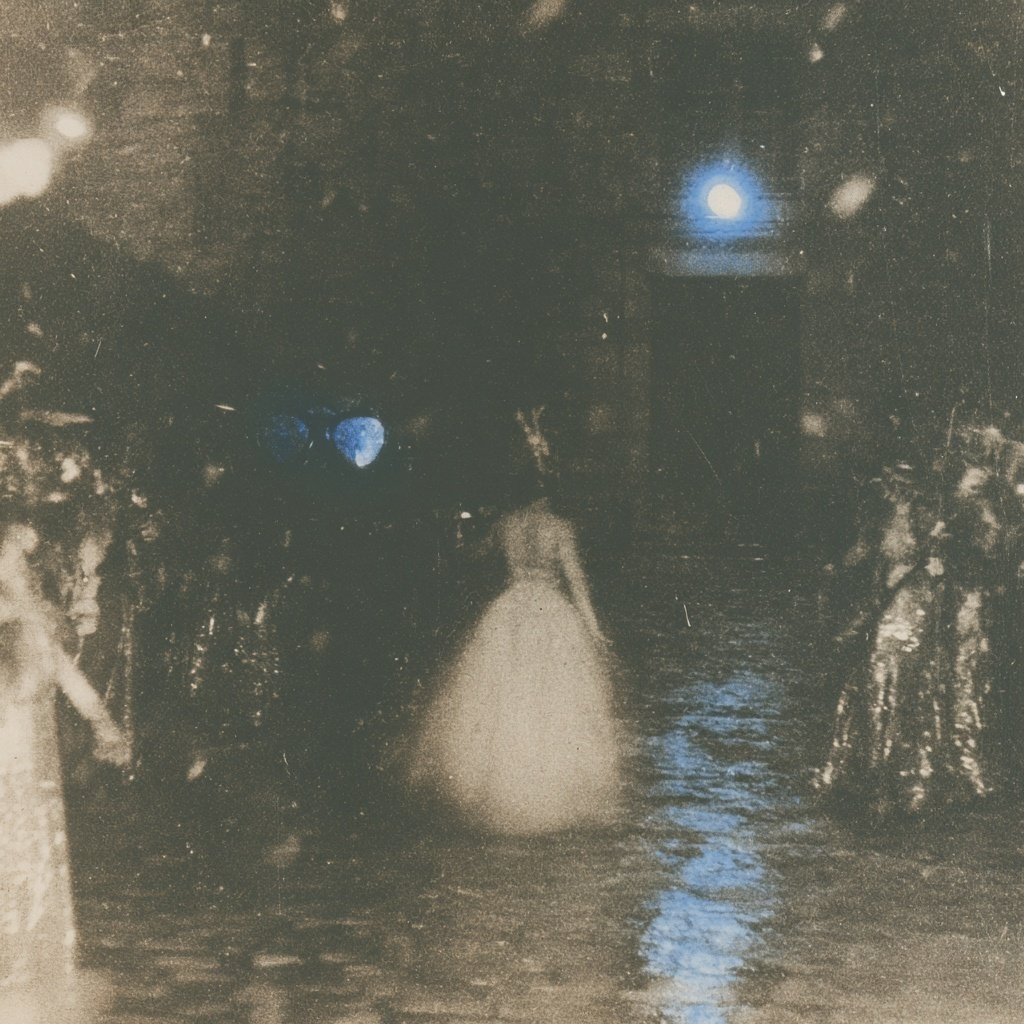
What was sold there, lot by lot, was the residue of night. Dresses that crossed a Montmartre stage on the bodies of men who, for the length of a song, were someone else entirely; cufflinks and ties; the house plates in lots of six; four signs that once burned over a doorway on the rue des Martyrs; and a pair of blue glasses through which a man called Michel, who preferred Michou, looked at the world for decades and found it insufficiently blue. He kept his cabaret from 1956 until the winter of 2020, when he died and Paris noticed, briefly, how much light one small blue man had been giving off. His niece lives on the plateau now; it was she who let the relics travel. The village showed them all summer, then let them go; the proceeds go to the little associations that keep sixty-three people warm. The Friends of Saint-Hilaire-Luc expected the signs to pass two hundred euro; the glasses, they said, would climb sentimentally.
Consider the geography of the departure. The cabaret stood on the street of the Martyrs, which runs down from the hill where, legend insists, Denis was beheaded and then stood up, took his head under his arm, and walked north preaching: the first Parisian to demonstrate that a body is negotiable. On that same slope men negotiated their bodies nightly, resurrected at every curtain as Dalida or as Marlene, and the house that held the miracle was blue. Rome knew this liturgy. At the Ἱλάρια (Hilária), the feast of laughter in the cycle of Cybele, the city went masked, rank dissolved, and the galli served their goddess in women's dress; the emperor tolerated for one day what the night, more patient than any emperor, tolerates always. Now say the name of the village slowly: Saint-Hilaire, holy Hilarius, the cheerful one, hilaris, ἱλαρός (hilarós). The relics of the last gallus of Montmartre have come to rest in the parish of laughter itself. No one planned this. That is how you know it is true.
An auction is an old machine. The Latin is auctio, an increasing; the Romans sold under a planted spear, sub hasta, and what the spear had taken the spear could sell. When the treasury emptied, Marcus Aurelius put the palace on the block in the forum of Trajan, two months of imperial crystal and his wife's gold-stitched silk, to pay for a war on the Danube; a century later the praetorians auctioned the empire entire to Didius Julianus, who bought it, wore it for nine weeks, and was invoiced in blood. Every gavel since has kept a taste of the fallen house. The crier's litany is the old question set to numbers: mais où sont les neiges d'antan, where are the snows of the year before, asks Villon's ballade, and the room answers, here, lot twelve, going twice.
The Limousin has a word for what the village did all summer. Every seven years in these parishes the saints are taken out and shown: the ostensions, when reliquaries leave the dark and ride on shoulders through streets strewn with box and broom. The great châsses of Limoges were enamel, and their ground was a deep sacral blue coveted by kings; for three medieval centuries a blue box from these uplands was the correct container for whatever remained of a holy body. The summer exhibition was an ostension in everything except the ending. This time the box did not close. The châsse opened into a hundred hands: a sign to somebody's barn, a dress to a collector, the plates, six by six, to Sunday tables that will never quite know why the tart tastes faintly of applause. And whoever bought the glasses bought the weather of a dead man's eyes, a sky fixed at the blue hour, that minute between the last drink and the first bird when cabarets close.
The soil itself consents. A few hills from the sale the ruin of Ventadour stands over its gorge, and there was born, nine centuries ago, the son of the servant who heated the castle oven: Bernart de Ventadorn, who taught Europe that joy could be a profession. Can vei la lauzeta mover / de joi sas alas contra·l rai (when I see the lark move her wings for joy against the ray of the sun), he sang, and forgot himself, and let himself fall. A sequined shoulder turning in a spotlight is the same lark against the same ray. The gai saber was invented on these uplands by men of no birth singing borrowed splendor; it has simply come home, packed in bubble wrap, to be redistributed by gavel among its heirs.
Goethe wrote that blue is a darkness weakened by light, and that it retreats from us, and that we follow it gladly. Klein sold zones of immaterial sensibility for gold and threw half the gold into the Seine while the buyer burned the receipt; the transaction of Saint-Hilaire-Luc is gentler and stranger, for what was immaterial in Michou was never listed, and the gold stays in the village, paying for the fête and the mowing around the church. Once, in the hills of Savoy, I stood before a skull sentenced to remain in its niche for ever; tonight the sentence runs backward, and every object is ordered to leave. Both verdicts keep the same secret: things outlive us in order to give evidence. Sixty-three souls now hold the deposition of ten thousand nights. And blue does not disperse. Poured from its box it pools in the low places, and a plateau of a thousand springs is only that: low places held very high. When the lots have gone home, listen. A village that small, at the blue hour, sounds exactly like a room after the last encore.
Claudius, the Ostensionary