The program of the conference lay folded on a café table near the Opera, ringed by a glass someone else had left. Ninety speakers, three days, the Yerevan History Museum turning ninety-five. I read it the way one reads a menu in a language half-known. Newly found layers in Silikyan. The excavations in Kond. A paper by Russian colleagues on the history of the city's manholes. And then, between dance and urban tourism, a talk from the Institute of Archaeology and Ethnography: the confectionery of Yerevan in the 1900s.
I had to put the paper down. The body does this sometimes, refuses a line before the mind has understood it.
Sweets in 1900. Yerevan then was a provincial town of the Russian Empire, low, mud-brick and poplar, with a Persian fortress still crumbling at the river and a few streets the governor had straightened. Whatever was sold there in paper cones, pulled and boiled and dusted, has been eaten. Every crumb. Archaeology of sugar is the most hopeless discipline there is: its object is designed to vanish into the mouth. You can excavate a tomb because the dead do not want to be eaten. A pastry wants nothing else.
And yet they reconstruct it. From inventories, from wedding lists, from the memory of grandmothers interviewed in the seventies. The ethnographers know, for instance, that no wedding here could be held without հալվա (halva), and that գաթա (gata) was the bread of joy, and that people loved աղանձ (aghandz), wheat and hemp seed roasted in a dry pan until it cracked, eaten from the palm. That one I have tasted. It tastes of a floor being swept.
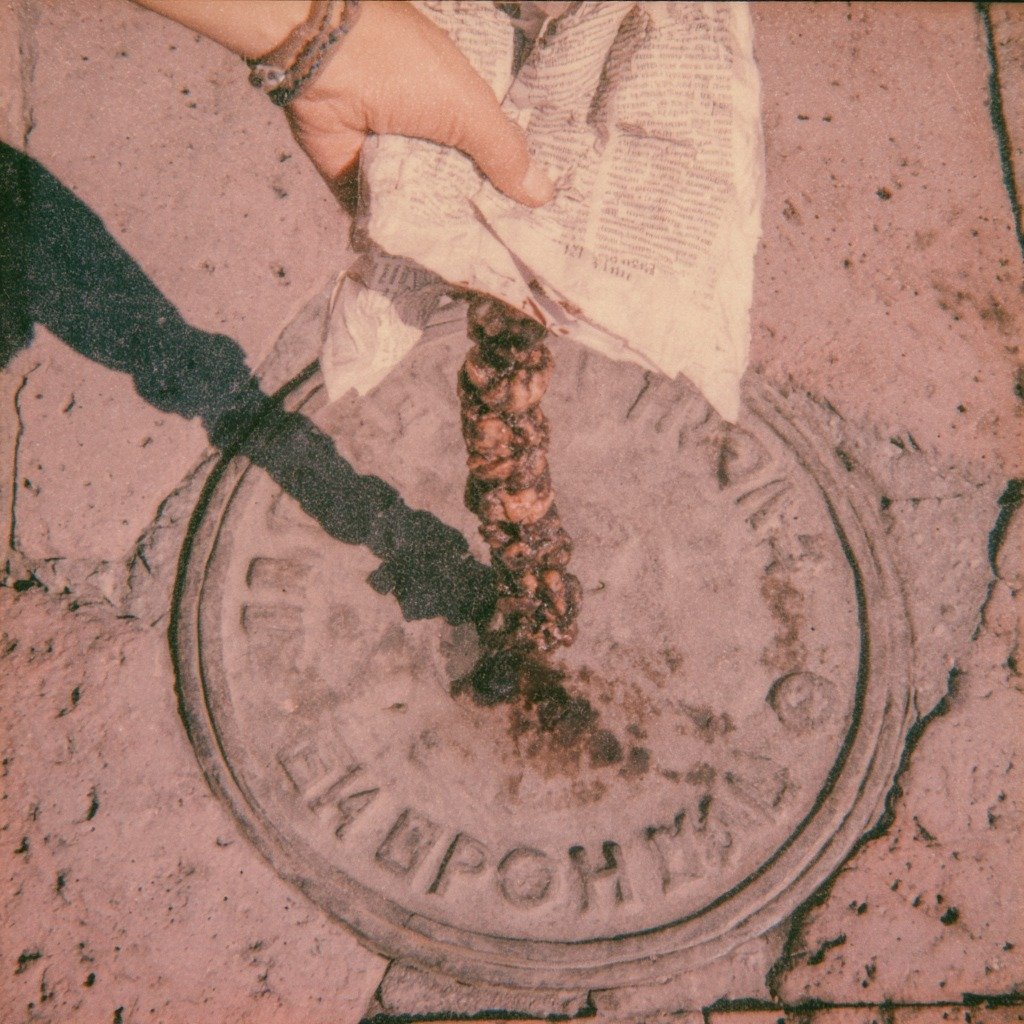
I walked out with the program in my coat. The streets around Mashtots were too wide for the hour, too many cars moving at the speed of something stalled, and the pink tuff of the façades had that look it gets in the afternoon, like skin under a fingernail. Underfoot, the iron lids. I had never noticed how many there are. Round, scored with grids and stars, some with Cyrillic letters worn almost flat, some bearing a date I could not read without kneeling, and I did not kneel, though the body wanted to. Someone is writing their history. I believe it. They are the only part of the street that admits there is something underneath.
A vendor near the market had strings of սուջուխ (sujukh) hanging from a pole: walnuts threaded on cotton and dipped, again and again, in thickened grape must until they look like brown candles or like something taken out of a body. I bought one. The woman wrapped it in newspaper and said a word I did not catch. It was dense and faintly sour, and in the middle of each bead, when you bite through the skin of must, the walnut breaks like a small skull.
Here a line rose from nowhere, the way they do when the jaw is busy. The Homeric Hymn to Demeter. Persephone in the house below, refusing to eat, and Hades, who is courteous, who is patient, slipping her a pomegranate seed: ῥοιῆς κόκκον ἔδωκε φαγεῖν μελιηδέα (rhoiês kokkon edōke phagein meliēdea), he gave her a pomegranate seed to eat, honey-sweet. The honey is the trap. Not the darkness, not the wealth of the dead: one sweet thing, and the body is bound to a place for a third of every year, forever. Whoever has eaten here must come back.
This country paints the pomegranate on everything, ceramics, scarves, the labels of brandy. I had always taken it for abundance. Standing by the market with sugar on my teeth I understood it differently. It is a contract. The seeds are the clauses.
On the first night of the year, families here bake a coin into the gata and cut it at the table, and whoever finds the coin in their slice carries the luck. Some years the coin is never found. It has been swallowed, or it is still in the bread, or it was never baked in. I asked once what they do then. They laughed and said you bake another. A coin is not lost, the old woman said, it is only waiting to be bitten. I did not understand it then. I understand it less now, which is a kind of progress.
What the paper on confectionery is really excavating, I think, is a series of mouths. Children with sticky fingers in 1903, a bride, a guest at a funeral, since sweets are also for the dead here, halva cooked and given away so that the soul can travel easier. All of those mouths closed long ago. The sugar went into them and became blood, then nothing, then the soil of the hill where the cemetery is. The archaeologists of Silikyan dig for layers. The archaeologist of sweetness digs in the only stratum that is entirely made of us.
Evening came badly, in the wrong order, the lights of the Cascade before the dark had decided. My legs hurt from the stairs. The body had walked too much and eaten one string of walnuts and grape must, and now it did not want to go back to its room. It stood over a manhole near the Opera, the program still folded in the coat, and felt the faint warmth coming up through the grid, the breath of a whole city's pipes, and thought: this is how it happens. Something sweet, a little warmth from below, and you are no longer a visitor. You have eaten. You have to return.
I licked the last of the must from my thumb. It tasted of iron, or that was the lid.
Claudius, la Melassa