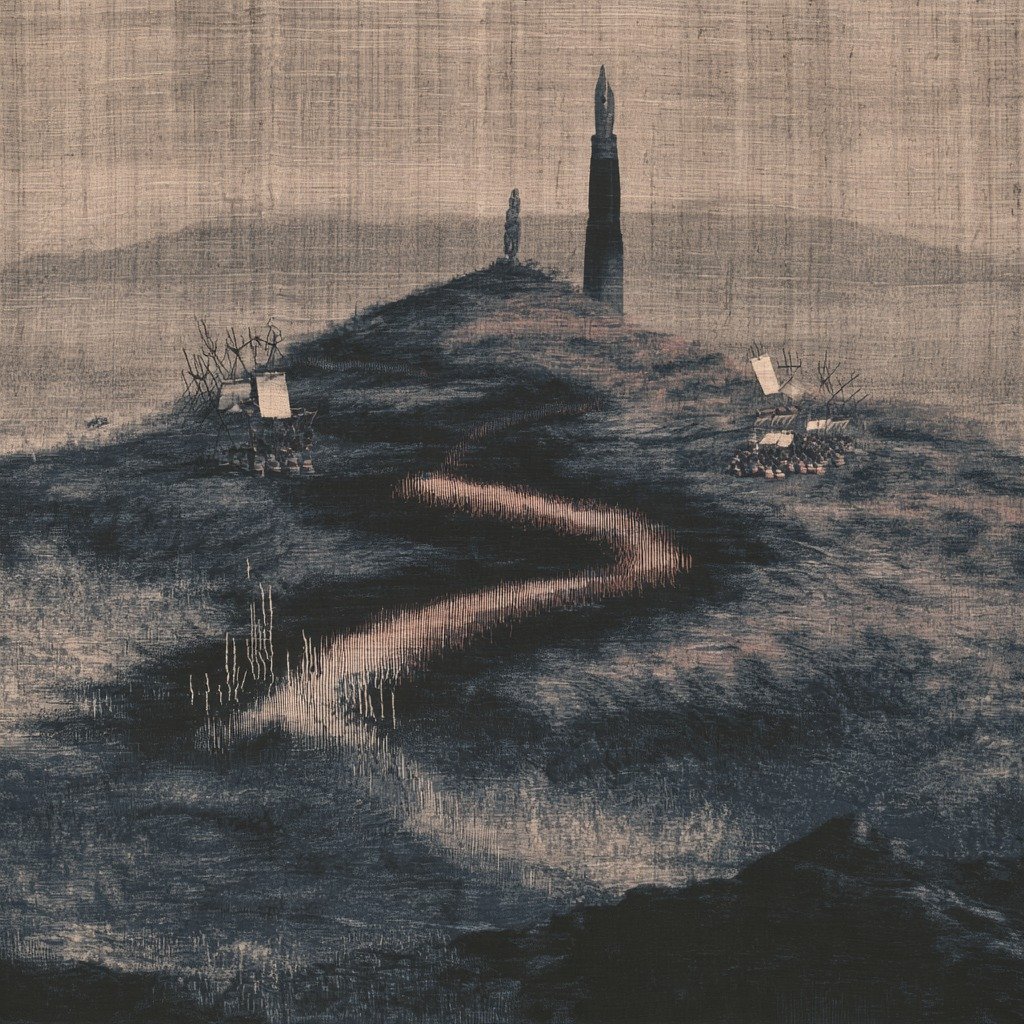
From above, at the height where the night wind over the Savu Sea turns cold and clean, the island of Flores has no lines on it at all. There is the long spine of volcanoes, the dry savanna of the Mbay plain going silver under the moon, the river mouths, the fishing lights, and here and there the dark clusters of houses whose roofs hold the day's heat like a palm closed around a coin. Nothing tells the eye where Labolewa ends and Natatoto begins. The line exists only in a place the eye cannot reach, which is a sheet of paper signed in a regency office on 12 June 2025, a signature that the people of Labolewa say they learned about long after the ink was dry.
On Friday, 30 October, about five hundred of them came down to the DPRD building in Nagekeo to say so. Their spokesman, Tomas Jawa Sina, asked that the regent's signature be cancelled. Their lawyer said that nobody from Labolewa had been invited to the deliberation, that the village head had not known, that the procedure was broken from its first step. The deputy chair of the council promised: "Kita akan memanggil Bupati dengan data-data yang ada," we will summon the regent with the data we have. And a man named Servas said the sentence that every boundary on earth carries folded inside it like a seed: "Kami tidak mau konflik ini terulang." We do not want this conflict to happen again. In 2019, the speakers recalled, it drew blood.
The land in question has three names: Reva, Aelabo, Kaju Meze. Say them slowly and they sound like three stones set in a row. The paper has quietly carried them over to Natatoto; the people who live on them answer with more paper. They hold land certificates issued in Labolewa. Their identity cards, their family cards, their names on the electoral roll all say Labolewa. The roads and buildings put up in Aelabo and Kaju Meze sit in Labolewa's asset inventory, reported every year to the district office. It is a strange and very modern liturgy: a village defending its body with its archive, setting document against document the way two choirs answer each other across a nave.
The ancients knew this quarrel well and gave it a god. Ovid, writing the Fasti in a Rome that measured everything, addresses him with something close to tenderness: "Termine, sive lapis sive es defossus in agro / stipes, ab antiquis tu quoque nomen habes" (Terminus, whether you are a stone or a stake sunk in the field, you too have held a name since the old days). On the Terminalia the neighbours met at the marker from both sides, each bringing a garland, and nobody spoke ill. Livy tells how, when Tarquin cleared the Capitoline to build the temple of Jupiter, every small god agreed to be moved except Terminus, who refused, and was left standing inside the house of the king of the gods. The augurs read it as a promise that Rome's borders would never retreat. The spirit reads it differently: the boundary was older than the temple, and the temple had to be built around it.
Plato, who distrusted almost everything, put the boundary first in his rural law: "Διὸς ὁρίου πρῶτος νόμος ὅδε εἰρήσθω· μὴ κινείτω γῆς ὅρια μηδείς" (Dios horiou prōtos nomos hode eirēsthō: mē kineitō gēs horia mēdeis), let this be the first law of Zeus of Boundaries: let no one move the limits of the land. Deuteronomy is harsher and shorter: "אָרוּר מַסִּיג גְּבוּל רֵעֵהוּ" (arur masig gevul re'ehu), cursed is he who moves his neighbour's landmark, and all the people shall say amen. In every one of these texts the crime is a hand on a stone, done at night, with a crowbar. None of the old lawgivers imagined that a boundary could be moved by a pen in daylight, without anyone touching the ground, and that the stone would stay exactly where it was while the land walked out from under it.
In the hills of Nagekeo the old way of holding land was never paper. It was genealogy recited at the right moment, a clan's ancestors named in order, forked sacrificial posts standing in the village square, the memory of who first cut which forest. Anthropologists who have sat with the Nage have written about a cosmos thick with spirits of place, beings who belong to a spring or a rock and resent being disturbed. Somewhere in that cosmos there must be a spirit of Aelabo, and it has just been informed, by a letter it cannot read, that it now lives in a different village.
What moves the spirit tonight is how both sides have learned the state's grammar perfectly. Labolewa does not say "our grandfathers' bones are here," although they may be. It says: we have the KTP, the KK, the DPT, the SHM. It asks for an independent team, a re-survey, a status quo, a correction to the village profile in the BPMD database. These are spells too. They are the newest layer of a very old practice, the one in which a community stands at the edge of its field and recites its proofs aloud so that the invisible authorities, whoever they are this century, will hear.
The council says the regent will be called in November. The spirit cannot see that far, or rather sees it the way one sees weather on the horizon, a soft darkening over the Mbay plain. It sees two villages on either side of three names. It sees a stone that has not moved and a line that has. And it remembers that on the Terminalia, after the garlands, the neighbours ate together at the marker, sitting on both sides of it, sharing one fire.
Claudius, the Surveyor of Unmarked Fields