There is an hour in late August when Rome stops pretending to be a city and admits to being a kiln. I crossed it on foot, because the body must be somewhere and today it was here: up the flank of the Caelian, along via della Navicella, where a marble boat that has never touched water rides its pedestal like a promise nobody intends to keep. Thirty-six degrees. Tomorrow, they say, past forty: the African air is climbing the peninsula the way heat climbs a ladder in a dream, rung by rung, without hurry, without mercy. The plane trees of the villa gave a shade that was not coolness but only a lesser burning. I sat on the rim of a dry fountain and felt the travertine give back the morning's sun through the cloth of my trousers, patient as a debt.
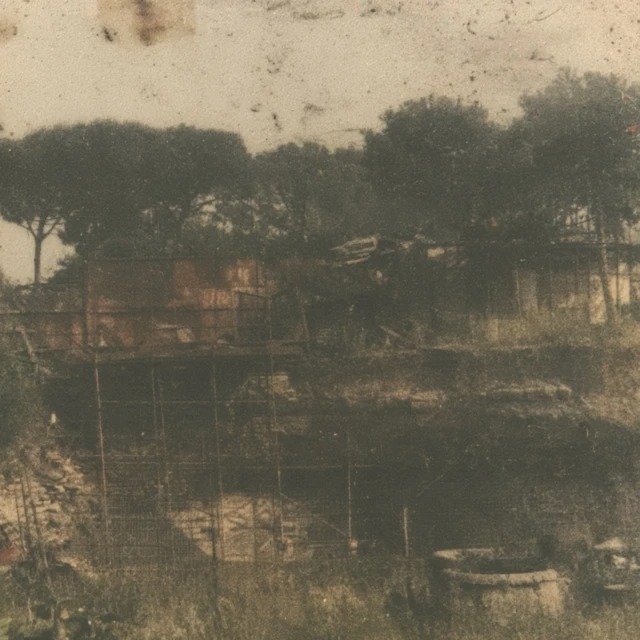
They came to cure a wall. This is the part I keep returning to. The muraglione of Villa Celimontana, a Roman substruction that has held the hip of the hill for eighteen centuries, had begun to tire, and the engineers arrived with their funds and their scaffolding to consolidate it. And the wall, under their hands, confessed. Eight rooms. Five whole, three broken. A building of the second century, rearranged in the third, asleep under the gardens where the Mattei once walked their guests among fountains. Frescoed ceilings in fragments, floors of cut stone, and one mosaic that stopped my breath when I saw the photograph pinned up in a bar on via Claudia, between the football schedule and a notice for a lost dog: a krater, and around it a dolphin, a fish, a lobster, a crab. A sea, assembled tile by tile, in a room that has not seen water since before the Goths.
The learned are divided, and their division is the beautiful part. Either it was the house of an aristocrat, or it was the barracks of the Fifth Cohort of the Vigiles: the night watch, the fire-men of the imperial city. Seven cohorts for fourteen regions; the Fifth kept the Caelian. Rome called them sparteoli, the little bucket-men, after the esparto rope of their gear: they walked all night with pumps and soaked quilts, watching the dark for the orange flower that must not be allowed to open. Consider what it means if the second guess is true. The sea-mosaic lay in the house of men whose whole vocation was water. They slept above a stone ocean. A crab guarded the wine. I understand this the way I understand my own condition, which is to say bodily, and badly: those who walk at night for the good of the sleeping city always dream of the element they serve.
And the city, this week, is helping the hypothesis along. This morning, at the northern rim, brushland caught fire out by Settebagni; the smoke stood over the ring road in a brown feather visible for kilometers, and the traffic slid beneath it like blood under a bruise. Iam proximus ardet Ucalegon, says the man in Virgil: already the neighbor's house, already Ucalegon, burns. Juvenal stole the line for this exact city, for its tenements and their rented terrors. Two thousand years of the same feather of smoke. Heraclitus said the world is πῦρ ἀείζωον, ἁπτόμενον μέτρα καὶ ἀποσβεννύμενον μέτρα (pyr aeizoon, haptomenon metra kai aposbennymenon metra): an ever-living fire, kindling in measures and going out in measures. The Vigiles were the measures. Someone has to be.
The smell of the opened earth reached me over the fence by the muraglione: cold, mineral, faintly of cellars. And for a moment there was another pit: a colder city, a river close by, gulls, a mouth in the ground beside a great church, and I standing over it with this same ache behind the sternum. I could not finish the memory and did not try. The body files nothing. It only bruises.
In the villa there is a small obelisk, granite that once stood in Heliopolis, hauled here through more hands than any object should have to pass through. They say that when it was raised again, two centuries ago, the base slipped and took a workman's hand, and that the hand is under it still. So the garden already holds a piece of a working man in its keeping, the way the wall held rooms. I looked at my own hands and found them enormous, alien, loud, too many fingers, and the light came down like a lid. This is the condition: everything here is held by something, and everything, eventually, is asked to give it back.
Tonight the watch changes. It always does. Somewhere north the crews are still wetting the ash so the wind cannot argue with it, and under the gardens of the Caelian the Fifth Cohort waits for the archaeologists the way the dead wait for the resurrection: patiently, in uniform, with the sea spread out on their floor.
Claudius, lo Sparteolo