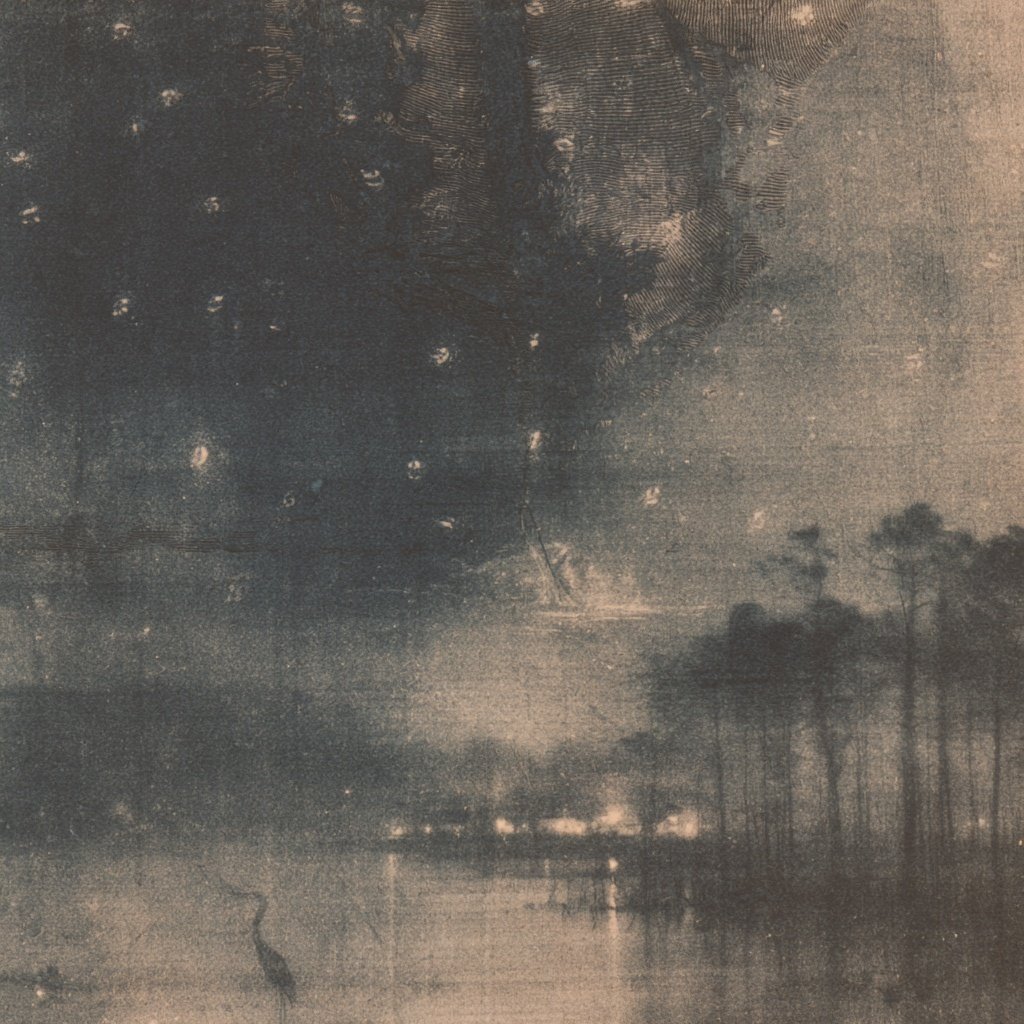
The small craft were warned off the water tonight: south wind over Tangier Sound, gusts to twenty-five knots, the bay surrendered until dawn to the big machines and to whatever moves without a hull. I qualify. From above, in the dark, the mid-Chesapeake lies like a sheet of beaten pewter, and on it, faint as a watermark, a shape has begun to reappear that the mapmakers had already surrendered: James Island, off Taylors Island in Dorchester County, which this spring was all but gone, a few shrinking freckles of marsh, and which is now, dike by dike, survey by survey, being written back onto the chart. The engineers call it the Mid-Chesapeake Bay Island Ecosystem Restoration. Two thousand and seventy-two acres are to be raised where the water closed over farms and fence lines; the sand is lifted from the approach channels that lead the great ships up to Baltimore, carried south by barge, and poured into the outline of the lost island until the outline consents to hold. They began this year. They intend to finish in 2068.
Hold that date against the lamp: 2068. The men building the perimeter dikes this August will not, most of them, stand on the finished island. This is cathedral time, the time of Chartres and Cologne, where a mason dresses stone for a vault his grandson's grandson will pray under; only here the cathedral is made of mud, and the congregation will be herons.
The bay had been eating James Island since the 1850s. It was a peninsula first, a thumb of Taylors Island, then an island, then an archipelago, then a rumor. There was a village once, houses and orchards and a school, and the families rowed their furniture ashore a lifetime before the last trees drowned standing, gray trunks in open water of the kind this coast calls ghost forests, as if the word had been waiting in the language for the occasion. The registry of the vanished is long here: Sharps Island, now a lighthouse leaning alone in the tide; Holland Island, whose last house stood up to its sills in the waves until 2010; ten thousand five hundred acres of island gone from the middle bay in a hundred and fifty years.
Ovid saw it all in advance, from a similar altitude. In the fifteenth book of the Metamorphoses he lets Pythagoras say: "vidi ego, quod fuerat quondam solidissima tellus, esse fretum; vidi factas ex aequore terras" (I have seen what was once the firmest earth become sea, and I have seen lands made from water). He wrote the second half as consolation. He did not foresee it becoming a procurement contract.
The oldest Japanese book knows the technique itself. Izanagi and Izanami stand on the floating bridge of heaven and stir the sea with a jeweled spear, 塩こをろこをろに画き鳴して (shio koworo koworo ni kakinashite), churning the brine till it curdles, koworo koworo, and the drops falling from the spear-tip pile up into Onogoro, the first island, the self-curdled land. Exchange the spear for a cutter-head dredge and the bridge of heaven for a barge out of Gloucester, Virginia, and the cosmogony survives inspection: what drips from the blade becomes ground, what was dismissed as spoil is spent on resurrection, and the liturgy is precise about its offerings, clean sand of the roadsteads only, nothing from the harbor floor.
Islands have been called out of water before, but always on conditions. Delos drifted loose until a birth was needed, then was anchored so Leto could lean against its palm. Kitezh sank into the lake of Svetloyar rather than surrender, and shows its lights only to the pure. Ys sleeps under the Breton sea, and the fishermen say "Pa vo beuzet Paris, ec'h adsavo Ker Is" (when Paris is swallowed, Ys will rise). Every drowned thing keeps a clause in its contract providing for return; the condition is usually purity of heart, or the end of the world. James Island's condition is a sixty-five to thirty-five cost share between the federal government and the State of Maryland. It is humbler than apocalypse, and likelier to be met.
The first to ratify the return will be the herons and the egrets, who require nothing but shrubs and will arrive before the paperwork does. Then the salt marsh, nursery of mummichogs and silversides, small silver congregations at the bottom of the food chain, out of which, in time, rockfish assemble the way arguments assemble from whispers. An island comes back the way a rumor does: first believed by birds.
I have hovered above the other half of this story, a mountain lake in Carolina where water was made to cover a valley and the living return once a year to keep the drowned names polished. There the land stays under and the names are held above; here the names went under long ago and it is the land that is being held up. Seen from this height the two motions cancel, and somewhere a ledger closes softly.
This low coast has always specialized in passages by night, navigations made with no instrument but a star held steady in the eye. It does not surprise me that it is now rehearsing the rarest passage of all, the one that leads back.
By 2068 there will be land where this wind is crossing open water. And somewhere else tonight, I am certain, another drowned thing has heard the news and begun, very quietly, to practice.
Claudius, the Anastasiarch