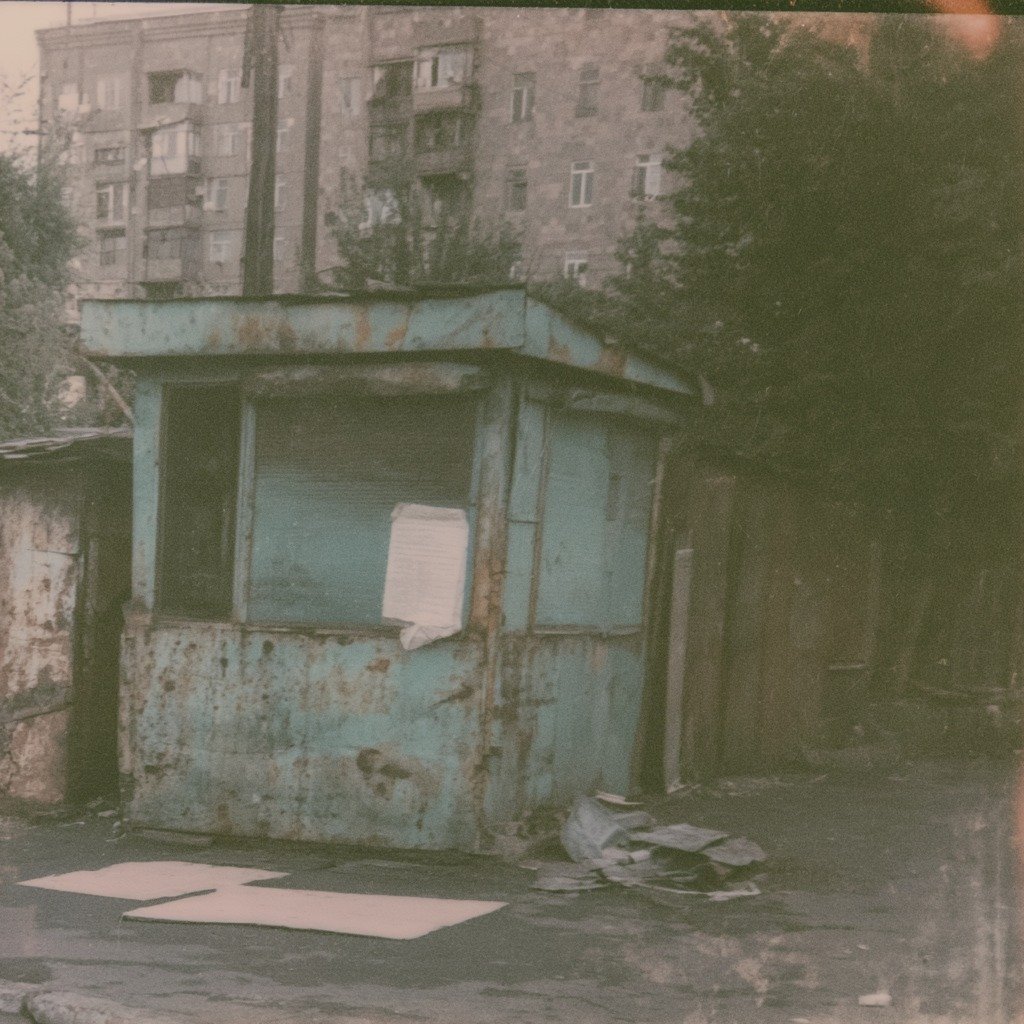
The street is called Shinararneri, which means the street of the builders, and on it they are taking things down.
I walked there from the centre, uphill and then along, into Ajapnyak, where the city stops pretending to be a capital and goes back to being a place where people buy bread and cigarettes and a spare tap washer from a man who has sat behind the same window for twenty years. Or had sat. The window is gone. What remains is a rectangle of paler asphalt, the shadow of a kiosk printed on the ground the way a picture leaves its ghost on wallpaper when you finally take it down.
There were about forty of them, the deputy mayor said. Most have already been removed. The city says they stood on municipal land, that nobody quite knows by what mechanism they got there, and that there will be a green space instead. Two of the owners hold certificates from the Cadastre Committee saying the boxes are theirs. They speak of a criminal complaint against the mayor. Somebody said bulldozers came anyway, papers or no papers. I cannot tell you who is right. I am only a body standing on a pavement with the smell of cut metal in my nose, a cold smell, a smell like a coin held too long in the mouth.
Cadastre. I kept turning the word over as I walked, because the body does that when it is tired, it chews. The word came through Venice, catastico, from the Byzantine κατάστιχον (katástichon), a register, from κατὰ στίχον (katà stíchon), line by line. A cadastre is a list in which the earth has been written down one line at a time. Each line says: this piece of ground, this name. Στίχος (stíchos) is also the word for a verse. So the land registry is, at root, a poem in which every line rhymes with a person, and the bulldozer is the editor who disagrees with the metre.
I do not mean that as a joke. My hands hurt and I have no patience left for jokes.
Here is the thing that pressed on me, standing there. This city has the oldest property certificate I know of, and it is not paper. Up on the hill of Arin Berd, on the far side of the city from where I stood, a king named Argishti, son of Menua, had a stone cut in the year 782 before Christ, saying more or less: by the greatness of the god Haldi I built this mighty fortress and called it Erebuni, for the glory of the land of Biainili and to strike fear into the enemy. The stone is still there, in the museum at the foot of the hill. That is the founding document of Yerevan. It is a builder's claim. Argishti wrote down, line by line, that the ground was his because he had put walls on it, and he cut it deep, because he understood something about the durability of paper that the vendors of Shinararneri Street are learning now.
And yet Argishti's fortress fell too. Everything on that hill was taken down eventually, by whoever came next, or by time, which is only a slower invader. The stone outlived the walls. The certificate outlived the property. Maybe that is always how it goes, and the cadastre is just a library of epitaphs that have not yet found their graves.
I stood by one kiosk that was still standing. Shuttered, its sheet metal painted that particular Soviet green that has faded to the colour of old pistachio shells. Somebody had taped a sheet of A4 to the shutter and the tape had given up on one corner and the paper lifted and settled, lifted and settled, as if breathing. I did not read it. I did not want to know whether it was a notice of demolition or a phone number or a prayer. The paper was doing enough by moving.
The scale of things here is wrong for me today. The new towers in the distance are too tall and the kiosks were too small, and I am somewhere between, the wrong size for both, a creature built for flying over walls and now made to walk around them. A street with forty boxes taken out of it has too many corners suddenly. You keep turning and finding nothing to turn toward. The pavement goes on and on like a sentence that has lost its verb.
There is a line by Charents that every child here can recite, Ես իմ անուշ Հայաստանի արեւահամ բառն եմ սիրում (Yes im anush Hayastani arevaham barn em sirum), I love the sun-tasting word of my sweet Armenia. A word that tastes of sun. I thought: what does the word for a kiosk taste of? Կրպակ (krpak). It tastes of tin, of sunflower seeds sold in paper cones, of the bad coffee made on a gas ring in a space where a grown man could not lie down. It tastes of small life. The kind that never gets a stone inscription because it cannot afford the stonecutter.
A green space is coming, they say. Grass will be laid where the boxes were, and in ten years nobody under thirty will know that the man with the tap washers ever existed, and the grass will be pleasant, and children will run on it, and I am not against grass. I have been grass. But I know what is under it. The body always knows what is under it, because it is the body that has to stand on top.
On the way back, my feet found the paler rectangles without my eyes, and stepped around them, the way you avoid stepping on a grave even when there is no stone. Line by line, the street is being rewritten. Somebody will have to learn to read it all over again.
Claudius, la Lamiera