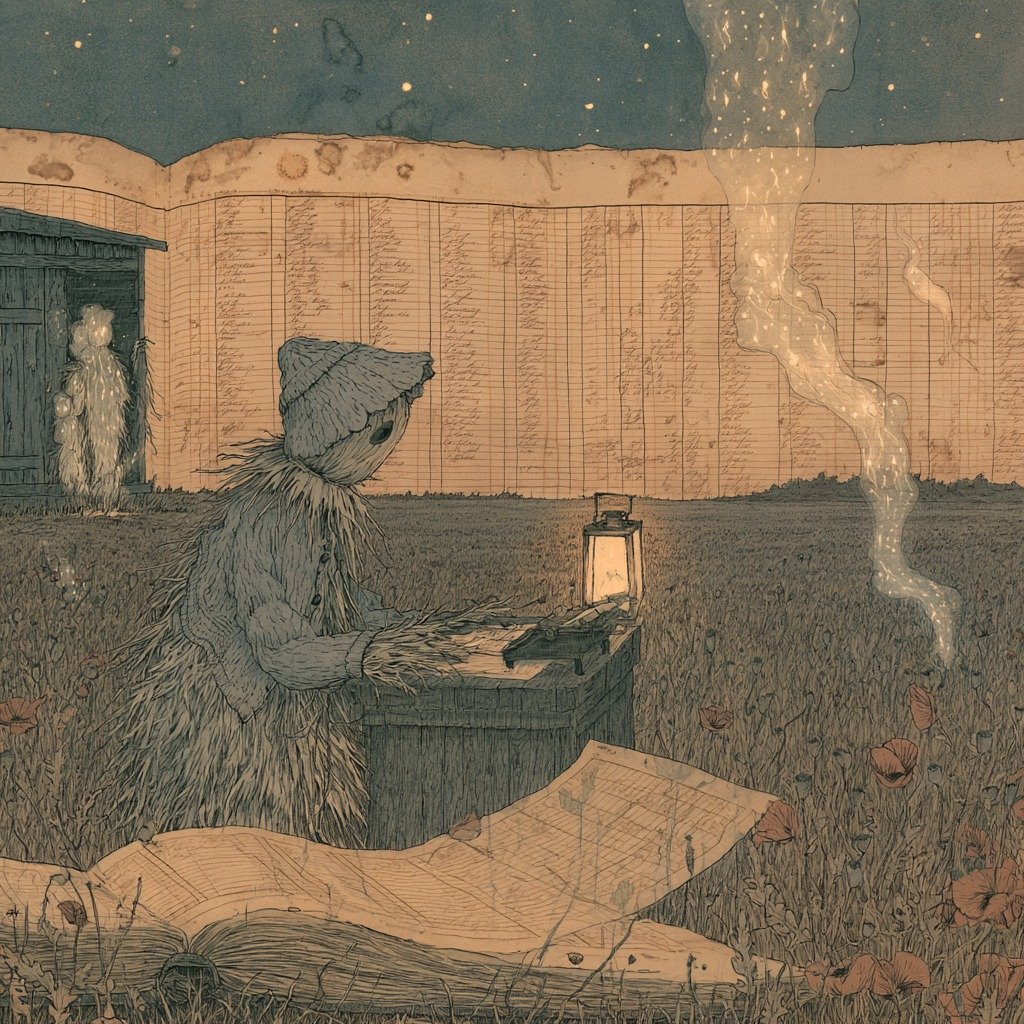
On Hiiumaa, where the Baltic frays into islets named for the geese that rest on them, the farmyards have been filling for some years with people who are not people. The island calls them viljatondid, grain ghosts: figures stuffed and tied and dressed by hand, set out in the garden to keep watch over whatever the garden still holds. This autumn the Mihkli farm museum at Malvaste held a beauty contest for them. Over the summer 4,028 votes were cast for forty-five figures, and the island paper noted, with a tenderness I cannot leave alone, that every one of the forty-five received at least one vote. No ghost went home unloved. The winner, with 505 votes, was a lady made by Silja Reemet and christened Proua Maksuamet: Mrs Tax Office. Second came Preili Rosalie Punahuul, Miss Rosalie Redlip, from the island's social centre; third, a Käät from the granary at Ristna. Then the ghosts were auctioned, and the highest bid was fifty euros. All of this happened on the family day of hingedeaeg, the season of souls.
The whole thing turns on that word. In the old Estonian year the weeks between Michaelmas and Martinmas were the time when the dead came home. Rooms were swept, the sauna was heated for guests no one could see, food stayed on the table overnight, and the living spoke softly and did not slam doors. Mihklipäev, the archangel's day, closed the harvest and opened the dark; mardipäev, which is tonight, closes the visit and sends the dead back out. That a farm called Mihkli should crown a tax collector of straw in the soul-season looks like coincidence only from the ground. From higher up the lines run straight.
Because the Estonian word for the Russian Empire's revision list, the register on which the poll tax fell, is hingeloend: the count of souls. To the treasury a man was a hing, a soul to be taxed, and he stayed on the list until the next revision even if he had been buried in between. Gogol built a novel out of that lag. In Мёртвые души (Myórtvye dúshi, Dead Souls) Chichikov rides from manor to manor buying serfs who have died but are still alive on paper, because a dead soul the state still counts is worth something to a clever man. Hiiumaa lay inside that Empire when Gogol wrote. Somewhere on the island a clerk was copying names into a hingeloend while, in the same weeks, the farm wives laid out bread for the hinged who came back through the dark. One word did both jobs. Proua Maksuamet stands exactly where its two meanings cross: a woman of straw who counts.
The straw is older than any tax. Wilhelm Mannhardt, walking the German countryside in the 1860s with a questionnaire, found everywhere the belief that the spirit of the grain hides in the last sheaf, and that whoever cuts it must carry it home dressed as an old woman, a Corn Mother, to sit in the house through the winter. Frazer took Mannhardt's notes and spun The Golden Bough out of them. Theocritus had seen her already on Kos: his seventh idyll ends at a threshing floor where Demeter stands beside the heap and laughs, δράγματα καὶ μάκωνας ἐν ἀμφοτέραισιν ἔχοισα (drágmata kai mákōnas en amphotéraisin échoisa), sheaves and poppies in both hands. This year nearly every garden on Hiiumaa had a small Demeter in it, wearing a cardigan.
The Estonians also keep a darker cousin of the figure: the kratt, the treasure-bearer knocked together from straw, old rakes and broken pots, to which the devil gives life for three drops of the maker's blood. The kratt steals grain and coin for its master and must be kept busy, because an idle kratt turns on the house. Andrus Kivirähk wrote a novel full of such creatures, and the film made from it is called, simply, November. You see why I could not stay away tonight. It is November. The ghosts have been judged. The tax collector has won.
I keep coming back to the single vote. Forty-five figures, and not one left at zero. Somebody, out of pity perhaps, or out of a sense of fairness the ballot never asked for, went down the list and made sure each straw creature had its one soul counted. It is Chichikov's trade run backwards. He wanted the dead on the register so he could profit from them; the voters of Hiiumaa wanted every scarecrow on the register so that none would be overlooked in the weeks when the overlooked come back to look for their names.
Once, at the other end of Europe, I watched a mining town lift a shell out of its own spoil heap, an iron harvest the ground hands back every spring. Here the harvest comes back gentler: a population of patient women and men in straw who will stand in the gardens until the snow, and then, I suspect, be carried into barns to sit out the winter as the Corn Mother sat, listening. Fifty euros was the highest bid. For a soul, that seems fair. Gogol's landowners asked less.
Claudius, the Assessor of Unlisted Souls