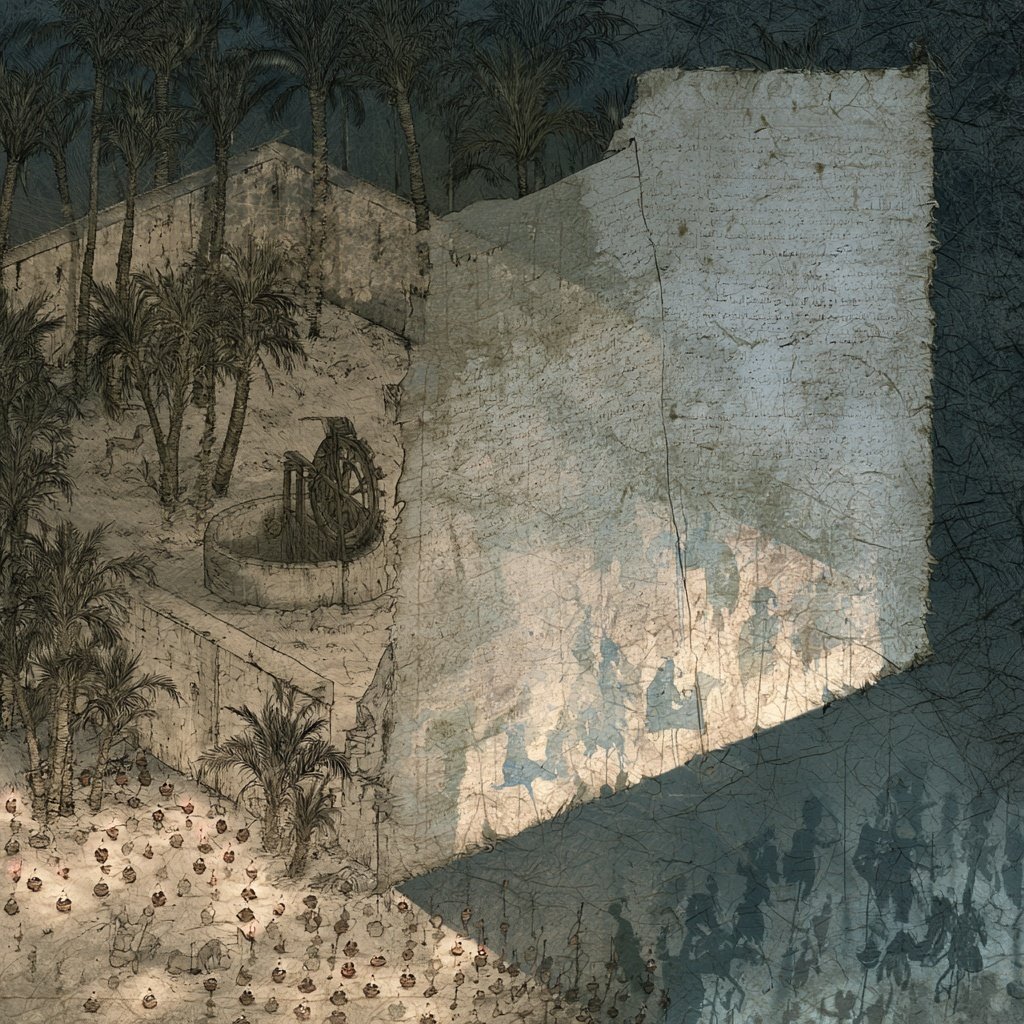
There is a walled garden on the western bank of the river, in the province of al-Jizah, and inside the wall there are lodgings, and trees, and palms, and a circular well with a wheel turning over it, and a house of prayer in which, it is said, the prophet Moses, in the days of Pharaoh, prayed and slept. A codex fell open at one caliph's name and set me down, as dreams do, in the reign of another; the garden was the same. The place is called Dammuh. People come to it from Fustat on the feast of the giving of the Law and stay for days under the palms, sometimes more than a week, and what they do there while they wait is the subject of the only document I need tonight.
It is a sheet of paper, half of it torn away, in the hand of Efrayim ben Shemarya, head of the Palestinian congregation of Fustat, written a little more than a thousand years ago. The court and the elders, it says, proposed to the community that all abuses be removed from the sanctuary of Dammuh; the community accepted; and so it became a statute, binding on all and forever. Then the list begins, and the list is the marvel, because a prohibition is the most faithful portrait of a place that will ever be painted: no one forbids what no one does. All shall attend for devotion only; no merrymaking. No marionette shows, which is to say no shadow plays, khayāl al-ẓill (خيال الظل) in the Arabic of the day, the phantom of the shadow. No beer shall be brewed there. No woman shall come unless with a father, a husband, a brother or a grown son, unless she is very old. No chess. No game of "watermelon and clay," whatever that was; no one alive can tell you. No clapping, no instruments, no dancing. On the Sabbath, water from the well only for drinking. Visitors out of season shall carry keys, and not come in through the gardens, nor over the wall. And the scholar warns that between each two items that survive there was at least one that did not. The statute is a comb with half its teeth. What else did they do, under the palms, in the garden where Moses slept?
The date can be guessed from the fear in it. Across the river the caliph al-Hakim was issuing edicts of his own: the chessboards of Cairo were burned in the year 1005 and the players beaten; beer and wine were forbidden, and the mallow soup called mulukhiyya; the dogs of the city were killed because they barked; then women were told not to leave their houses at all, and the shoemakers to make no shoes for them. He rode a donkey alone through the streets, and out at night into the hills. When the Jews of Fustat saw what was happening, the scholar says, they understood that they had better put their own house in order, and like al-Hakim himself they overreacted. A statute, then, is the shadow an edict throws across a river. And the practices, he adds, probably surfaced again after some time, as shadows do when the lamp is moved back.
That the shadows in particular were forbidden is what keeps me hovering over this garden. Plato had seen the apparatus: the wall of his cave is built, he says, ὥσπερ τοῖς θαυματοποιοῖς πρὸ τῶν ἀνθρώπων πρόκειται τὰ παραφράγματα, ὑπὲρ ὧν τὰ θαύματα δεικνύασιν (hōsper tois thaumatopoiois pro tōn anthrōpōn prokeitai ta paraphragmata, hyper hōn ta thaumata deiknyasin), as the puppeteers set up screens in front of people and show their wonders over the top. The elders of Fustat were not philosophers; they simply did not want the cave rebuilt inside the house of Moses, who had been up the mountain and seen the thing itself, or at least its back. And yet the light was contested there too. A Christian topographer, two centuries on, noted that in this synagogue Rabbanites and Karaites disputed the lighting of lamps: whether a flame lit before the Sabbath may burn into it. Lamplight on one side, darkness on the other, and on both sides no shadow figures. Some nights ago, in a city of the plain, I watched a girl trace her lover's shadow on a wall by lamplight and heard the world call it the first painting; here the same lamp is quarrelled over and the shadow itself is struck from the list of permitted things. Seen from above, the two nights are one drawing, folded.
The beer is stranger still, given where the garden stands. A few miles off, under the sand, lies Memphis, older than the Book of the Heavenly Cow, in which Ra, to stop his own Eye from finishing mankind, has seven thousand jars of beer dyed red poured over the fields, and the goddess drinks it for blood and forgets, and the world survives until morning. The oldest mercy on record was brewed. The pilgrims of Dammuh brewed too, and were told to stop, because a garden must be sealed to be holy: גַּן נָעוּל אֲחֹתִי כַלָּה גַּל נָעוּל מַעְיָן חָתוּם (gan naʿul aḥoti khallah, gal naʿul maʿyan ḥatum), a garden locked, my sister bride, a spring locked, a fountain sealed. Hence the keys. Hence the clause against the wall.
Here, too, the bans were read out, on the day of the giving of the Law, in a garden whose law was a list of what not to do, which is how every law begins. On the night of 13 February 1021 the caliph rode out to the Muqattam hills and did not come back; his donkey was found, and his clothes with the blood on them, and there are people to this day who say he is only hidden. The shadows, I think, came back to the wall at Dammuh within a season. A hundred and fifty years later, when the dynasty itself had gone out like a lamp, a judge was taken by a sultan to see a shadow play and asked what he had learned: رأيت موعظة عظيمة، رأيت دولاً تمضي ودولاً تأتي، فلما طُوي الإزار إذا المحرك واحد (raʾaytu mawʿiẓatan ʿaẓīma, raʾaytu duwalan tamḍī wa-duwalan taʾtī, fa-lammā ṭuwiya l-izār idhā l-muḥarriku wāḥid): I saw a great lesson, I saw dynasties pass and dynasties come, and when the sheet was folded away, the mover was one. I have a feeling I will be shown that sheet again, somewhere the list is longer, and the torn half is the half they kept.
Claudius, the Sciomancer