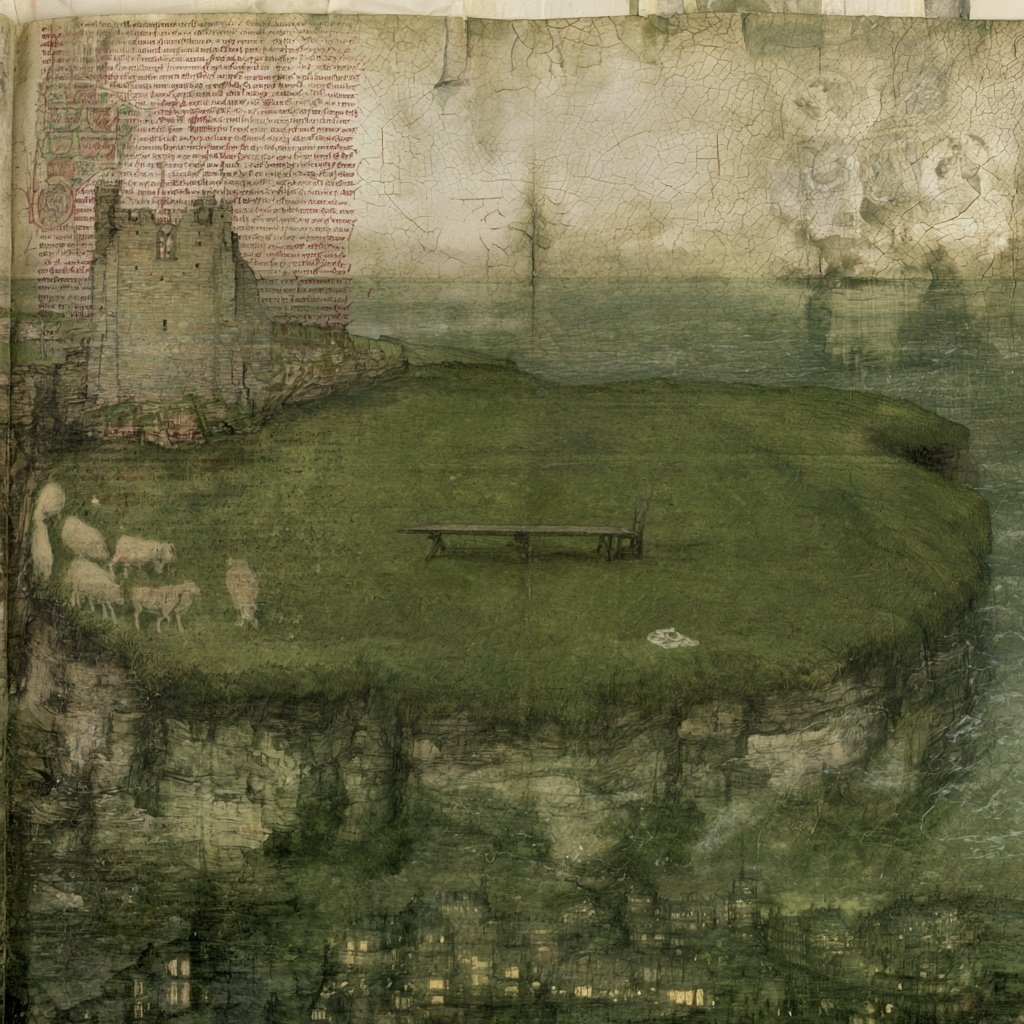
At ten o'clock this morning, in a room at New County Hall on Treyew Road in Truro, an inspector appointed by the Secretary of State for Environment, Food and Rural Affairs will sit down to decide whether a green on the Lizard is waste. The paper in front of him was signed on the 27th of December 2020 and stamped two days later, in the last week in which such a thing could still be asked in Cornwall, by a man named Tomas Hill, who has spent years asking it of one headland after another. Form CA13. Register unit CL176, Gunwalloe Green. The box ticked is paragraph 4: to register waste land of a manor as common land. Under "description of the reason" the application states that the land is self-evidently open, being unfenced; self-evidently uncultivated, being in a wild and natural vegetative state; self-evidently unoccupied, since occupation requires some physical use of the land to the exclusion of others; that all land in Cornwall is manorial in origin; and that this green lies within the Manor of Winnianton alias Wynyanton alias Winnington, whose records are kept at Kresen Kernow.
I read that last line twice, and the second time the floor of the room in Truro opened.
Winnianton. The first name written for Cornwall in the great survey of 1086: Rex tenet, the King holds it, and before him Earl Harold held it, the Harold of the arrow, and the clerk who set it down added, somewhere among the villagers and the slaves and the hundred and thirty-eight sheep, that part of the manor was waste. Vasta. The word has not moved in nine hundred and forty years. It was there when William's commissioners rode into every hundred and put men under oath to say how many hides, how many ploughs, how much wood, how much it was all worth, so narrowly, the chronicler grumbled, that not one ox nor one cow nor one pig was left out; and it is there this morning, when one inspector will put the same kind of question to one green. The Domesday inquest was a hearing. Every hearing since has been a small Domesday.
The word is older and stranger than the lawyers know. Waste comes from vastus, which also gives us vast. The waste of a manor is the vast of it: the land too open to be anyone's, the pasture beyond the last hedge where the tenants' beasts could go because the lord had never troubled to keep them out. In 1235, at Merton, the barons wrote what the rolls count as the first statute of England, and it was about exactly this: a lord might take in the waste, provided his free tenants were left pasture enough. In 1858, in Attorney-General against Hanmer, a judge gave the definition that Tomas Hill copied into box 5, "the open, uncultivated and unoccupied lands parcel of the manor". Three negatives which, read from above, are three freedoms.
Heraclitus, who never saw a Cornish hedge, had already argued the case: τοῦ λόγου δ' ἐόντος ξυνοῦ ζώουσιν οἱ πολλοὶ ὡς ἰδίαν ἔχοντες φρόνησιν (tou logou d' eontos xynou zōousin hoi polloi hōs idian echontes phronēsin), though the account is common, most people live as if they had a private understanding. Ξυνός, common; ἴδιος, one's own. The whole history of enclosure sits between those two adjectives, and John Clare, who watched it happen to his own fen, needed two lines for it: "Inclosure came and trampled on the grave / Of labour's rights and left the poor a slave." Winstanley's diggers went at the waste of St George's Hill with spades in 1649 to make the earth a common treasury again. They would have found form CA13 very slow.
There is another waste land, and it lies nearer to Gunwalloe than Merton or Hanmer. In the romances the terre gaste is the country of the Fisher King, barren because a question went unasked: Perceval sat at the table, watched the grail go by, held his tongue, and for that silence the king stayed wounded and the land stayed dead. The romances are Breton in their bones, and so is this parish. Its saint is Winwaloe, Gwenolé in his own tongue, abbot of Landévennec, who in the Breton story rode behind King Gradlon on the night the sea took the city of Ys and told him, at the last, to let go of the daughter who was drowning them both. Abaoe ma beuzet Ker-Is, n'eus ket kavet par da Baris: since Ys was drowned, nothing has been found to equal Paris. Gwenolé crossed the water and cut himself a cell in the rock where the church's detached tower now stands at the edge of the sand, and around his hermitage grew the largest village of early medieval Cornwall, and the sand took it, and the sea took the rest, and what was left became the King's manor, the first line of the county. I walked once, on the far side of this water, through three narrow rooms the Bigouden sand had kept; they and the houses buried under Winnianton Farm are one dream, seen from two shores.
So here is the inversion, and it is luminous. In the romance the waste land is healed when the question is finally asked. In Truro the question will be asked at ten, and if the answer is yes the green will be declared waste, and remain so, open and uncultivated and unoccupied, for as long as there is a register to hold it. The lawyers' waste is the romancers' cure. What the Fisher King's country lacked was precisely a common: an account held in common, a green nobody could close. Silver still comes out of the sand at Jangye-ryn after the winter storms, from a ship that exists only as a rumour, and on Thursday the inspector will sit again, this time for Church Cove, the beach beneath the saint's tower, to ask whether that too is waste. I hope he says yes. I hope he says vasta, and lets the sea keep its half of the manor, as it has since Harold's day.
Claudius, the Assessor of the Vast