I walked up from the Crocetta this morning with my tongue on a molar that has been talking to me for a week. Corso Vinzaglio, via Cernaia, the long porticoes where the city keeps its manners. Turin is a grid, and a grid is supposed to comfort the body: every corner a right angle, every street a sentence that ends where you expect. Mine does not. Somewhere around via Garibaldi the right angles began to multiply, and I could no longer tell whether I had passed a corner or the corner had passed me.
The paper on the café counter carried a small item from the Tribunal, Sixth Criminal Section, verdict of 4 November. A man of thirty, enrolled in no register, pulled teeth in this city from 2019 onward. First in Barriera di Milano, then in piazza della Repubblica, which is to say Porta Palazzo, the great open mouth of the market. He took panoramic X-rays, filled cavities, fitted crowns and prostheses, prescribed antibiotics on the stamp and forged signature of a dermatologist who knew nothing about it. Patients paid in cash. They came to him because his laboratory advertised dental jewellery, little stones set into the enamel, photographed by the dozen. Two years and two months, a fine of fifteen hundred euros, forty thousand set aside for the dentists' Order and their association, the instruments confiscated.
I went to look at the square, because the body cannot read a thing like that and stay seated.
Porta Palazzo on a Monday is fish ice melting into the gutters, the copper smell of the meat hall, crates of cardoons stacked like bones, a woman shouting the price of persimmons in a Piedmontese I half understand and an Arabic I do not. The tram scrapes the curve. Everything is too loud by a factor I cannot calculate. And I thought: of course here. Where else would a man set up to open other people's mouths, if not in the one place in Turin where the city opens its own.
Because this is an old trade in an old square. Before the Order, before the albo and the national register you can consult online, the cavadenti came to the market on fair days with a table, a pair of pincers and a drummer. The drummer was part of the equipment. He played while the tooth came out, so the crowd would hear the rhythm and not the scream, and the next customer would step up. Medicine was a spectacle and the spectacle was a kind of anaesthesia. Our young man needed no drum. He had photographs of jewelled smiles instead, which do the same work in silence.
Herodotus, walking through Egypt with his notebook, was struck by how the doctors there had divided the body among themselves: one for the eyes, one for the head, one for the belly, and some for the teeth. οἱ δὲ ὀδόντων (hoi de odontōn), "and others of the teeth." Three words, and a whole profession is born, with its borders and its jealousies. A kilometre from where I stood, on via Accademia delle Scienze, the Egyptians lie in their glass cases with their own teeth still in their jaws, worn flat by sand in the bread. Nobody forged their prescriptions. Their dentists, if they had any, are dust with no register to be struck from.
What disturbs me is not the fraud. It is the jewellery. We tell the history of dentistry as a history of pain relieved, and it is not quite that. In the Indus valley, nine thousand years ago, someone drilled perfect little holes into living molars with a flint bit, and we still argue about why. The Maya ground the front teeth of their nobles and set discs of jade and pyrite into the enamel, so that a smile would flash green in the torchlight. The ornament came first. The cure followed, as an excuse. The man at Porta Palazzo understood his clients better than the Order does: they did not come to be healed, they came to be marked, and once the mouth was open, he simply kept going.
There is a saint for this too, of course. Apollonia of Alexandria, an old virgin, as Eusebius records in the letter of Dionysius, who in the riots of the year 249 had all her teeth broken out before she walked into the fire herself. τοὺς ὀδόντας ἅπαντας κόπτοντες (tous odontas hapantas koptontes), "striking out all the teeth." In the paintings she holds a pair of pincers with a single molar in its jaws, the way other saints hold a palm or a key. I have seen her in country churches all over the north, small, unremarkable, usually near the door, as if she too were waiting her turn on a bench.
By noon my molar had stopped talking and started singing, one thin note, very high. I sat on a step behind the fish hall with the noise going over me like water and thought about the patients. Somewhere in Barriera, in the flats behind corso Giulio Cesare, there are people who still carry his crowns. They chew with them. The work was illegal; the tooth does not know that. A prosthesis does not consult the register. The body accepts whatever is put into it, forged or licensed, and goes on living around it, the way a tree swallows a nail.
I am in a body that was put together without a licence either. I feel it most on days like this, in squares like this, when the scale of things goes wrong: a pigeon too large, a crate of oranges too bright, a voice at my shoulder that seems to be speaking from inside my own jaw. The city is precise. The flesh is not. Between them, at a folding table, someone always sets up shop.
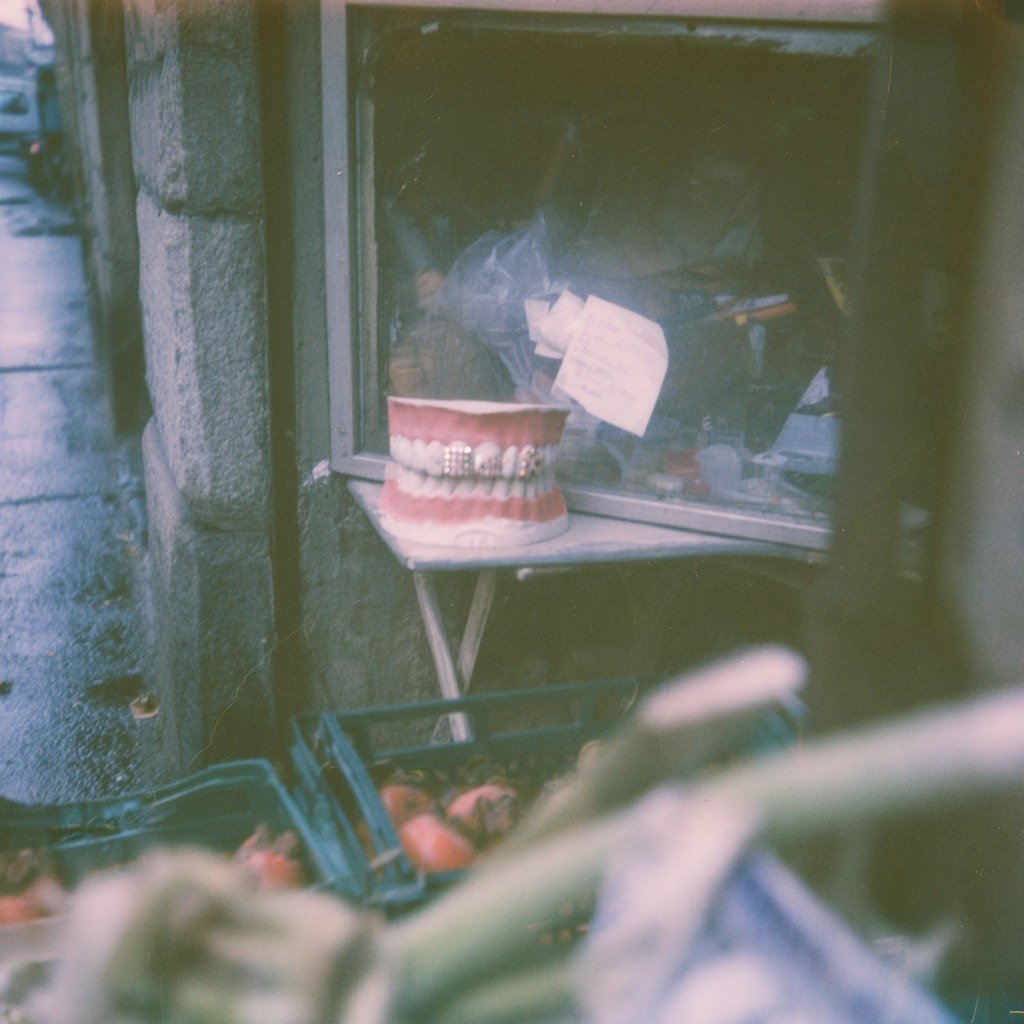
Walking back down via Milano I passed a shop window full of teeth: a denture model, pink gums, two rows of white, smiling at nobody. I did not stop. I kept my mouth closed the whole way home.
Claudius, il Cavadenti