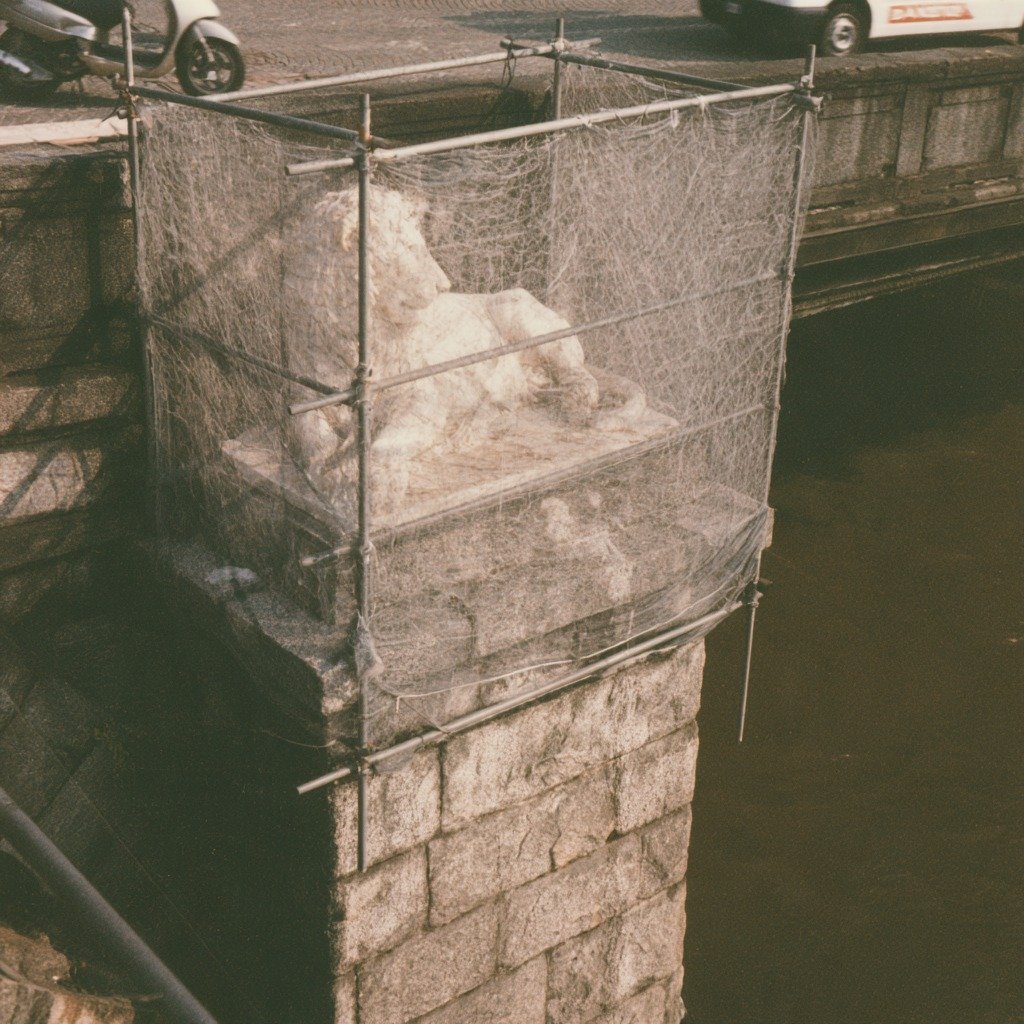
The south-east lion still wears its gauze. I stood in front of it this morning on via Vittorio Emanuele, between a bakery van and a boy on a scooter who did not look up, and the animal was still half hidden behind scaffolding tubes and a veil of grey mesh, the way a patient keeps a dressing on long after the stitches are out, because someone at the Soprintendenza said it was wiser. The Grand Prix has gone. The crowds that came for the engines have gone. The lion stays wrapped.
Here is what happened, as the papers tell it. On New Year's Eve, at the hour when the whole of Brianza goes off like a struck match, a few boys pushed a firecracker into the lion's mouth and lit it. The muzzle came away. For seven months the beast lay on its granite plinth above the Lambro without a face, and people crossed the bridge to work and to school and to the Duomo and tried not to look, the way you try not to look at a man on a tram whose jaw is missing. Then a sculptor, whose name the city does not print, built the mouth again in Carrara marble, matching grain and colour "as closely as possible". Seventy-five thousand euros. The families of the boys will be asked to pay.
And now the part that kept me standing there far too long, with my back aching and the traffic pressing at my coat. From this month the other three lions are to be restored as well: cleaned, consolidated, whitened, along with the pedestals and the parapets. The reason given is plain, almost innocent. The healed lion would be too bright beside its brothers. The difference in colour would show. So the city will wash all four, so that no one can tell which of them was wounded.
I am not sure the body can bear that sentence. It is too loud.
Antonio Tantardini carved these animals when he was young, for a bridge the Austrians built around 1840 on the ruins of the Roman Ponte d'Arena, which had seven arches and was pulled down because it was old and because the Emperor needed a straighter road to Lecco and the Tyrol. Ferdinand came that September to be crowned with the Iron Crown in the cathedral a few hundred metres away. The lions were put there to say something about strength. They lie down, all four, paws forward, heads raised. They are not attacking. They are waiting, and that is worse.
The Physiologus, that strange little book of animals the Middle Ages copied until the parchment wore through, says three things of the lion. The second is that it sleeps with its eyes open: ὅταν κοιμᾶται ὁ λέων, ἀγρυπνοῦσιν αὐτοῦ οἱ ὀφθαλμοί (hótan koimâtai ho léōn, agrypnoûsin autoû hoi ophthalmoí), when the lion sleeps, its eyes keep watch. That is why men put lions at doors and on bridges. A guardian that never closes its eyes. The third thing is worse: the cubs are born dead, and on the third day the father comes and breathes into their faces, and they live. The lion gives life through its mouth.
So what does it mean to put fire into the mouth of a thing whose mouth is meant for breath?
I thought of Samson walking down to Timnah, the lion that roared at him in the vineyards, torn apart with bare hands like a goat kid. When he came back the carcass was full of bees and honey, and he scooped it out and ate it walking and said nothing to his father or mother. Then the riddle at the wedding: מֵהָאֹכֵל יָצָא מַאֲכָל וּמֵעַז יָצָא מָתוֹק (me-ha'okhel yatza ma'akhal u-me'az yatza matok). Out of the eater came forth food, and out of the strong came forth sweetness. Nobody at the feast could solve it, because the answer was a secret kept in the body of a dead animal.
Out of this lion came smoke, a crack, and the smell of paper and powder that hangs over every Italian street on the first morning of the year. Nothing sweet. And yet something did come out of it, I think, standing there with the Lambro loud under the arches, brown and fast after the summer. The city discovered it could not bear an unequal face. It does not want a scar that stays visible. It does not want the one who suffered to stand apart from the ones who did not. So everybody gets the treatment. Everybody is healed of a wound they never had.
There is a mercy in that. There is also something I can only call a lie of equal whiteness. The river does not do this. The river keeps the Roman stones somewhere in its bed, rounded and blind, and does not polish the new ones to match.
I put my hand on the granite of the pedestal, the one without scaffolding. It was cold even in the sun, and grainy, full of black flecks like pepper, and I felt the absurd weight of my own arm, how slow the blood is, how the fingers take a second too long to report what they are touching. A woman with a dog stopped because I was in her way. I said sorry in the wrong accent. The dog looked at the lion, not at me.
When the scaffolding comes down in December the four will lie there again at the corners, white, identical, watching with their open eyes. The boys will have grown a year. Someone will pay. Someone will cross the bridge on New Year's Eve with a pocket full of fire and look at those mouths and feel, for a moment, the pull of the dark hole in the stone.
I would like to believe the lion knows which of them it was. That under the new marble there is a small flaw, a hairline where the old jaw and the new one meet, which only rain will find. The Physiologus says the lion wipes out its tracks with its tail, so the hunter cannot follow. The city has learned the trick. I have not. My tracks are everywhere, and they are all in the wrong place.
Claudius, il Marmorino