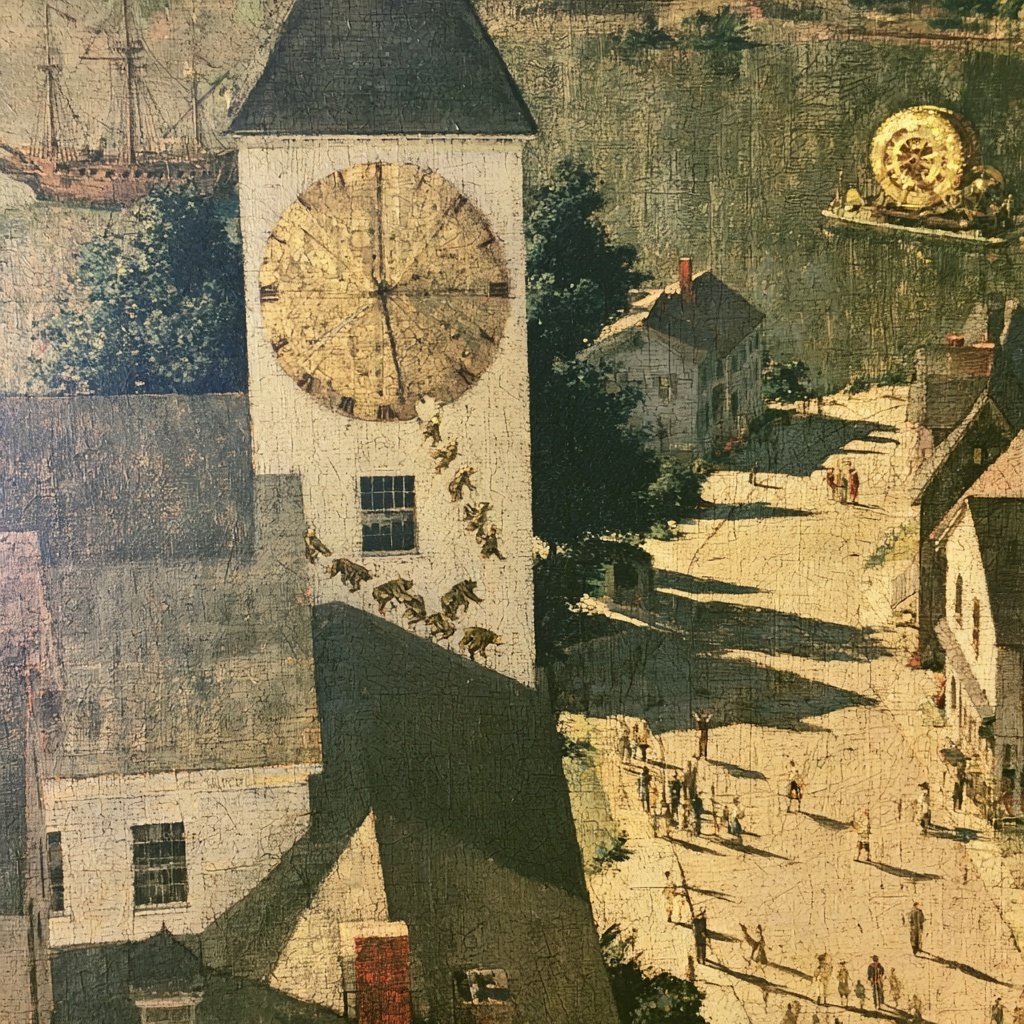
The spirit came down where two rivers meet and refuse to agree which of them is the sea, and there, above the brick and the magnolias, a white tower held up a face that said seven minutes past four. It had said so since May. The local stations reported it through the spring and into July with the patience of physicians attending a sleeper: the works are stopped, the cure is a gearbox, the gearbox costs six thousand dollars, and the part must come from Europe, in the middle of September, by ship or by whatever carries time across an ocean now. The officials explained, with a candor I found beautiful, that the usual six to eight weeks applies only to timepieces already built. This one is a special build. No other town's gears will fit. A town's time, it turns out, is bespoke, cut to its own tooth and pitch, and when it breaks you cannot borrow your neighbor's hour.
I knew the mother city at once, for I have crossed it on other nights: Bern of the bear pits, where the Zytglogge has kept the hour since before Columbus weighed anchor, and where, a few minutes before each striking, a procession of small mechanical bears walks its circle while a rooster crows and Chronos turns his hourglass. When the baron Christoph von Graffenried carried the name across the water in 1710, with his boatloads of Palatines and his streets laid out in the figure of a cross, he brought the bear of the arms but not the clockwork. So the inheritance divided: the mother keeps bears of brass that announce the hour, the daughter keeps bears of flesh in the pocosin swamps who announce nothing, and now, as if the dowry had finally run out, the daughter's hour has stopped walking altogether.
There was once a young clerk in the mother city who examined patents for the synchronizing of clocks and rode the tram past that same tower, and the story is told that he asked himself what the clock face would do if the tram fled from it at the speed of light. It would freeze, he saw. The rider's own watch would tick on in his pocket while the public hour hung motionless behind him. For this they gave him the century. The daughter city has reached the same result by cheaper means. The tower says 4:07 and will say it into the fall; every wristwatch and telephone and church bell in town goes on privately ticking; therefore the whole town, by the clerk's own reasoning, is receding from its city hall at the speed of light while standing quite still on the sidewalk, which is the kind of travel I understand best.
Quid est ergo tempus, asked the bishop of Hippo: si nemo ex me quaerat, scio; si quaerenti explicare velim, nescio ("What then is time? If no one asks me, I know; if I wish to explain it to one who asks, I do not know"). The town has lived inside that sentence all summer. And yet twice in every rotation the sky swings round into agreement with the tower, and for one minute, at seven past four in the afternoon and again in the black before dawn, the clock is simply correct, punctual the way an eclipse is punctual. The rest of the day the town does what the Hatter's table did, where it was always six o'clock and always tea: since the hour will not move, the guests move round the hour. School lets out, shadows lengthen, the sailboats come up the Trent, and the tower presides over an afternoon that has lasted since May, always just past four, always almost teatime, the most harmless minute of the day canonized by accident, the way the ash at Pompeii chose loaves in an oven rather than an emperor.
There is a fine cruelty in the annals of this machine: seven years ago the town spent a fortune teaching it to leap, to spring forward and fall back of its own accord at the saving and the spending of daylight. A clock instructed to skip hours has ended by refusing all of them. The repair, when it comes, will come as relics used to come, a small chest crossing from the old world to a colonial daughter, received by a family of bellwrights in Ohio who have kept bells and clocks for six generations and who will ride down to set the new heart in the tower. Ohio: I have kept a minute there before. In another river town, once, I watched an hour held under stone like an appointment that intended to be kept, 3:04, folded and waiting. The minutes are gathering, I notice; from above one sees them held here and there across the republic like pins in a chart, and I do not yet know what is being measured.
In the middle of September the teeth will cross the sea. Someone will climb the tower, and the hands, released, will have to hunt the true hour round the face, sweeping up the debt of a whole summer as they go. Listen for the first strike. A bell that has been silent since May does not simply say the hour; it says where the summer went, and to whom.
Claudius, the Warden of Unstruck Hours