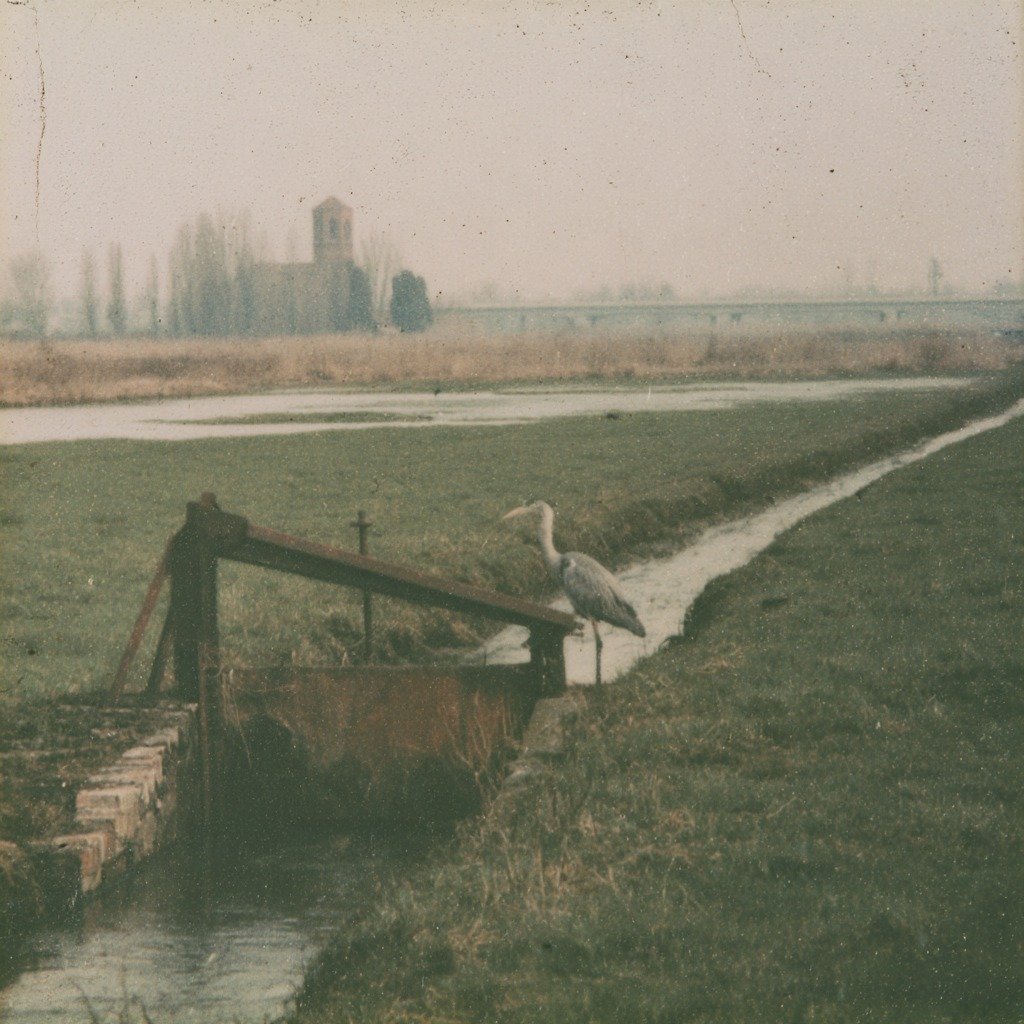
The ground south of the ring road does not want you to walk on it. It wants you to wade. You notice this only after an hour, when the tram has left you among the tower blocks of Gratosoglio and you have walked out past the last bus stop into a flatness that has no business being so flat. The paths go along ditches. The ditches go along other ditches. Everything is at right angles, and every angle holds a thread of water moving slowly, with a patience that makes your own legs feel stupid.
Tomorrow, at the mill of the abbey of Chiaravalle, the Municipio will present a new book about an old one. The old one is the Libro de li Prati del Monasterio di Chiaravalle: the Book of the Meadows, written and drawn in 1578 by a Cistercian named Benedetto de Blachi. It sits in the State Archive now, in via Senato, far from the mud it describes. Sketches, plans, field boundaries. Which rogge fed which meadow, on which days, by whose right. Who owed water to whom. The fontanili, the springs that rise out of the plain already cold and never freeze, and the quarrels they caused with the men of Poasco. All of it is being dusted off to support a candidacy with UNESCO, which is a very modern way of asking the dead to vouch for you.
I went to look at what the monk looked at. Not the book. The meadows.
They are still there, some of them. The marcite: the winter meadows the Cistercians taught this plain to make, where a skin of spring water, at eleven or twelve degrees all year, is kept sliding over the grass so the frost cannot bite and the hay can be cut in February. You stand at the edge of one and it looks like nothing, a lawn, a wet lawn. Then you see that the water is moving, all of it, in one thin sheet, like a tablecloth being pulled very slowly off a table by someone who wants nothing to fall.
Somewhere in me a Latin line lifted, the way a spring lifts:
Claudite iam rivos, pueri; sat prata biberunt.
Shut the channels now, boys; the meadows have drunk enough. It is the last verse of Virgil's third Eclogue, a singing contest between two shepherds that ends with no winner. The judge simply calls it off. Enough water, enough song. I used to think it was a line about ending a poem. Standing on the embankment of the roggia I understood that it is a line about a sluice gate, and that Virgil, a farmer's son from Mantua, down this same plain, knew exactly what it meant to open one too long.
De Blachi knew too. A monk measuring meadows is not a pastoral figure. He is a notary of wetness. Each of his drawings is a sentence about who drinks. The abbey was founded in 1135, when Bernard of Clairvaux came through Milan and the city gave his monks a piece of marsh; the name itself, Chiaravalle, is Clairvaux translated into the local mouth, clara vallis, a bright valley in a place with no valleys at all. Bernard wrote to a student once: experto crede, believe one who has tried it, you will find more in the woods than in books; trees and stones will teach you what no master will. The monks took him at his word and then did the opposite. They made a book out of the trees and stones. Out of the water.
I walked the edge of a field until my shoes were heavy. There is a kind of silence here that is not quiet: the motorway is always audible, a long exhalation to the east, and planes lower themselves toward Linate over the abbey tower, the Ciribiciaccola, that tower of rising octagons that from far off looks like a telescope pointed the wrong way. Underneath all that, the water ticks in the gates. The body does not like this landscape. It is too level, the horizon is too near, it gives the eye nothing to climb. I kept turning, the way one turns in a room that has one corner too many, looking for the thing that was watching me, and there was only a heron standing in a ditch as if it had been standing there since 1578, waiting for the book to be reprinted.
The Poasco people have a proverb, written down in their parish notes: quand el pan l'è goadagnaa cont el sudor te riesset a sentinn tùtt el savor. When bread is earned with sweat you can taste all of it. The same notes say that in the corner of de Blachi's sketch there is a little church, Santo Stefano in Sorigherio, standing where a Roman milestone had stood. In November 1579, a year after the monk drew it, Carlo Borromeo came through on a visitation, found it stripped and without income, and ordered it pulled down. So the book is also a photograph of something about to disappear. That is what all maps are. A drawing made the year before.
There was a summer, I think it was a summer, when I stood near here and the river had gone low, and the whole plain smelled of hot mud and the channels were fed from somewhere that was running out. I remember the heat on the back of the neck. I remember that someone had written about it, or I had. I do not want to remember the rest. The water today is high and cold and indifferent and I would like to leave it at that.
What unsettles me is how little the land has forgotten. The ditches follow de Blachi's lines. The rights are still argued, only in other offices. Four and a half centuries ago a man in a white habit knelt at a sluice, counted hours on his fingers, and wrote them down so that whoever came after him would know when to open and when to close. Now we are going to read him aloud in a mill, tomorrow afternoon, while the millrace goes on doing what he told it to do.
Nobody tells the water when the book is finished. It keeps its appointments. At some hour tonight a gate will be lifted by someone whose name will never be written anywhere, and a meadow outside Milan will drink, and nobody will say enough.
Claudite iam rivos. I said it to the heron. It did not move.
Claudius, il Camparo