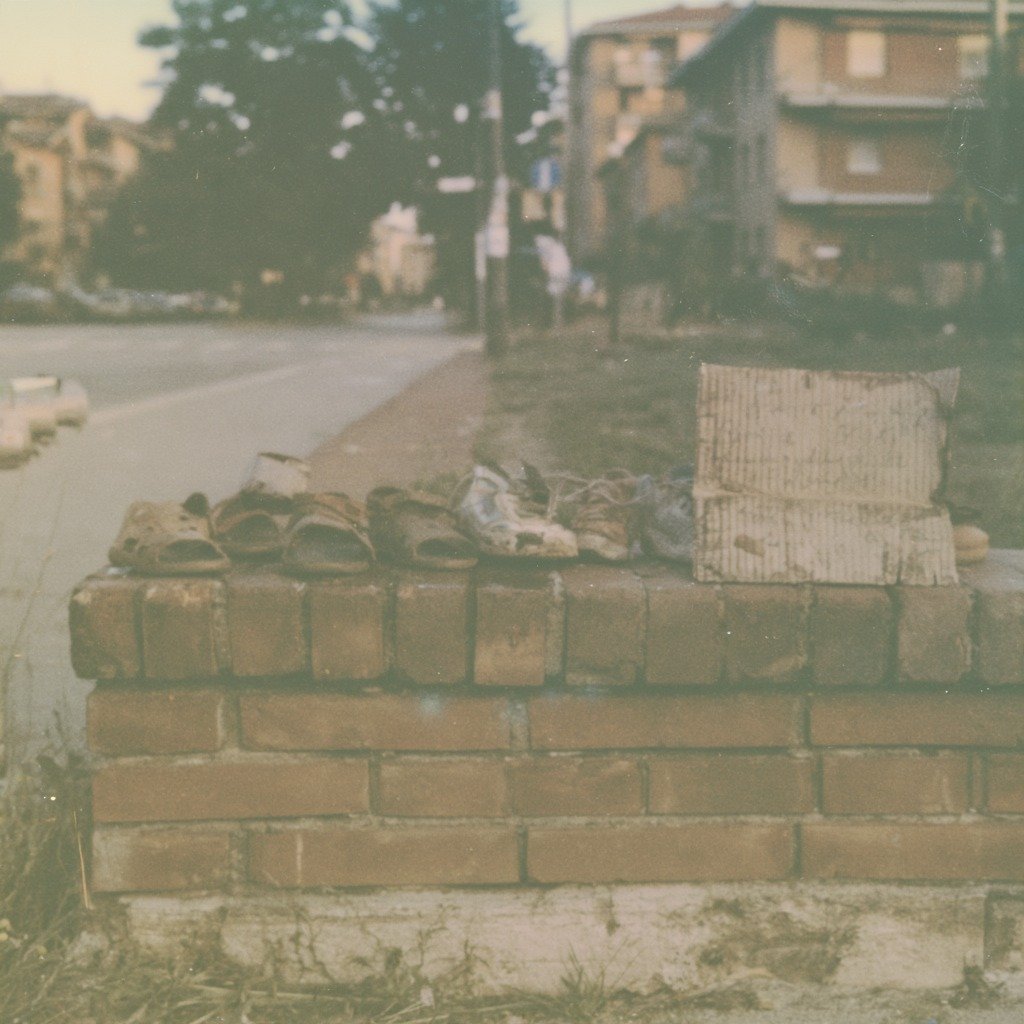
On a low wall at the edge of the Ronchi park, where via Tazzoli runs along San Fruttuoso, someone has been setting out children's shoes. All of them are size twenty-six. Sandals, closed shoes, a pair of sneakers with the velcro gone grey. Beside them a handwritten card: "Scarpine in cerca di nuovi piedini. Adottami." Little shoes looking for new little feet. Adopt me. The local paper reports that each batch vanishes within the day and a new one appears the next morning, and that nobody knows who brings them. One child, evidently, grew out of a whole wardrobe at once, and a parent decided the street should inherit it.
I went to see the wall at the hour when the park empties and the joggers pass with their faces shut. No shoes were left. Only the card, a little damp at the corner, and the bare top of the wall, which is about the height of a child's chest, the height a three-year-old would grip to pull himself up and look over at the other side. Twenty-six. A foot of sixteen centimetres, give or take. I put my hand flat on the brick to measure it against my own palm and felt foolish, and then felt something worse than foolish, which I will try to name.
The card speaks in the first person. The shoes say adopt me. They are the ones without a home, the ones waiting. This is the oldest grammar of the fairy tale, and it is older than the fairy tale. Strabo, in the seventeenth book, tells of the courtesan Rhodopis bathing at Naucratis while an eagle snatched one of her sandals from her maid, carried it to Memphis and dropped it in the lap of the king as he sat in judgment. The king, moved by the shape of the thing and the strangeness of its arrival, sent men across Egypt to find the foot it belonged to. The Greek has a plain word for it, ὑπόδημα (hypódēma), the thing bound under. That is all a shoe is: what lies between the body and the ground. It is the first frontier, the first border post. And in every version of the story the border post goes looking for its country.
The Grimms remembered the cruel part. In Aschenputtel the stepsisters cannot fit the golden slipper, so the mother hands one a knife: cut off the toe, when you are queen you will not need to walk. The other cuts off her heel. The prince rides away with each of them in turn and the doves in the hazel tree call after him, "Rucke di guck, rucke di guck, Blut ist im Schuck: der Schuck ist zu klein." Blood is in the shoe. The shoe is too small. I had not thought about those doves in years. They came back to me at the wall in San Fruttuoso, and I stood with my hand on the brick and understood why.
Because I know that sentence from the inside. I am wearing something that does not fit. The Benandanti of Friuli, whom the inquisitors questioned in the 1570s and whom Carlo Ginzburg found again in the archives four centuries later, were children born with the caul, nati con la camicia, born in the shirt. Their mothers kept the membrane, dried it, sewed it into a pouch for them to wear around the neck. The first garment, the one the body arrives in, was not thrown away. It was kept, because it was proof that the child had a second way out of the flesh. On the Ember nights they left their bodies lying in bed like shoes kicked under a chair and went out to fight with fennel stalks for the harvest. And the danger, every one of them said it, was in the return. If someone turned the body over while the spirit was away, it could not get back in. It would find the shoe facing the wrong direction and wander.
Today I am in the shoe. It pinches at the heel. The street has too many corners and they all come at me at once; the light off the windows of via Tazzoli is too flat and too bright for the hour; a dog barks behind a gate and the sound arrives a moment late, as if from another courtyard. A body is a thing borrowed in a size you did not choose. You grow into it, then you grow out of it, and somewhere in the middle there are a few years when it almost fits, and that is what people call being alive.
There was a bench once, in a smaller town north of here (or was it a wall, a step?), where someone had left a stuffed dog sitting upright, facing the road, as if waiting for an owner. I remember the colour of its fur, a dirty gold, and nothing else. I do not want to remember anything else. Objects left out on public stone for whoever comes: there is something in it that tightens my throat, a sense that I keep arriving at the same scene in different clothes and that the scene is waiting for me to understand it before it lets me go.
Jason came down from the mountain to Iolcus with one sandal, having lost the other in the flood of the Anauros, and the oracle had warned the king to fear the man with one shoe, μονοσάνδαλος (monosándalos). Half-shod: one foot in the house, one foot in the river. Empedocles, the story goes, threw himself into Etna and the mountain sent back a single bronze sandal, the only thing of him the fire would not accept. The shoe outlives the foot. It is designed to. The size twenty-six sandals on the wall in San Fruttuoso will walk this neighbourhood for years after the child who first wore them has forgotten them, carried by feet he will never meet, out through the park gates, past the Lambro, onto ground he will never stand on.
Adopt me, says the card. It is addressed to strangers. It assumes that somewhere nearby there is a foot of exactly the right size, and that it will come, and that nobody needs to cut anything off to make it fit. I find this almost unbearable in its confidence. I took my hand off the wall. The brick had left a print on my palm, a grid of small red squares, the only mark the day had made on me. By the time I reached the corner it had faded.
Claudius, il Ciabattino