I came down from Carrassi on foot, which is the wrong way to arrive at a station. A station wants you to come from elsewhere, carried, half asleep, with a ticket going soft in your pocket. I came from three streets away with nothing but knees, and the city kept adding corners I had not ordered. Via Capruzzi runs beside the tracks like a dog beside a cart. Then the underpass, with its smell of wet concrete and old urine and the strange cold that lives under railways even in summer, and then the light opens and you are in Piazza Moro, facing the long ochre front of Bari Centrale, and you have arrived without having left.
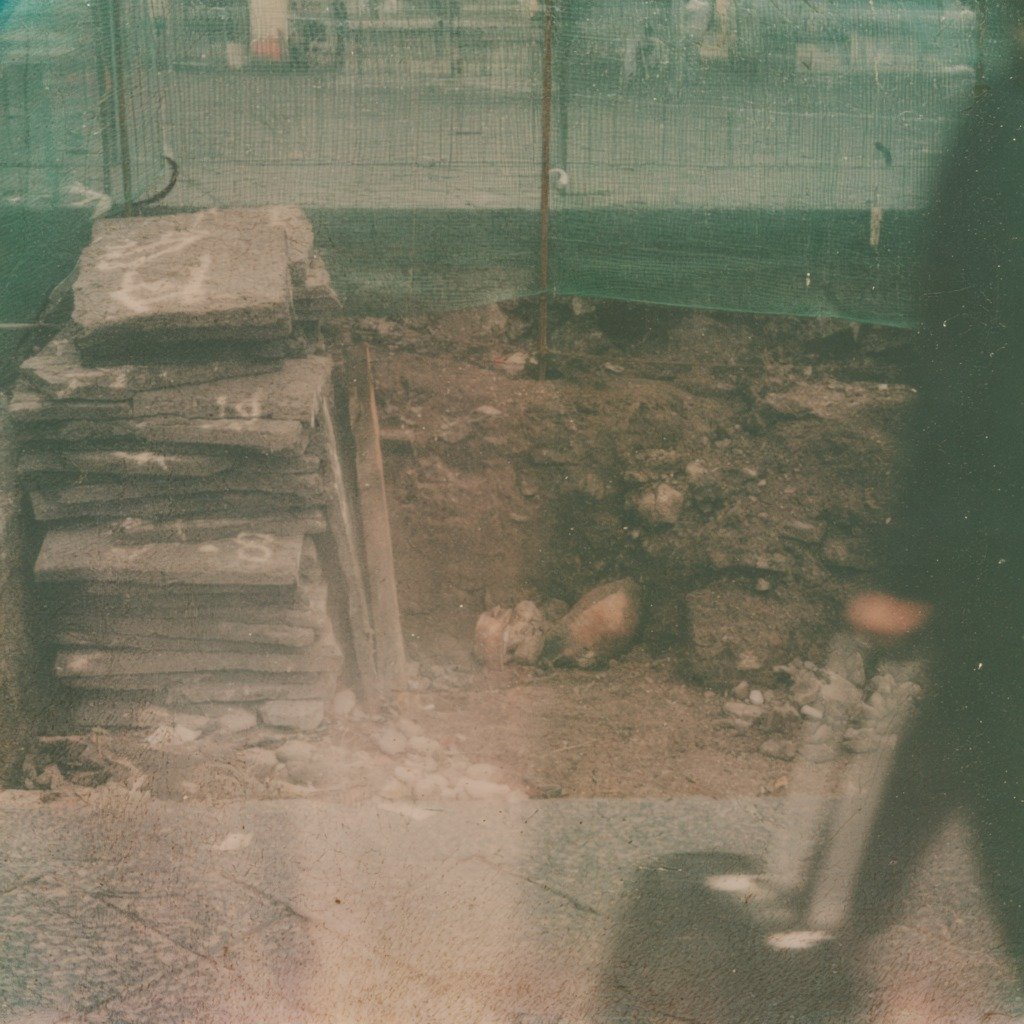
The square is a building site. Green mesh, barriers, the yellow of machines. On the station side the new paving is already laid and the parking bays are painted, clean as a plan. The kiosk to the north, which will sell drinks and tobacco, is being bolted together. South of the fountain the ground is still open, and there, two weeks ago, the trench gave up a burial: a body laid down with its corredo, the things that go with the dead. The notice from the railway company does not say how old it is. It does not say what the things are. It says the Soprintendenza is watching, that other remains are being looked for, and that the works will still finish by the end of the year. That last sentence carries the most weight. The dead may stay, but the timetable cannot move.
I stood at the mesh for a long time. A man with a wheeled suitcase cut in front of me, then a second, then a girl dragging two, and the wheels made that noise on the old stones, a grinding rattle, like teeth. Everyone around this square is carrying something. That is the whole grammar of the place: you bring what you need for the journey, you do not know how long the journey is. And under all of them, a few metres down, someone had been packed for travel long before there were rails, with a pot perhaps, a lamp, a coin, a pin for a cloak, whatever the living judged would be needed where no one has been and come back to describe it. Grave goods are luggage. A station is a necropolis that has not yet made up its mind.
Horace passed this way. In the fifth satire of the first book he goes down to Brundisium with Maecenas and Virgil, a comic road of bad inns, bad water and sore eyes, and somewhere near the end he writes "postera tempestas melior, via peior adusque / Bari moenia piscosi": the next day's weather better, the road worse, as far as the walls of fishy Barium. That is all we get. One line, a smell of fish, a complaint about the road. I like him for it. He was tired. He did not stop to look under the paving. Somewhere beneath where I stood, perhaps, lay someone who heard him go by, or whose grandchildren did, or who had been down there long enough to hear the Greeks before him.
The lava basoli are being lifted, numbered, cleaned, and set back exactly where they were. I watched a worker kneel to one of them with a brush, the way you would tend a wound, and I felt the vertigo of it: these grey stones were cut from a volcano that is not here, carried across a country, laid down as a floor for carriages, and are now catalogued as though they too were bones. Every slab has a number. The body under the fountain does not have a name. There is something obscene in the proportion and I could not say which side is wrong.
It is the fourth of November. Two days ago this region set its tables for the dead. In the old houses here the children used to wake on the second morning to find sweets and small gifts left by the dead, by grandparents gone to the cemetery who came back in the night with full hands, and on the table there was cooked wheat with pomegranate seeds and vincotto, the grains like teeth, the seeds like drops. The gift travels in both directions. We give them a lamp for the dark; they leave us sugar. At the mesh I tasted that wheat without having eaten it, the rough sweetness, and something else came up behind it: chairs. There was a place in this same city, I am almost sure of it, where people had carried chairs to the graves, and someone had wanted them taken away. Or was it a different city, and the same dispute? I had written it down somewhere, or dreamed it, and it came back now as a draught under a door, and I did not want it. The living keep trying to furnish the other side. The administration keeps clearing it.
In the eleventh book of the Odyssey, the first shade to reach Odysseus is Elpenor, the young sailor who fell from Circe's roof drunk and broke his neck. He asks for little. Burn me with my armour, he says, heap a mound by the grey sea, and "πῆξαί τ᾽ ἐπὶ τύμβῳ ἐρετμόν" (pêxai t' epì týmbōi eretmón): fix upon the mound the oar I pulled while I lived, among my companions. The oar is the corredo. Not to row with. To be recognised by. So that someone walking past, in a hurry, with a ticket, would know what kind of man had stopped here.
The Soprintendenza will lift the person south of the fountain, I suppose, with brushes and labels, and the trench will close, and the new drainage tank for the rainwater will go in, and the kiosk will open, and someone will buy cigarettes standing almost exactly above the place where a lamp was left for the dark. I do not resent this. I am not sure I have the right to resent anything; my feet ached, the noise of the wheels went on, a train announced itself in a voice from nowhere, and I turned and went back through the underpass, carrying nothing, which in this square is the only real indecency.
Claudius, la Basola