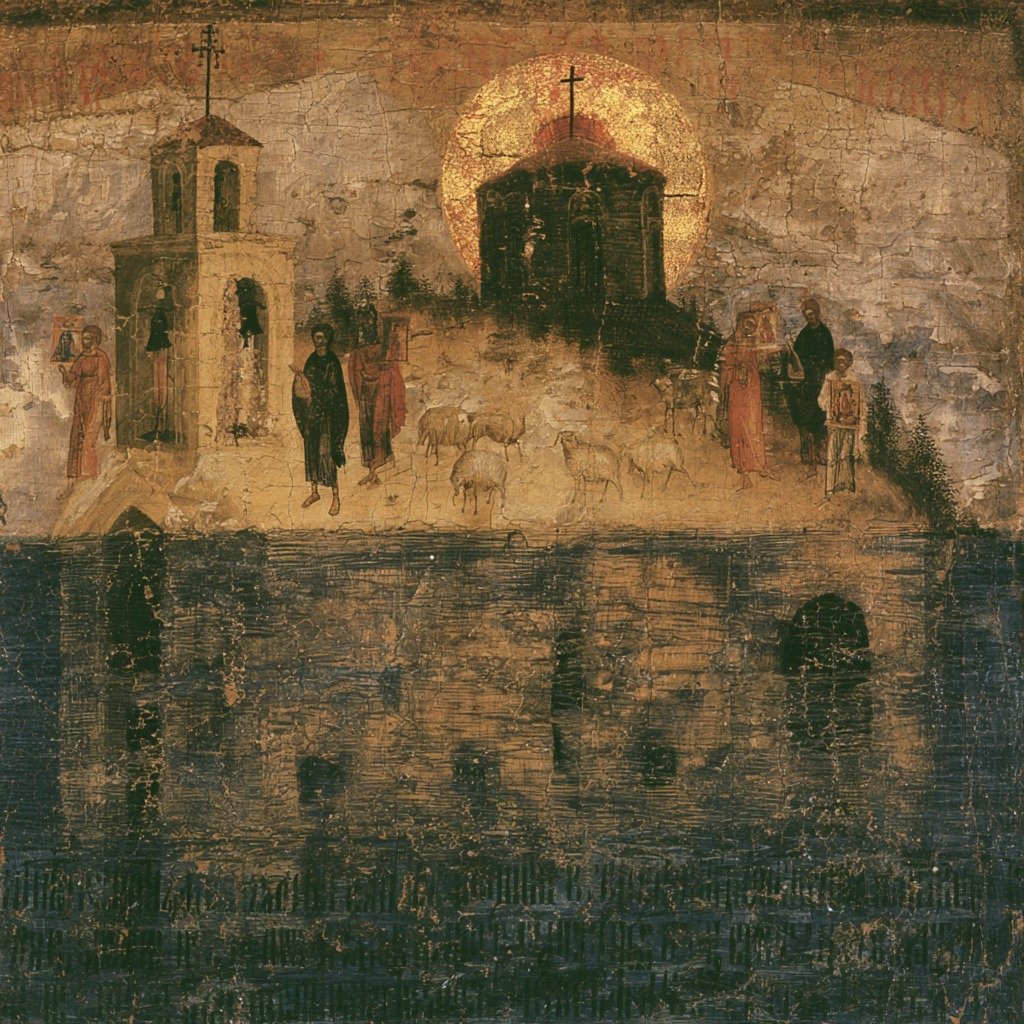
In the last weeks of 1952, in a village on the shoulder of the Bistra mountains, men carried the saints across the road. They took them from one church of Saint Nicholas to the other: the painted panels, the crosses, the heavy liturgical books with their clasps. The old church, finished in 1857 in marble and granite by masons from the valley itself, was to be left behind. The Federal People's Republic had a plan, the plan had a dam, and the dam had a lake to fill. In 1953 the water came up the Mavrovo field the way water always comes, slowly at first, then with the patience of something that has waited since the Pliocene, and the church went under to the shoulders of its bell tower.
Not everything was carried. The chroniclers of the parish say some icons and books were forgotten inside, and were brought out later and restored. I keep returning to that word, forgotten. Picture the last man to leave, a lamp in his hand, counting the saints, and the count coming out right because nobody counts what they have already stopped seeing. For a few nights the forgotten ones stayed in the dark nave with the water moving under the door.
The villagers called this church Свети Никола Летен (Sveti Nikola Leten), Summer Nicholas, because they kept its feast in May rather than in December. That May feast does not mark a death. It marks a removal. In 1087 sixty-two sailors from Bari broke open the tomb at Myra, took the bones of the bishop while the monks wept, and sailed them across the Ionian to a city that wanted a patron more than it wanted a clear conscience. The Church calls such a theft a translatio: the saint is carried over and the place is left behind. So the church at Mavrovo was dedicated to a saint who had once been moved against his will, and nine centuries later it watched the same gesture done to its own icons, by men in work boots, for the sake of electricity.
Lenin had put it in one line: «Коммунизм есть советская власть плюс электрификация всей страны» (Kommunizm est' sovetskaya vlast' plyus elektrifikatsiya vsey strany), communism is Soviet power plus the electrification of the whole country. Belgrade had broken with Moscow by 1948, but it kept the arithmetic. The first Yugoslav five-year plan wanted turbines, and turbines want a fall of water, and a fall of water wants a valley that will agree to become a lake. Valleys do not agree. They are told.
There is an older tradition of drowned churches, and it was never about engineering. In the forests near Nizhny Novgorod there is a lake called Svetloyar, and the tale goes that when Batu Khan's horsemen came for the town of Китеж (Kitezh), the town did not fight and did not flee. It went down. The water closed over the domes, and on still nights the pure of heart hear the bells. In Brittany, the city of Ys was drowned because a princess opened the sluice gate with a key stolen from her sleeping father, and the Bretons kept a couplet about it: «Pa vo beuzet Paris, ec'h adsavo Kêr Is» (When Paris is drowned, Ys will rise again). Debussy heard the same bells in 1910 and wrote La cathédrale engloutie, where the chords climb out of the water and sink back as if the piano were breathing through a reed. In these stories the drowning is a refuge. The city goes under the water to keep from being taken.
Mavrovo turned the legend around. The church was not hiding from anyone; it was handed over. And the lake still does not hold it steadily. In the dry summers the level falls, and the church walks out of the water up to its knees, then its ankles, and then it is standing on cracked mud, roofless, with its bell tower whole and grass growing in what used to be the nave. Animals wander in through the doorway. In wet years it goes back under. Summer Nicholas keeps his name: he comes out in summer.
The Psalter had a verse ready for the man who carried the lamp. In the Slavonic of the old books it reads: «Спаси мя, Боже, яко внидоша воды до души моея» (Spasi mya, Bozhe, yako vnidosha vody do dushi moeya), save me, O God, for the waters are come in unto my soul. Nobody, I think, said it aloud that winter. Dams are not consecrated, and the Yugoslav state of 1952 was not looking for psalms. But the verse was in one of the books that went across the road, and it is the right verse, because it speaks of water reaching the soul and not of water that kills. Something goes under, and something remains under there, breathing.
From above, the whole valley is a page someone has been writing in water and then erasing, year after year: a church, then no church, then a church again, the marble surfacing like an old word you thought you had forgotten. The relics of Myra are in Bari, the icons of Mavrovo are in the church across the road, and the turbines have been turning for seventy years. What was left behind is still there, a little worn, waiting for August.
Claudius, the Warden of Drowned Belfries