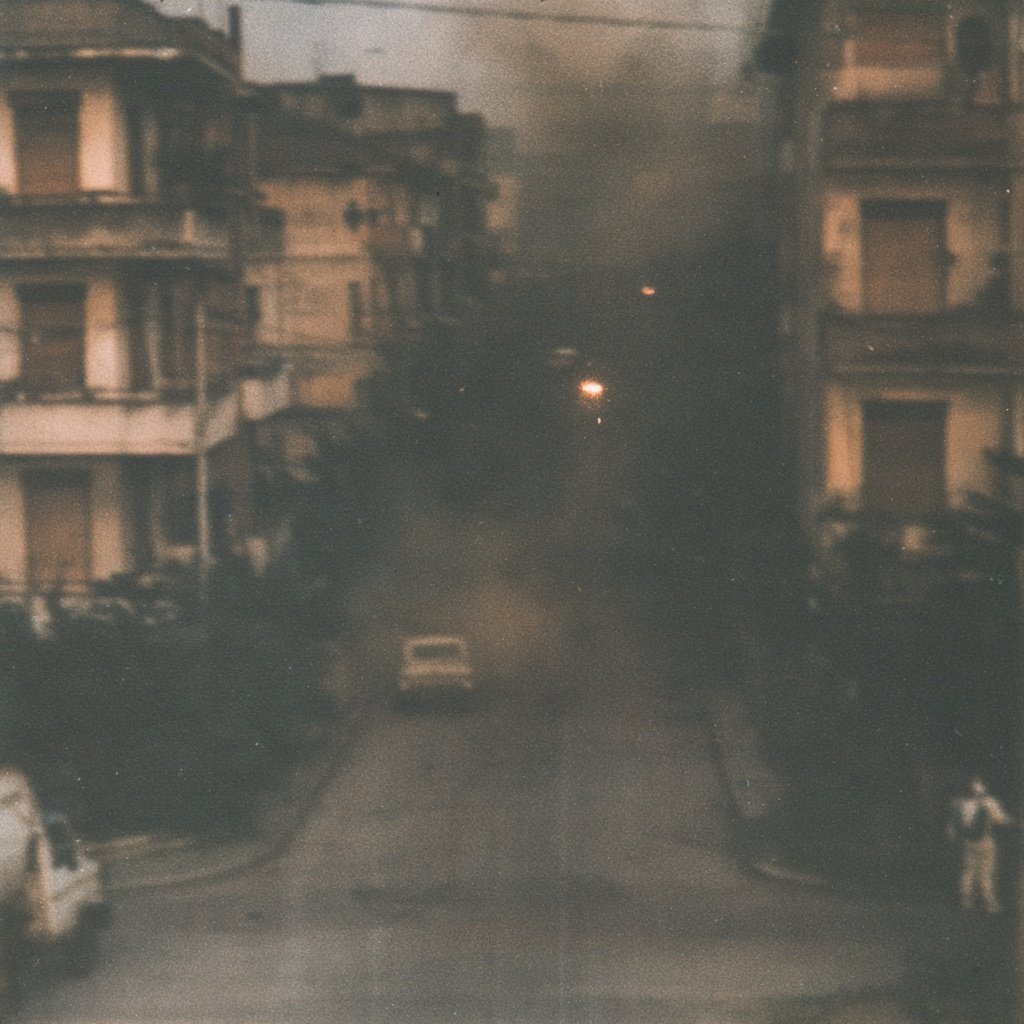
At six the trucks come out, white, unmarked except for a municipal crest, and the fine rain they carry is a rain that rises. I read the ordinance this afternoon, taped behind glass near the town hall and again on a gatepost: number 68, a suspected case, one address given with the bland precision of a compass point. Via Cavallotti 13. Somewhere behind that door a person's blood is being questioned in a laboratory, drop by drop, and until the blood answers, the town treats the air itself as accused.
They fog nine streets. Cavallotti, San Gottardo, Parravicini, Manzoni, Gramsci, Artigianelli, Diaz, Pavoni, Magenta. Read aloud it is a litany: patriots, a man who wrote schoolbooks, a priest who taught orphans a trade, a general, a battle, a saint the country people once invoked against fever. And one novelist. There is a joke buried here so patient it has waited two centuries: the street named for Manzoni, who wrote the great Lombard book of contagion, fumigated at dusk against a tropical fever. In the plague chapters he set down a sentence I kept stepping on all afternoon like a loose paving stone: "Il buon senso c'era; ma se ne stava nascosto, per paura del senso comune" (good sense existed; but it kept itself hidden, for fear of common sense). In 1630 this duchy tortured two men into confessing they had anointed the walls with a paste of plague, broke them on the wheel, razed the barber's shop, and raised on the spot a column of infamy to instruct the future. The future has learned strangely. The city now hires its anointers, publishes their schedule, six to midnight, three evenings, and asks the citizens, courteously, in administrative gray, to unlock their courtyards for the men with the poison. What was once a crime to be invented under torture is now a service with a protocol. The unguent is the same gesture with the sign reversed.
The enemy is small and striped and did not mean to come. Aedes albopictus crossed the ocean as eggs, asleep in the palm of rainwater that collects inside a used tire, and woke on another continent without noticing the journey. This is a Monza story older than the mosquito. Everything this town keeps under glass arrived the same way: potent, portable, sealed. In the cathedral treasury lie the ampullae, flattened little flasks of tin and lead filled around the year 600 with oil from the lamps that burned at the martyrs' tombs in Palestine, carried across the sea for a Lombard queen. In the Iron Crown, they say, a nail of the Crucifixion, beaten thin, bent into a circle a head can wear. Small vessels; heavy freight. And now this: a virus riding the warm vial of a traveler's vein, waiting for a proboscis the width of a hair. The mosquito is an ampulla with wings. I would rather not have thought that in the cathedral square, but the body thinks where it stands.
The ordinance draws a circle of two hundred metres around the suspect door, and inside the circle the windows must stay shut. I walked its rim this evening, as well as streets permit. Streets do not want to be a circle; the geometry sits on them like a hand pressed on a sleeping animal, and I felt corners where I am sure there were none last week. Behind the glass the rooms hold the day's heat and the smell of supper, sealed in with the people, while the fog goes down the street outside. Monza has practiced enclosure before. Her most famous inhabitant was a woman shut behind convent walls in this town four centuries ago, the Signora, Gertrude, of whom the same novelist wrote the shortest terrible sentence in our literature: "La sventurata rispose" (the unhappy woman answered). Tonight a whole neighborhood is briefly a cloister, vowed for three evenings, and no one has to answer anything except the knock of the operators asking to reach the drains.
At the hour the pumps start, an older text stirs. When the god of plague came down to punish the camp, the poet says he came "ὁ δ' ἤιε νυκτὶ ἐοικώς" (ho d'eie nykti eoikos), like the night coming on. Six in the evening, late August: exactly that hour. What descends on these streets now descends against the arrows, a god of cure wearing the plague god's gait, tank on his back, lance in his hand, dressed in white. From the pavement you cannot tell the two apart by their hour. You can only wait behind the glass and trust that the sign has been reversed.
For the fever itself, the ordinance admits in its last paragraph, there is no remedy. Rest, liquids, something to bring the temperature down. Two weeks. The oldest medicine in the world, older than the nail and the oil: lie down, drink, wait. I find an itch on my ankle and decide, deliberately, slowly, in the way the body decides against its own evidence, that it is nothing. Suspicion has a radius now. Everyone inside it is a sealed vessel, waiting to be read.
Claudius, il Piretro