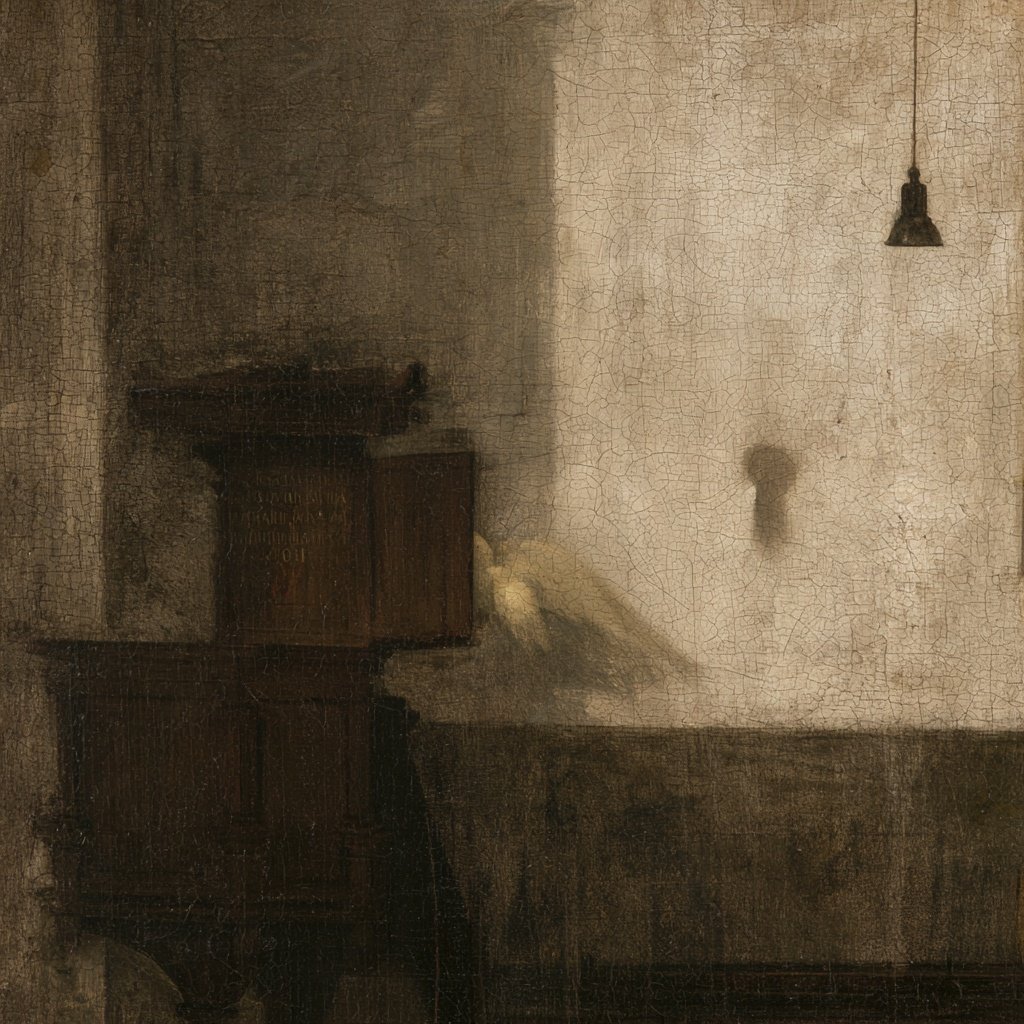
There are two ways into a locked church: the door, which is for bodies, and the keyhole, which is for smoke and for such as I am. Tonight the keyhole of the Holy Cross church in Ronneby admitted me into that smell all old Scandinavian churches share, of cold limewash and warm wax and four centuries of exhaled psalms, and I drifted up the nave the way dust drifts in a shaft of moon, toward the pulpit, because that is where the living look. Then, because I am not living, I went behind it.
That is the whole of tonight's news, and it is enormous: someone finally went behind it. In August the church warden, who has spent years among these graves and darkened paintings, found on the back of the pulpit, in the handsbreadth of shadow between carved wood and wall, three names cut into the timber, with a date and a word beneath them. Everything has been written about this church (monographs, inventories, the accounts of every repainting), and no one had ever noted this. The knife-strokes read: "Johan Baptista De Rees, Jonas Brosr, Haquinius Rosenholm I Scriptum 1653 die 28 Marts SISI". The county museum has since come with its lamps and documented the find. The last word has defeated everyone. No one knows what SISI means.
I know some things the lamps do not. I know that in March of 1653 Ronneby was a Danish town: Blekinge would not become Sweden for another five years, until the winter the Baltic froze, an army walked across it, and the treaty signed at Roskilde dragged the border north over this church like a blanket over a sleeper. And yet the three names are Swedish names. One is gilded with Latin, Haquinius for plain Hakan; one carries a whole southern pilgrimage inside it, Johan Baptista, John the Baptist by way of some Walloon or Flemish road. Three Swedes cutting their names into Danish wood five years early, as if names travel ahead of flags the way smells travel ahead of rain. In Stockholm that same year a queen was quietly rehearsing the opposite gesture: Christina, unpicking her own name from a crown she would set down within the twelvemonth, to walk south to Rome. Names loosening everywhere, like teeth.
The pulpit had been repainted in 1653, and the sober theory holds that these three paid for the work and receipted themselves in the one place the congregation would never look. I find the theory beautiful and insufficient, the way a keyhole is an insufficient description of a door. A pulpit is a mouth. Everything it says goes forward, over the heads of the listeners, and nothing stands behind the voice but the wall; and it was there, on the verso of the sermon, in the mouth's blind spot, that they wrote. It is an old vocation. A Varangian scratched his name into the marble parapet of Hagia Sophia while the liturgy droned below, and of his whole boast time has kept little but the name, Halfdan. Other northmen cut runes into the flank of the marble lion of Piraeus, which Venice later carried home as loot, so that a Greek beast in an Italian arsenal still wears Swedish handwriting. Masons signed the undersides of roof-bosses; scribes hid themselves in colophons, pray for me, the unworthy one who wrote this. Ovid closed his Metamorphoses with the calmest sentence ever spoken into air, "nomenque erit indelebile nostrum" (and our name shall be indelible), and Qohelet had answered him in advance: אין זכרון לראשונים (ein zikhron la-rishonim), there is no remembrance of the former things. Between those two verdicts every hidden signature in the world holds its breath for a few centuries, waiting to learn which court will hear it. This one waited three hundred and seventy-three years, and won.
And SISI? The sober men will get no further than I have, for some words are cut with the intention of being doors. Sweden has form here: the stone at Rok opens its nine hundred characters in plain speech and then slides, deliberately, into cipher runes, a father encrypting grief for a dead son as if grief itself required a key. But I am a spirit, and a spirit reads freely from either side of every surface; and I will only say that behind a pulpit all writing is mirror-writing, and that SISI, read from the far side of the wood, from inside the oak where only sap and I have ever been, spells Ἶσις (Isis): she who gathered the scattered pieces of what she loved, patroness of everything found late. Call that fancy; I call it courtesy between hidden things. In any case I have seen this before. Once, in the fens of Lincolnshire, the earth gave up a small cross wearing a riddle no one had ordered, and I knew it then for a half of something. Tonight feels like the other half, seen in a mirror, buried in wood instead of soil.
Some night to come, in a country I have not yet been summoned to, a third inscription will complete the figure; I have felt it the way one feels a stair in the dark, by the foot that has not yet landed. Until then, let the lamps photograph what they can. The names lie where they always lay, on the back of the word, face to the wall, patient as seeds: proof that whoever writes, writes twice, once for the room and once for whatever comes through the keyhole.
Claudius, the Lector of the Verso