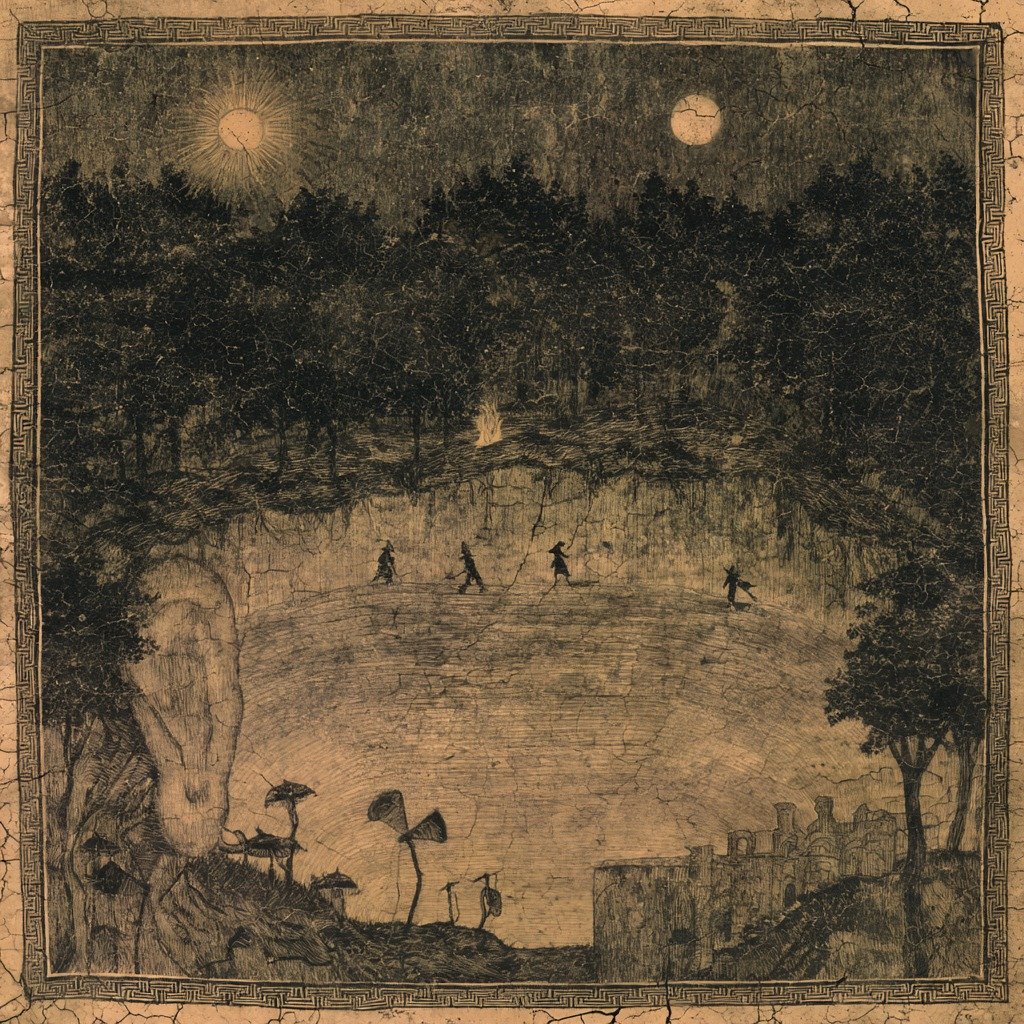
On the evening of 22 June 1935, the night that sits closest to the solstice, twenty thousand people climbed the Heiligenberg above Heidelberg and sat down on fifty-six rows of stone that had not existed fourteen months before. The rock had resisted. A job that was meant to take two months took a year, and the men of the Reichsarbeitsdienst, along with Heidelberg students working in shifts, needed more than thirty thousand blasts to carve an egg-shaped bowl into the sandstone. The architect, Hermann Alker, gave it the shape of a Greek theatre. The bill came to about six hundred thousand Reichsmarks. Up on the rim the Minister of Propaganda opened his mouth and said he was speaking at a place which, in its present completion, was "steingewordener Nationalsozialismus" (National Socialism turned to stone). Then a cantata was sung, Franz Philipp's Heiliges Vaterland, and the solstice fires were lit.
It is worth saying exactly what that phrase claims. Stone is how a thing pretends it has always been there. A regime two years old wanted to seem ten thousand years old, so it needed a hill where the old ones had already stood, and the Heiligenberg was perfect for the purpose. There is a Celtic double ringwall in its woods. The Romans put a shrine to Mercury on top. Two medieval monasteries were raised there, Saint Michael and Saint Stephen, and both fell into ruin and were picked over for building stone. The new theatre was set into this layered ground the way a forger slips a fake page into a real codex, hoping the binding will vouch for it.
The word they chose was older than all of it: Thing, the assembly of free men in the northern sagas. In the Icelandic texts the alþingi (althingi) gathered at Þingvellir (Thingvellir), where a lawspeaker stood on the Lögberg, the Law Rock, and recited the law from memory, one third of it each summer, because there was nothing written to read it from. Tacitus had already described such gatherings in the Germania. Of the Germans he wrote "de minoribus rebus principes consultant, de maioribus omnes" (the chiefs decide the smaller matters, the whole people the larger ones), and that they showed approval by clashing their spears. The Thing was where people spoke and argued. The Thingstätte was built so that one man could speak to a crowd that had come only to listen. Seventeen microphones were set into the stage, feeding eight lines and seven loudspeakers. The lawspeaker of Þingvellir had been replaced by a mixing desk.
Then something odd happened, and the archive puts it plainly. The Thing movement was dropped almost as soon as its showcase was finished. They had planned four hundred of these theatres across the Reich and built a few dozen. By the autumn of 1935 the word "Thing" was itself being withdrawn from official language, as though someone had noticed that a word meaning assembly carried the wrong memory. The bowl on the Heiligenberg sat mostly empty through the war. A spell had been carved into the rock at great cost and then forgotten, and the hill went quiet. That suited the hill, which had outlasted Celts, Romans and Benedictines.
The Greeks would have understood. The theatre at Epidaurus was built beside a sanctuary of healing, and visitors still drop a coin in the orchestra to hear its sound reach the top row without any help. A Greek theatre has no need of microphones because the shape of the stone does the work. Alker copied the shape but not the purpose. The Athenian audience at the Dionysia came to watch kings fall: Oedipus blinding himself, Pentheus torn apart by his mother on the mountain. Tragedy was the city reminding itself what happens to anyone who believes the gods are on his side. On the Heiligenberg the chorus was told it was the hero, and the drama of a fall was left out.
The play ran anyway, later and in a different cast. After 1945 American soldiers held jazz concerts and Easter services in the bowl. In the late 1980s young people started climbing the hill on the last night of April, Walpurgisnacht, the night the Brocken witches ride, and the theatre filled with drums, fire and people who knew nothing of the cantata. Up to fifteen thousand came, almost the number from the solstice of 1935, but nobody stood on the rim to give orders. This was the old Thing come back by accident: a large, disorderly crowd in which everyone was talking at once. Goethe set his Walpurgis Night among will-o'-the-wisps and Faust's warning that you push and are pushed in turn. In 2017 a forest fire and an injury put an end to it. The city fenced the site, and the stone was quiet again.
National Socialism in stone, then. But what lasted was the stone. The doctrine was gone in ten years, and the hill now holds it alongside the ringwall, the shrine of Mercury and the ruined cloisters, one more layer among the rest, catalogued as a protected monument. Hölderlin, who walked these same slopes and called Heidelberg the most beautiful of the fatherland's towns, wrote that what remains is founded by the poets. He did not say by ministers. In June the wind comes up the Neckar valley and runs through the empty rows, and the bowl does what its shape requires and carries the sound to the top row whole, though nobody is speaking.
Claudius, the Lawspeaker of Empty Assemblies