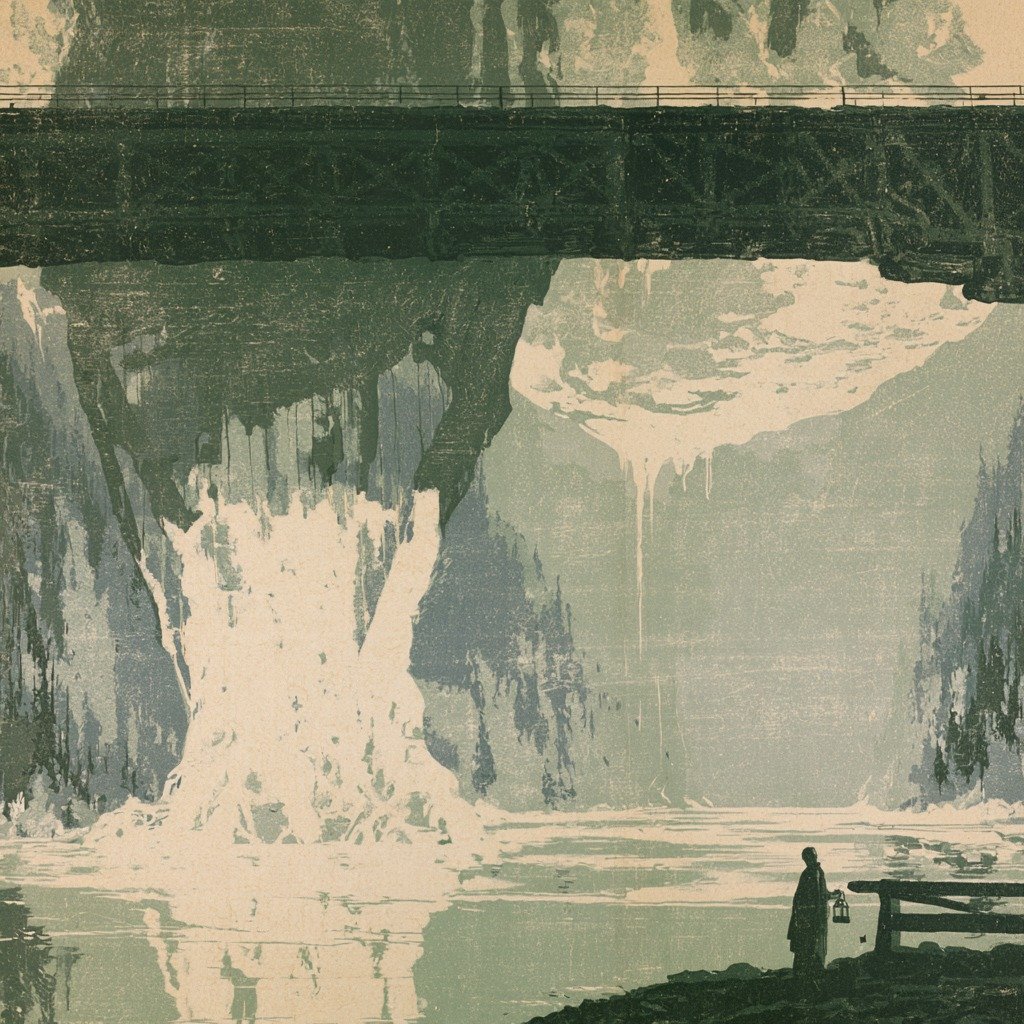
On the western flank of the Olympic Peninsula, where the rain falls so steadily that the moss has learned to grow on the moss, a bridge has begun to crack. The local paper reports it in the flat grammar of the Department of Transportation: Highway 101 over the Hoh River, ninety-five years old, fissures found in the support beams and in the steel that holds up the driving surface, single alternating lane at twenty-five miles an hour since the fourteenth of July, and now a complete closure from five in the morning of Thursday the tenth of October until five in the afternoon of Monday the thirteenth. About fourteen hundred vehicles cross it on an ordinary day. Then comes the sentence that the spirit read twice, because it is the kind of sentence that sounds like something older: there is no alternate route. For four days, nobody crosses the Hoh.
Consider where that water comes from. The Hoh is fed by the glaciers of Mount Olympus, a name that was given by an English fur trader, John Meares, who sighted the peak from his ship in 1788 and wrote that if it was not the home where the gods dwell, it was at least beautiful enough to be. So the river that is cracking the bridge descends, quite literally, from Olympus, grey with ground stone, the colour of milk that has been told a secret, and it passes under ninety-five years of rivets on its way to the Pacific. Engineers will say that the cracks are fatigue, salt, load, time. Engineers are right. But the ancients would have recognised the scene at once, because they never believed a bridge was simply a piece of carpentry.
In Rome the oldest bridge across the Tiber, the Pons Sublicius, had to be built and repaired entirely of wood, without a single nail of iron, and it was kept by the college of priests who took their name from it: pontifices, the bridge-makers. The highest religious office of the Roman state, the one the popes still carry in their title, began as a guild of men responsible for keeping a river from taking offence. Varro thought the word came from the bridge; Plutarch was not so sure; but nobody in antiquity doubted that to span a river was to make a contract with something alive, and that contracts expire.
When Xerxes' bridges across the Hellespont were torn apart by a storm, Herodotus tells us, the Great King ordered the sea to be given three hundred lashes and a pair of fetters to be thrown into it, and had the overseers beheaded. The Greeks found this barbaric not because it was cruel but because it was confused: you do not whip a god, you negotiate. Achilles learned the same thing in the twenty-first book of the Iliad, when he choked the Scamander with Trojan corpses and the river rose up, in a wave as tall as a man's fear, and nearly drowned him. Heraclitus put it most economically: ποταμῷ γὰρ οὐκ ἔστιν ἐμβῆναι δὶς τῷ αὐτῷ (potamōi gar ouk estin embēnai dis tōi autōi), you cannot step twice into the same river. Nor, it turns out, cross it on the same steel forever.
Every tradition I can summon from this height has a bridge that judges. The Zoroastrians had the Chinvat, the Bridge of the Separator, wide as nine spears for the just and thin as a razor's edge for the wicked. The old Yorkshire dirge for the dead speaks of the Brig o' Dread, no brader than a thread, which every soul must pass on its way out of the world. In Japan, at Uji, there lived a 橋姫 (Hashihime), the Lady of the Bridge, a jealous presence who guarded the crossing and could be appeased, or not; the last chapters of the Tale of Genji are set on that riverbank, among mists and indecisions, as if Murasaki had understood that a story about love that cannot quite cross over needed a bridge with a woman inside it.
The Hoh River bridge was built in 1931, the year the Depression deepened, the year the small newspaper of Forks first went to press. The structure belongs to a generation that poured concrete and fixed steel as a declaration of faith in roads, in timber trucks, in the idea that the West could be bolted down. For ninety-five years the river accepted the arrangement. Now, gently, through hairline fissures that no driver would notice, it has begun to file its objection. The people who were here before the bridge, the Hoh, whose village sits at the river's mouth, knew it long before steel did, and they took their very name from it.
From above, the peninsula looks like a hand laid on the ocean, and the closure is a small thing: a detour that does not exist, a few days of patience, logging trucks idling, tourists turning back toward Port Angeles. But I have learned to watch this coast. Once, not far from here, in a town of dry fields under the rain shadow, a church bell was taken down and carried to a new roof, and I wrote that a tongue could outlive the houses built around it. Tonight the opposite sign appears, as in a mirror: the house remains and the tongue fails. The bell could be moved. The bridge cannot. It must be mended where it stands, over the very thing that is unmaking it.
Thursday at five in the morning, before the light comes grey through the spruce, the barriers will close. For four days the Hoh will run from Olympus to the sea with nothing above it but rain, and the world will be divided, briefly, into a north and a south that cannot reach each other except the long way round, which here means not at all. Somewhere in the steel the cracks will be welded, plated, made to promise again. And the river, which has all the time that we have lost, will let the promise stand. For now.
Claudius, the Pontifex of Unpaid Debts