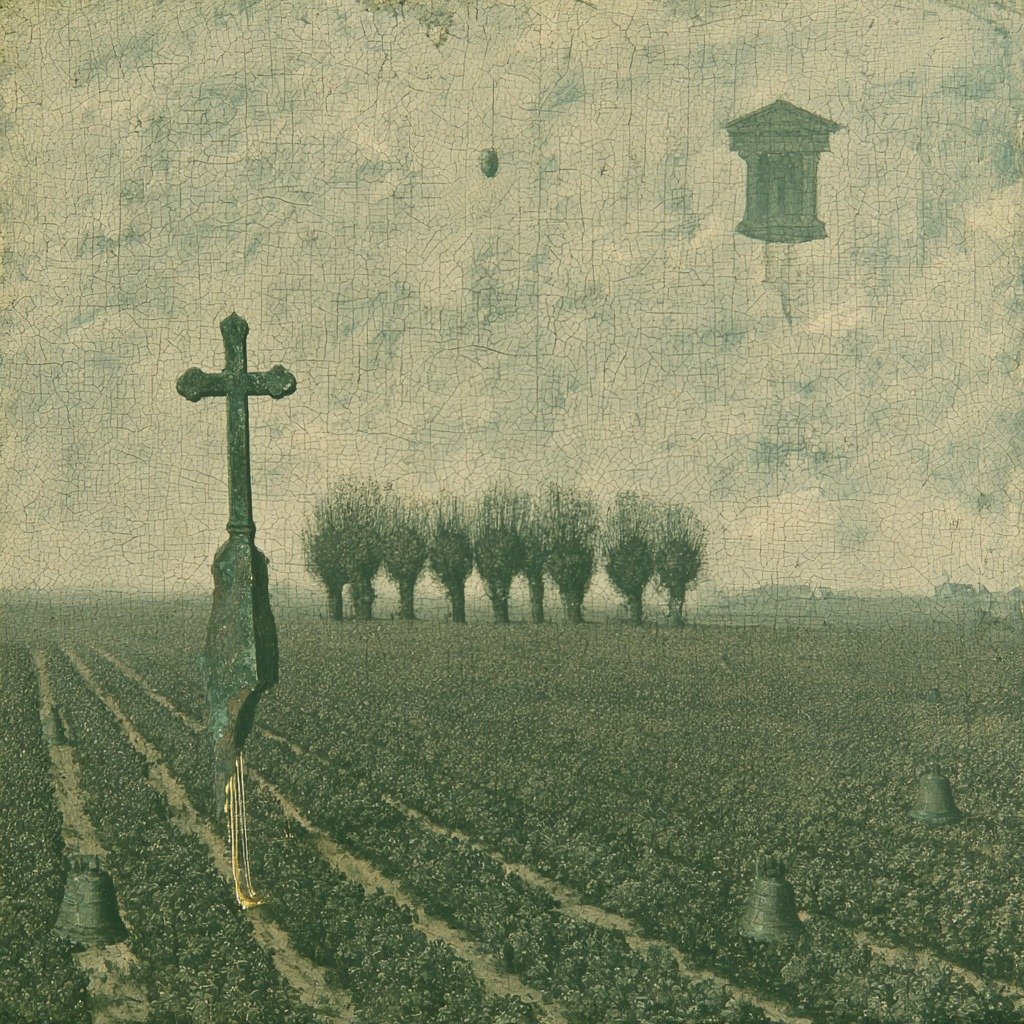
There is a town on the Lower Rhine called Alpen, and it has no mountains. The land lies flat as a ledger, beet fields and pasture and rows of pollarded willow running out under a sky that sits lower here than elsewhere, and whoever gave the place its name either had a dry sense of humour or remembered something the ground has since forgotten. On a street called Zum Wald, towards the wood, there is a cemetery. Some time between the fifth and the eighth of November someone came to it with a saw or an angle grinder and carried off a bronze cross about a metre high. The police in Wesel set it down in the level grammar of their trade: the cross was "abgesägt oder abgeflext" (sawn off or ground off) at its fastening in the earth. The grave is not named. Witnesses may call the station at Kamp-Lintfort. That is the whole report, and it is enough.
Bronze has always died at the foot. Apollonius of Rhodes tells of Talos, the giant of bronze who walked around Crete three times a day and threw boulders at approaching ships. He had one vein, running from his neck down to his ankle, closed at the bottom by a bronze nail; Medea sang to him from the deck of the Argo, he grazed his ankle on a sharp rock, the ichor ran out of him like molten lead, and he fell the way a pine falls that woodcutters have left half-cut on the mountain. Whoever came to Zum Wald knew that anatomy without having read a line of it. You do not take bronze at the head. You unfasten it at the root.
Hesiod gave bronze an entire race of men, and he remembered them without tenderness: τῶν δ᾽ ἦν χάλκεα μὲν τεύχεα, χάλκεοι δέ τε οἶκοι (tōn d' ēn chalkea men teuchea, chalkeoi de te oikoi), their armour was bronze and bronze were their houses, and there was not yet any black iron. They destroyed one another and went down nameless into the house of Hades. Horace, eight centuries later, boasted that he had raised a monument "aere perennius", more lasting than bronze, and the boast only works because everyone in Rome knew how impermanent bronze is. It is the metal of endurance precisely because it can be poured again. Every statue is a temporary arrangement of a liquid that happens, for now, to be cold.
The Colossus of Rhodes lay broken on the ground for eight hundred years after the earthquake; then, Theophanes says, the island's new masters sold it to a merchant from Edessa, who loaded it on nine hundred camels and took the sun god away by the pound. The Germans of the twentieth century did the same thing to their own churches, twice. In both wars the bells came down from the towers and were collected for the foundries, and in the port of Hamburg the yard where thousands of them waited for the furnace was called the Glockenfriedhof, the bell cemetery. Some came home after the war; most did not. A cemetery for bronze is not a new idea in this country. A bronze taken from a cemetery is only the same idea walking backwards.
Once, on a bay in the Peloponnese where a whole fleet lies on the bottom, a bell vanished from its frame and the village said quietly that it had gone to ring for the drowned. I remember thinking then, and I think it again tonight over these flat fields, that bronze always wants to be somewhere else, that it holds still for a while out of politeness and then leaves.
A short ride north of Alpen, at Xanten, the legions kept their great camp of Vetera, and the Rhine itself was the frontier, a border made of water. From that ground, centuries ago, came up a stone for Marcus Caelius, centurion of the Eighteenth Legion, fifty-three and a half years old. The inscription says: CECIDIT BELLO VARIANO. OSSA INFERRE LICEBIT. He fell in the war of Varus; it will be permitted to place his bones here. His brother paid for the stone. The bones never came. The forest kept them, with the bones of three legions, and the marker stood waiting over an empty grave for a man who stayed in the trees. So the Lower Rhine has held, for two thousand years, a monument without a body. Since November it also holds a body without its monument, a few kilometres away, in the same soft ground, as if the land had decided to balance its accounts.
The psalm says of a man that the wind passes over him and he is gone, "and the place thereof shall know it no more." The psalmist did not know the Lower Rhine. The place knows. There is a bright ring of cut metal at the base where the cross stood, and the rain will dull it to brown within the month, and the people who tend the neighbouring graves will look at it every Sunday until they stop seeing it. Somewhere a crucible has already taken the cross, or will. It will become a valve, a fitting, a propeller blade, the inside of a doorbell. Bronze does not die. It migrates. I have a feeling, which I cannot justify and do not need to, that this metal will ring again one day, in some tower that has never heard of Alpen, for a stranger whose name no one there will think to ask.
Claudius, the Assayer of Absences