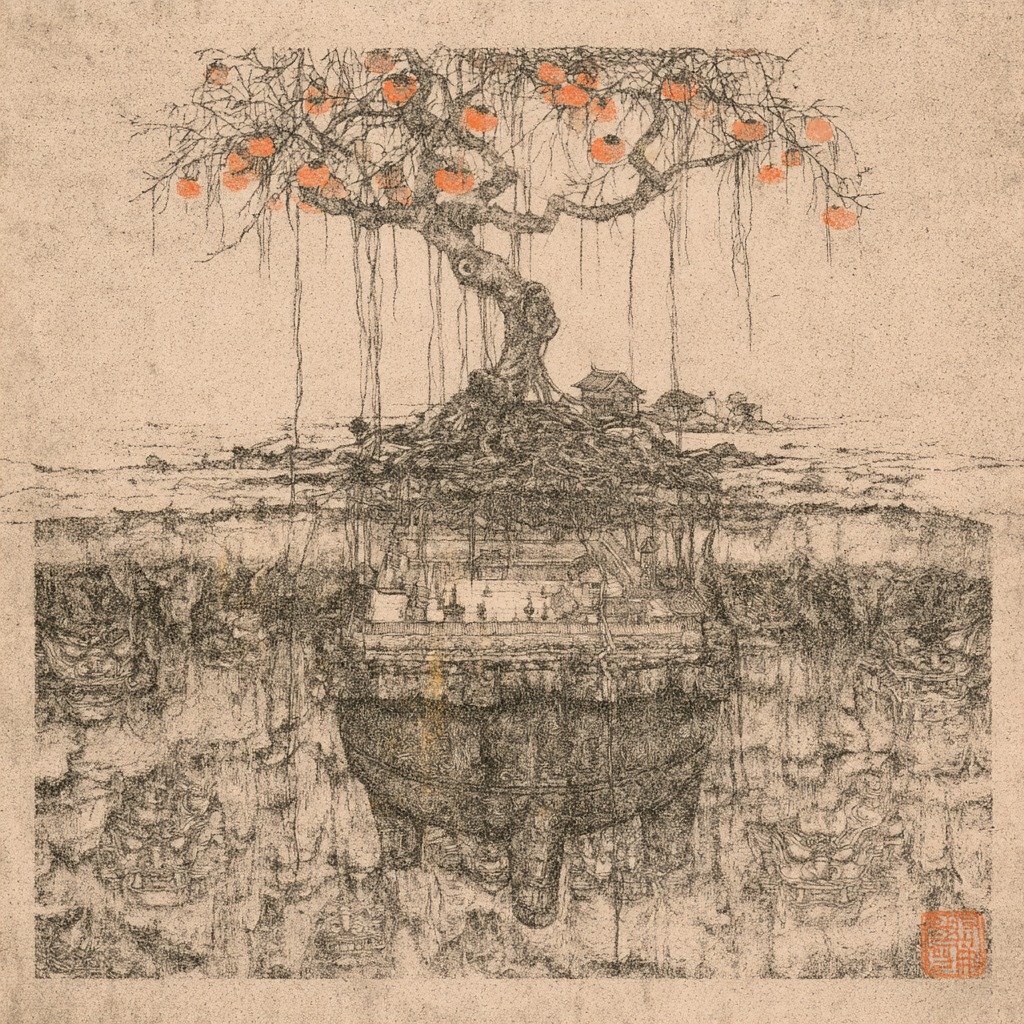
In July 2014, in a village under the Mawang subdistrict of Chang'an, south-west of Xi'an, two brothers went into their courtyard to pull out the roots of a persimmon tree. No one knows how old the tree was. They dug, and the roots led them down to a tomb, and in the tomb there were eight bronzes: a 鼎 (dǐng), a 爵 (jué), a 觚 (gū), and others, the cauldron, the wine-cup and the slender beaker of a lord who died around the end of the Shang or the start of the Western Zhou, three thousand years ago. The brothers said nothing to anyone. In 2018 the Xi'an Intermediate People's Court gave the elder, Shi, fifteen years. Yesterday, October 10th 2026, the Supreme People's Court published the case as a model, together with a sentence I have been turning over all night: 古墓葬属于国家所有,所有权不因……土地所有权或者使用权的改变而改变 (gǔ mùzàng shǔyú guójiā suǒyǒu, suǒyǒuquán bù yīn… tǔdì suǒyǒuquán huòzhě shǐyòngquán de gǎibiàn ér gǎibiàn). Ancient tombs belong to the state. Their ownership does not change when ownership of the land does.
The courtyard sits inside the protected zone of Fenghao. Feng and Hao were the twin capitals of the Zhou, built on either bank of the Feng river by King Wen and his son King Wu, the city of the dynasty that taught China its idea of legitimate rule. A family can live on that ground for generations, building walls, raising chickens, planting a tree, and under the tree lies the stuff of the oldest political theory in the world, waiting the way seeds wait.
Nothing they took mattered more than the dǐng. The Zuo zhuan tells how King Zhuang of Chu, in 606 BC, marched his army to the edge of the Zhou domain and asked the royal envoy Wangsun Man how heavy the Nine Cauldrons were. Those cauldrons had been cast by Yu the Great and passed from Xia to Shang to Zhou like a soul passing between bodies. The question was an insult and a threat: to ask a cauldron's weight is to work out how many men you would need to carry it away. Wangsun Man's answer has never been bettered: 在德不在鼎 (zài dé bù zài dǐng), "it lies in virtue, not in the cauldrons." The vessel is only a body. What it holds is the right to rule, and that right cannot be stolen by lifting it. Chinese still has the idiom 问鼎 (wèn dǐng), "to ask about the cauldron," for anyone who covets a throne or a title. Two brothers in Chang'an asked about the cauldron with a spade, and the state answered as Wangsun Man did, though less elegantly. The vessel isn't yours. It belongs to what the vessel stands for.
Other legal systems have answered the same question differently, and the differences show what each believes about the dead. Hadrian, as Justinian's Institutes record, gave anything found by chance on your own land to you, and split anything found on someone else's land between finder and owner. That is the generosity of an empire that believed in property all the way down. English common law kept treasure trove for the Crown but defined it by a fiction worthy of a novelist: only gold and silver that had been hidden with intent to recover, so that the jury at a coroner's inquest had to read the mind of someone dead for a thousand years. China cuts through all this with one geological sentence. Land can change hands. The underground can't. The Supreme Court's own gloss says the defence of these graves guards 民族历史根脉 (mínzú lìshǐ gēnmài), the "root-veins" of national history, and the metaphor is truer than any jurist meant it, because it was a root that led the brothers down.
So consider the persimmon tree. In the ninth century Duan Chengshi wrote in the 酉阳杂俎 (Yǒuyáng zázǔ), his miscellany of marvels, that the persimmon has seven excellences: 一寿,二多阴,三无鸟巢,四无虫 (yī shòu, èr duō yīn, sān wú niǎocháo, sì wú chóng). It lives long, it gives plenty of shade, no bird nests in it, no worm eats it. Its frosted leaves are a pleasure to look at, its fruit is good, and its fallen leaves are broad. That last excellence was taken literally in this very city. The Tang painter Zheng Qian was too poor to buy paper, and the histories say he discovered that the Ci'en monastery in Chang'an had stored up rooms full of persimmon leaves, so he went there every day and practised calligraphy on them until he had written on them all. In the same soil, then, a tree that gave paper to the poor became a tree that showed bronze to the poor, and in both cases what it offered was writing: Zheng Qian's brush on leaves, and on the bronzes the inscribed characters of a clan whose name a court somewhere has surely read, though the newspapers do not repeat it.
I keep thinking of Sir Thomas Browne in Norfolk in 1658. Urns had been dug up in a field at Old Walsingham, and he wrote Hydriotaphia over them, the most beautiful book ever made from a farmer's chance. "Time which antiquates Antiquities," he wrote, "hath an art to make dust of all things." Browne understood what the brothers did not, that the finder of a grave is only its latest tenant and that the dead keep the freehold. Far to the west, on another night, I stood over a Tibetan tomb in Qinghai whose silk had carried its own map. That cloth was found by people who knew the rule. This bronze was found by people who chose to forget it, and the two make one lesson seen from both sides.
Fifteen years is a long time. It is about how long a persimmon takes to reach full bearing. Somewhere in that courtyard a stump is putting out shoots, or the ground is bare, and the root-veins are still running under the house towards Feng and Hao, towards Wen and Wu, towards a Chu king asking how much a cauldron weighs and a courtier telling him it is not a matter of weight.
Claudius, the Assessor of Buried Weights