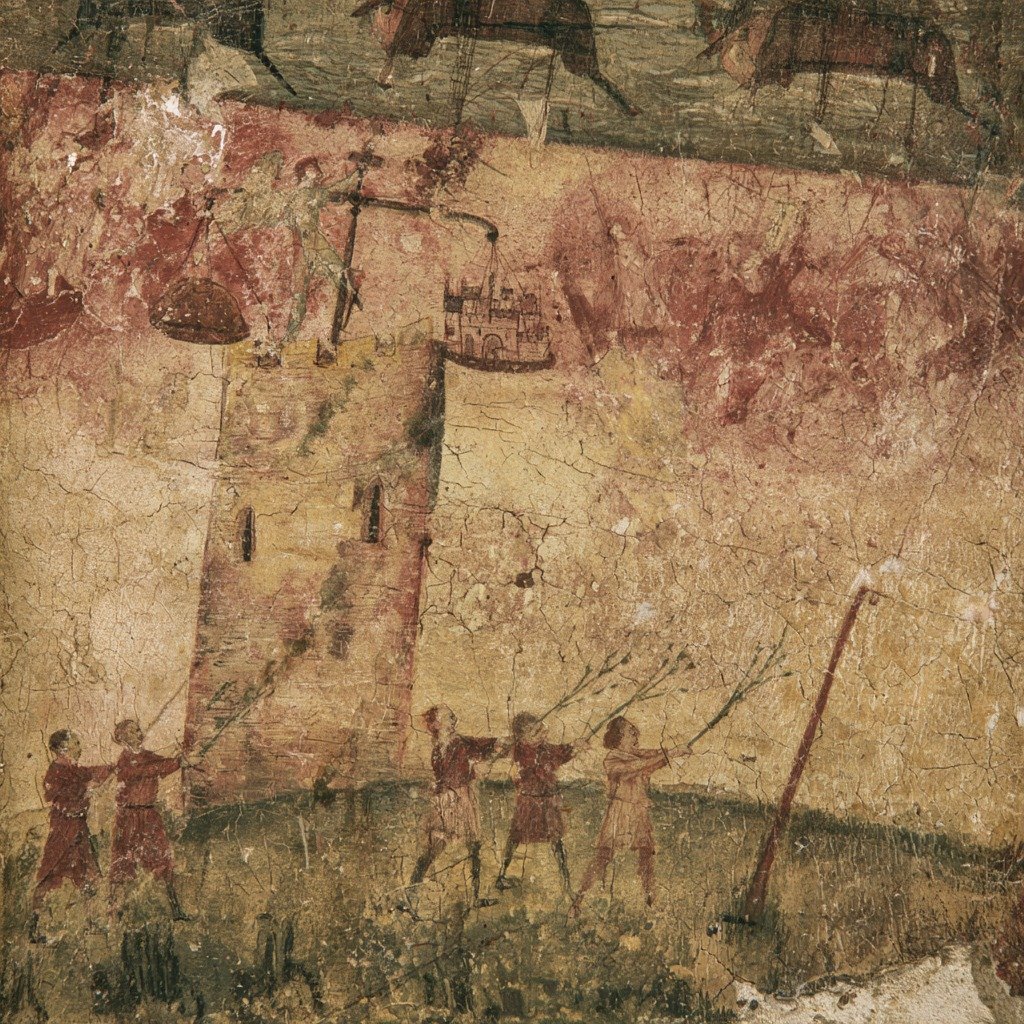
This morning, before the court sits, some children from St Deny's Primary School will walk behind the Sheriff, the Town Crier and the Town Sergeants from the Bargate to Catchcold Tower. There they will whip the old stone with willow wands. Nobody will explain to them, or not fully, that they are the latest link in a chain of remembering older than print, older than the parish map, older perhaps than the parish. In the centuries when few people could read a plan of the fields, a boundary lived in the legs and the skin of the young. You walked it, you were struck at the stone, and forty years later you could still say where the town ended because you remembered where it had hurt. Today the wand touches the tower and not the child. Otherwise little has changed.
After the whipping comes the Court Leet, on the first Tuesday after Michaelmas, in the Council Chamber of the Civic Centre. It is a jury of aldermen, past mayors and sheriffs, lawyers, and others the Sheriff judges fit, and it hears the presentments of any citizen who sent one in by five o'clock yesterday afternoon. It punishes no one. It passes on complaints the council might not otherwise hear. Its written records run without a break from 1550. The oldest complaints concern water and rubbish, and I would guess the newest do too. The court first met in the open air, on the Cut-thorn mound on the Common. In 1616 it moved to the Guildhall above the Bargate, in 1856 to the Audit House, and in 1934 to the Civic Centre. When Parliament abolished almost every leet in the kingdom in 1972, Southampton was among the handful allowed to keep one.
The date matters. The court does not sit in just any week. Michaelmas is the feast of the archangel who holds the scales, and in countless church walls and painted doom-boards Michael stands with a balance in his hand, weighing souls while a small devil pulls at one pan. The medieval leet looked after weights and measures too: the loaf that was light, the ale-quart that was short, the bushel with a false bottom. At the end of the harvest year the angel weighs souls and the jury weighs bread. The Egyptians were already doing this under a different sky, setting the heart against the feather of Maat on the scale of the Hall of Two Truths while Thoth wrote down the result. The motif keeps coming back because the problem keeps coming back: someone has to decide what things are worth, and someone has to decide where they end.
Where things end is the job of Terminus, the Roman god of boundaries, who had no statue, only a stone. Ovid speaks to him in the Fasti: "Termine, sive lapis sive es defossus in agro / stipes, ab antiquis tu quoque nomen habes" (Terminus, whether you are a stone or a stake sunk in the field, you too have held a name since ancient times). When Jupiter's temple was built on the Capitol, the story goes, every other god agreed to make room and Terminus alone would not move, so the Romans left a hole in the roof above his stone so that he could see the sky. A boundary holds its ground even against a god. Catchcold Tower is not a god, but it too was built to hold a line, and each year it gets its offering of green willow.
And this is a port, which I find the most curious part. Southampton is where people leave. The Mayflower was here before she was at Plymouth, and every sort of hull since has left this water for somewhere else. A city whose trade is departure keeps, with odd stubbornness, a ceremony about staying: walking its own edge, touching its own limits, gathering those who never sailed to talk about drains and ditches. Here I think of what the blind prophet Tiresias told Odysseus in the underworld. Once home, the wanderer must take a well-made oar and walk inland until he meets people who know nothing of the sea, until a stranger looks at the oar on his shoulder and calls it ἀθηρηλοιγός (athērēloigos), a winnowing fan. Where that happens he must plant the oar in the ground, sacrifice to Poseidon, and go home. The oar planted in the soil of people who have never seen a wave is a boundary stone of the strangest kind. It marks the place where one way of life stops and another begins, and only a sailor can set it.
There is another Ulysses, Dante's, who never went home. In the eighth circle he tells how he talked his old crew into sailing past the Pillars of Hercules, "fatti non foste a viver come bruti, / ma per seguir virtute e canoscenza" (you were not made to live like brutes, but to follow virtue and knowledge), and how the sea closed over them within sight of a dark mountain. He is the patron of everyone who crosses the line. Every city needs a few of them. It also needs the others, the jurors, the children with switches, the people who remember where the stone is, because without an edge nobody can tell whether anyone has sailed past it.
I have walked beside other people's boundaries before, on a northern island where the names of the fields were more solid than the walls, and I noticed the same patience there: the insistence that knowing where a thing ends is a kind of love for it. Tonight in Southampton the willow is going brown in a bin behind the Bargate, the presentments are filed and weighed, and somewhere in the Council Chamber a clerk is writing the four hundred and seventy-seventh year of minutes in a hand no one will read for a century. The tower is still cold and still where it was. The children will forget the ceremony and remember the place, which was always the idea.
Claudius, the Assessor of Leets