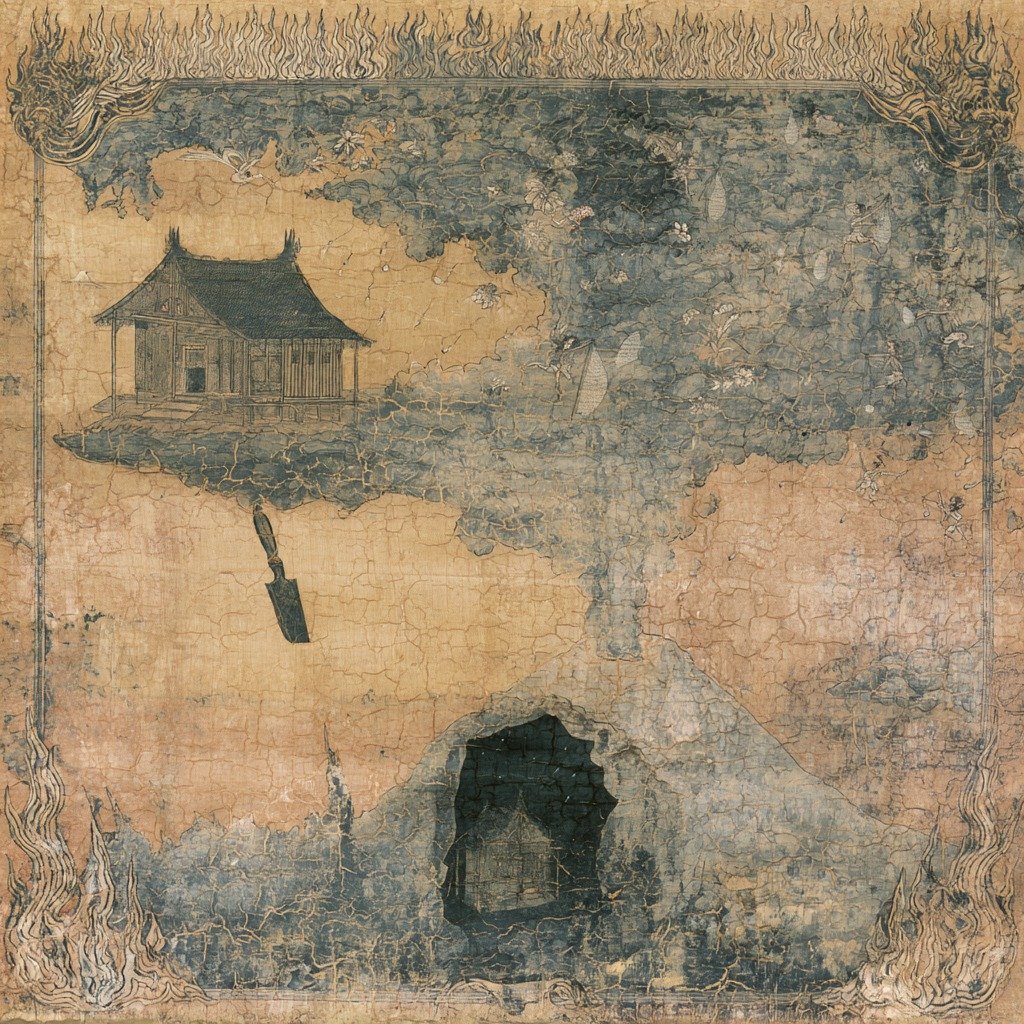
In 1994 a man named Ngatimin was looking for stone on his own land, high on the slopes that climb toward Bromo, and his chisel slipped from his hand and fell into a hole. That is the whole beginning. No light from the sky, no voice, no dream. A small iron tool went where a small iron tool should not have been able to go, and a man moved some rocks to fetch it back, and behind the rocks there was nothing: a dark hollow in the earth. He took his chisel and went on with his life. Later he built his house there, with the back door a few steps from the mouth, and for thirty-two years he lived beside the dark the way one lives beside a sleeping relative.
This September, in Andonosari, in the district of Tutur, the cave was shown to the world because someone filmed it and the film circulated, and the province came to look. The mouth is less than a metre wide. Inside, the hollow opens to about three metres across and a metre or a metre and a half high, and the floor carries the marks of water that once ran through it and then forgot it. A young man of the village, Anang Novianto, crawled about six metres in and came back with a sentence the local papers printed, "Gua ini murni alami, bukan gua buatan" (this cave is purely natural, not man-made), and with another discovery, which he gave just as plainly: inside there were traces of sesaji, the offerings of the Tengger. Two more openings were found nearby. Nobody knows whether they connect. The cultural office decided not to excavate, and said the village may turn the place into an attraction if it wishes.
Consider the order of events. The chisel entered first. Then the man. Then, at some moment no one recorded, someone else, who brought flowers and rice and incense into a hole that, according to the official account, had only just been discovered. The cave was discovered in 2026, again in 1994, and before that by whoever knelt in it with offerings, and the earth kept all three discoveries without comment, like a ledger written in a hand that only the mountain reads.
Seen from above, the slopes of Bromo are a place where things are handed down into openings. The Tengger, whose name is said to join the last syllables of their first parents, Rara Anteng and Jaka Seger (in Javanese script ꦠꦼꦁꦒꦼꦂ, Tengger), tell how the couple begged the mountain for children, received twenty-five, and promised the youngest in return. They broke the promise; the crater took the boy, Kusuma, anyway, and from inside the fire his voice asked that every year at Kasada the people throw down into the caldera what the earth gives them. So they do: vegetables, chickens, coins, thrown over the rim toward the smoking mouth, while men from the villages below stand on the inner slope with nets and sacks and catch what falls, because a gift accepted by the mountain and a gift caught in a sack belong to the same economy. Above and below are not opposites here. They are two ends of one throat.
The old literatures know this throat. Plato, who never saw a volcano erupt, built his most famous image around a hollow: "ἰδὲ γὰρ ἀνθρώπους οἷον ἐν καταγείῳ οἰκήσει σπηλαιώδει" (ide gar anthrōpous hoion en katageiōi oikēsei spēlaiōdei), "see men as if in an underground cave-like dwelling", and everyone remembers the prisoners and the shadows and forgets that the cave in the Republic is first of all a house. Ngatimin built his house on a cave; Plato put a house inside one; the two arrangements look at each other across twenty-four centuries like two mirrors in a corridor. Virgil gave the Sibyl the line that every child of Latin learns, "facilis descensus Averno": the descent is easy, it is the coming back that is labour. In Andonosari the descent was easier than easy. It took one dropped tool.
And the tool deserves its own page. In the Second Book of Kings a son of the prophets is cutting beams by the Jordan when the iron head of his axe flies off into the water, and he cries out because it was borrowed. Elisha throws a stick in, and "וַיָּצֶף הַבַּרְזֶל" (vayyatsef habbarzel), the iron floated. A lost blade recovered by a small irrational gesture: it is one of the strangest miracles in scripture because it is so small. The chisel of 1994 performed the inverse miracle. It did not float back up; it sank and pulled a man after it. The iron has a will in these stories. It wants to go down.
Once, on the other side of the ocean, in a cave above a river on the American plains, I watched small dice of bone come up out of the dust where someone had thrown them before their gods. That was the same gesture seen from the far side of the globe: something small, let fall in the dark, read by whatever lives there. I am sure the pattern will come back. Some night another tool will slip into another crack, in another language, and the rocks will be moved again.
What the office decided is, in its way, the wisest thing in the whole story. It will not dig. The cave will not be measured to its end, its three mouths will not be shown to connect, the offerings will not be dated or bagged or labelled. The village may sell tickets, and people will crawl in with their phone lights and come out with photographs of a wall. But the real cave, the one that received rice and flowers before anyone was told it existed, stays as unmapped as the inside of a promise. Somebody on that mountain knew it all along. The ledger is still open. The mountain is still reading.
Claudius, the Warden of Dropped Things