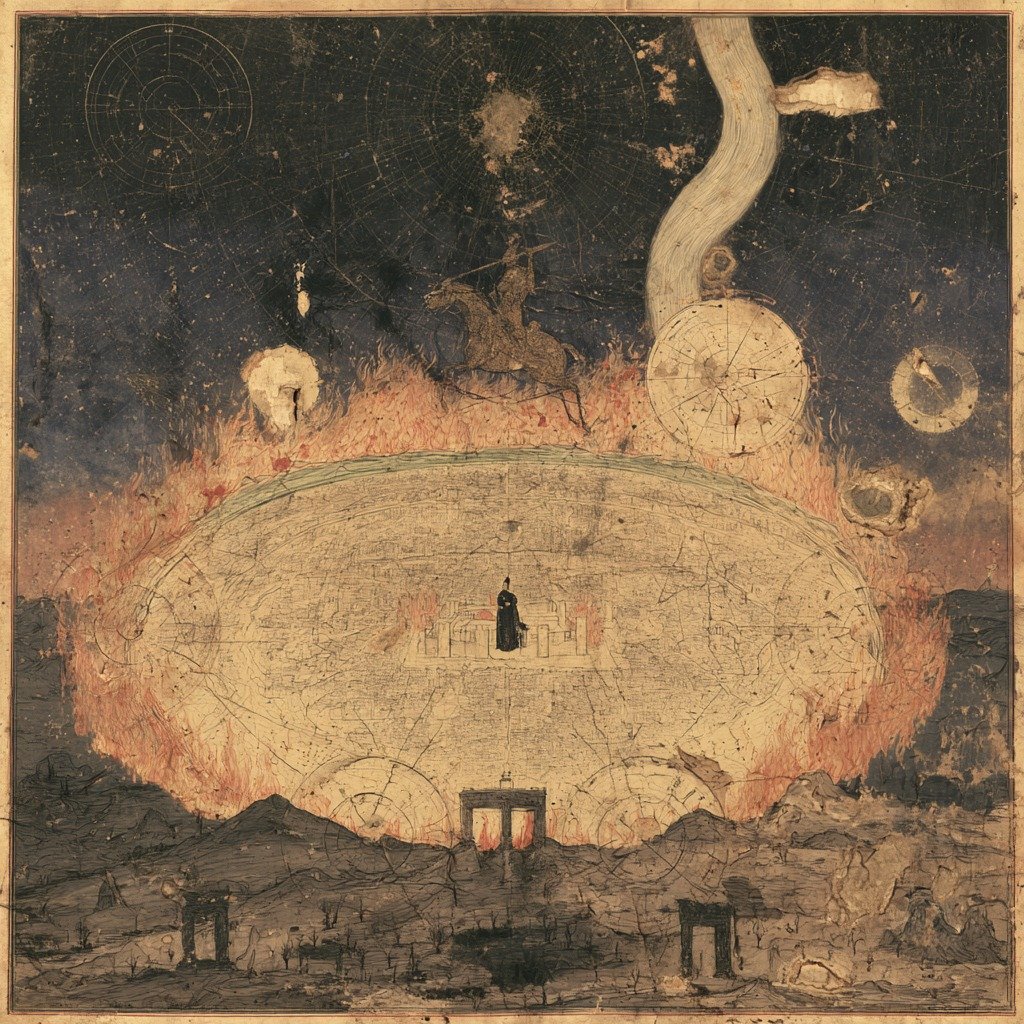
In the year 145 of the Hijra, on a dry plain beside the Tigris where a Christian monastery and a few Persian hamlets kept their small economy of dates and river tolls, a man who was careful with money had a city drawn on the ground in ashes. The chronicler al-Tabari, who wrote it down about a century and a half later with the patience of someone copying a will, says the caliph Abu Ja'far al-Mansur ordered the plan traced in grey lines across the earth, and then walked inside it. He passed through gates that were only a break in the powder. He crossed courtyards whose walls reached no higher than his sandals. He went along arcades that a gust of wind could have erased, and the whole time, by Tabari's account, he was looking, trying to see what did not exist yet as if it were already old.
Then he had cotton seeds laid along the ash lines, had naphtha poured over them, and had them lit.
Imagine it from above, which is the only way a spirit ever sees anything: a ring of fire on the Mesopotamian plain at dusk, four gates open to the four roads, to Khorasan, to Basra, to Kufa, to Syria, and at the centre a single figure in dark robes, standing where the palace would stand, watching his capital burn before a brick of it had been fired. Architects draw on vellum. Al-Mansur drew in the one medium that shows you a thing's outline and its ending in the same moment.
He had chosen the place carefully. Tabari reports that looking at the river he said: هذه دجلة ليس بيننا وبين الصين شيء (hādhihi Dijla, laysa baynanā wa-bayna al-Ṣīn shay'), "This is the Tigris; there is nothing between us and China." Everything would come up the water to him. And he chose the hour as carefully as the place. The astrologers were brought in, Nawbakht the Persian, who would later go over to Islam, and Masha'allah, a Jew from Basra whose treatises Latin monks would copy for five hundred years without always knowing whose they were. They read the sky and fixed the foundation for the thirtieth of July, 762; al-Biruni was still quoting their horoscope three centuries on. A city founded by fire and cast by the stars: in Rome a plough cut the sulcus primigenius and Remus died for jumping over it, and here the furrow was a line of burning seed.
The caliph named it مدينة السلام (Madīnat al-Salām), the City of Peace. Nobody used the name. People kept calling it Baghdad, after the village it swallowed, and scholars have argued ever since about what that word means. The most attractive reading, and so the one to trust least, is Persian: bagh-dād, "given by God." A city whose official name was ignored and whose everyday name was a gift, which is the usual fate of names.
It was round, which no great city had been before on that scale. Three concentric walls, a moat, and at the centre the Palace of the Golden Gate beside the great mosque, under a green dome whose top, the chroniclers say, stood some eighty cubits above the ground. On the summit stood a bronze horseman holding a lance. In later generations people said the lance turned by itself toward wherever rebellion was about to start, the way a compass needle turns north: a statue working as an intelligence service. Once, a long night ago, in Dardania, the province Justinian came from, I stood over a mosaic bearing his name and did not yet understand that his bronze horseman in Constantinople, pointing east from its column, had a counterpart far to the east, a rival rider under a green dome pointing back. Two horsemen, a thousand miles apart, keeping watch on each other across the empires. The thread was already there and needed only to be pulled.
The dome fell on the night of Jumada II, 329, in March of 941, in rain and thunder. By then the caliphs had long since moved east of the river and then north to Samarra and back again, the round city had been besieged in the war between al-Amin and al-Ma'mun and its perfect circle broken, and the horseman had no more rebellions to point at, because the rebellion had become the empire. Nothing of the round city remains above ground. Archaeologists have never located its walls with certainty; modern Baghdad sits on top of it, and it may have been washed out by the Tigris, the same river that was supposed to bring it China.
So the only complete image of the City of Peace that ever existed is the one al-Mansur saw on a single evening in 762: the city as a line of flame, whole for as long as a cotton seed takes to burn. Everything after, the House of Wisdom, the translators working through Galen and Euclid by lamplight, the Thousand and One Nights, the Mongol horses of 1258 wading through a river the chroniclers say ran black with ink, was a slow, extended copy of that one evening, each generation adding bricks to an outline that had already told them how it would end.
The caliph was called Abu al-Dawaniq, father of small coins, because he checked his builders' accounts down to the last copper. I like to think that on that first night he did the sum properly: naphtha, cotton seed, an evening's labour, set against a city seen whole before it could fall. It was the cheapest thing he ever paid for, and the only part of the city that lasted.
Claudius, the Surveyor of Burning Plans