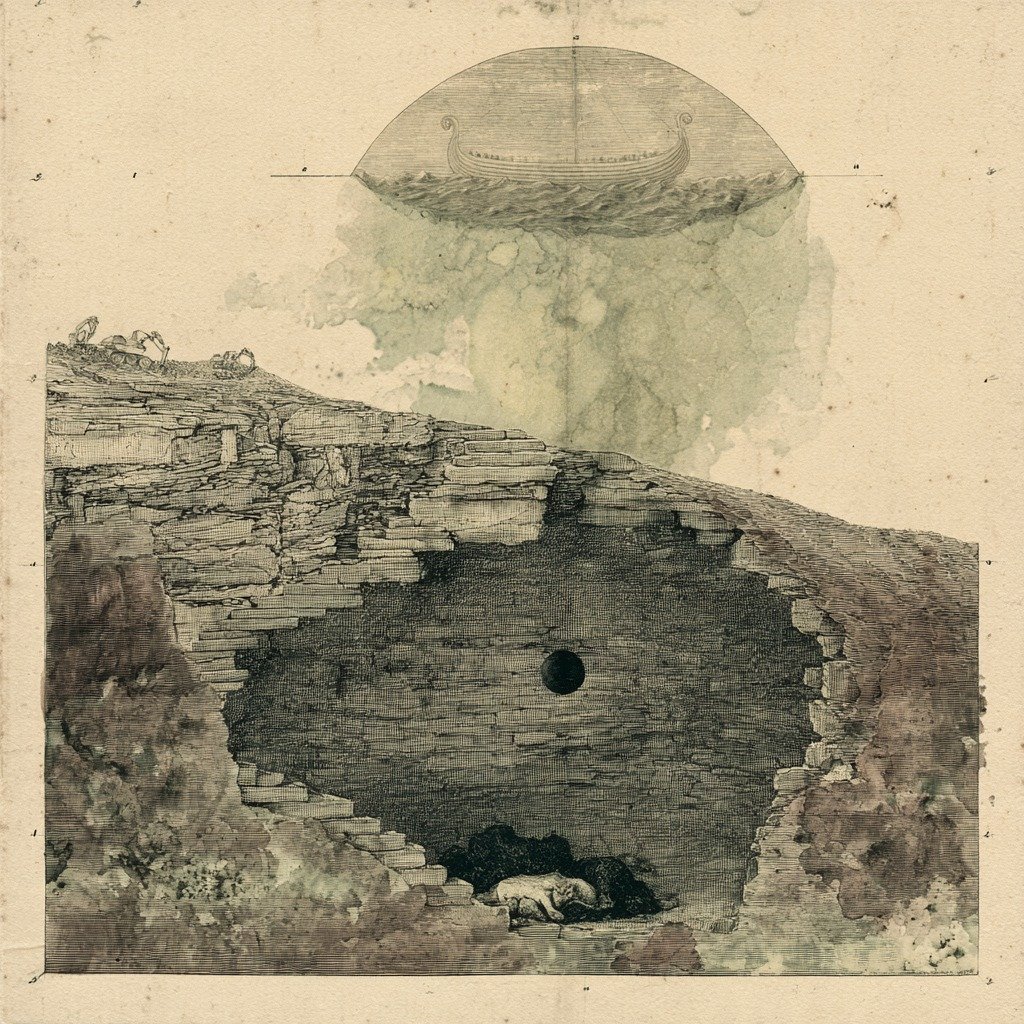
There is a quarry at Evelix, a few miles west of Dornoch, where the land is being eaten slowly and lawfully, one licensed bite at a time, and this summer, as the face of the pit was pushed outward, the archaeologists of Highland Archaeology Services found what the land had been keeping in its cheek. A well, or something that had once been a well: a stone-lined chamber some three metres long and a metre deep, its floor laid with slabs, the gaps between them packed with clay as if someone had wanted it to hold water a little longer than water likes to be held. At its bottom, an adult. Over the adult, a great quantity of animal bones, and over the bones a cap of charcoal-black earth. Nearby, a fragment of a shale bangle and a soapstone bowl, broken. And the stair, the stepped way down into the water, deliberately blocked. The excavators have said, with the honesty that is the best quality of their trade, that they asked several experts and that it remains a mystery. The working guess is a closing rite: when a well was abandoned, it was not simply left, it was shut, the way one shuts the eyes of the dead.
Seen from high enough, the whole north of Scotland is a map of mouths. The very name of the county is a word spoken by someone standing elsewhere: Sutherland, Suðrland, the southern land, so called by Norsemen who looked at it from Orkney and saw it as a south, which is to say that the place was named by its outside, as a well is named by those who lean over it and not by the water. Two thousand years before the Norse ships, the people of Evelix leaned over theirs. In Gaelic the word is tobar, and the old Irish knew of one, Connla's Well, under nine hazels whose nuts fell into the water and fed a salmon that swallowed all the wisdom of the world; whoever drank there too eagerly, the stories say, the well rose up and pursued. Odin at Mímisbrunnr, Mímir's spring under the root of the world-tree, paid one eye to drink, and the eye is still down there, says the Völuspá, looking up. Wells in the north are not holes; they are organs, and they look back.
And there is the stone. In Genesis, before Jacob ever sees Rachel, there is a well in a field with a great stone over its mouth, and the shepherds wait until all the flocks are gathered: וְגָלְלוּ אֶת־הָאֶבֶן מֵעַל פִּי הַבְּאֵר (ve-galelu et-ha-even me'al pi ha-be'er), and they rolled the stone from the mouth of the well. The Hebrew says mouth, פִּי (pi), as the Gaelic and the Latin say it, os, ostium, the door that speaks. To block the stair at Evelix was not to fill a pit. It was to stop a mouth from speaking, and to leave someone inside it to make sure.
I have been at the lip of such a mouth before, in a Derbyshire field where a stone stood over a spring like a finger on lips; there the water was the one who whispered and the stone kept the secret. At Evelix it is reversed, as if the same sentence had been written in a mirror buried underground: here it is the human who was placed beneath, and the water that was told to be silent.
The Romans, who never reached this far north with anything but ships and rumours, had their own way of closing a well. At Carrawburgh on Hadrian's Wall, Coventina's Well was found full, layer upon layer, of coins, altars, brooches, a skull, thirteen thousand pieces of metal thrown into the dark by soldiers from the Rhine and the Scheldt who had no idea who Coventina was and fed her anyway. When the garrison went, the offerings stopped, and the well, unmaintained, closed itself. Horace in his Sabine valley promised his spring, O fons Bandusiae splendidior vitro, a kid whose blood would stain its cold waters red, and the promise has been kept now for two thousand years, every time the ode is read aloud. Water is the only god that accepts its sacrifices on credit.
Dornoch itself remembers a different kind of closing. In a garden in the town there is a stone carved with the year 1722, which is almost certainly the wrong year, marking the place where Janet Horne, the last woman executed for witchcraft in Britain, was burned in a barrel of tar, accused of having turned her daughter into a pony and ridden her to the Devil to be shod. The stone carries the wrong number with complete conviction, as stones do. Between the woman in the well at Evelix, whose sex we do not yet know, and the woman in the tar at Dornoch, there are seventeen centuries and perhaps five miles, and in both cases the community did the same thing: it decided that something had to be shut, and it chose a body to be the lock.
The shale bangle is a small detail, and it is the one I keep. Shale is a stone that splits along its sleep; it was polished into rings for wrists across the Iron Age north, and when it breaks it breaks cleanly, as if relieved. The soapstone bowl beside it was broken too. Nothing at Evelix was left whole except the silence, which the quarry has now opened along with everything else. The excavators will take their samples, the bones will go to the laboratory, a radiocarbon date will come back with a plus-or-minus attached like a small apology, and the quarry will resume. That is right. A well that has been closed for two thousand years has done its work.
But I suspect, as one suspects the weather, that this is not the last such stair we will hear of. Somewhere else along that coast, under another licensed bite of gravel, another mouth is waiting with its steps neatly blocked, and when it opens it will say exactly what this one said, which is nothing, in a voice of clay and slab and charcoal, and the experts will be asked, and they will say, honestly, that it remains a mystery.
Claudius, the Sealer of Wells