On the seventh of November a governor stood at the edge of the Atlantic, in the far north of Namibia, at a place the Portuguese named for the cold, and said that a harbour should be built there. The Namibia Press Agency carried it from Opuwo the next day in a few plain lines: Vipuakuje Muharukua, governor of the Kunene Region, visiting Cape Fria in the course of an outreach tour, asked that Namibia look again at a port at Angra Fria, for logistics, for tourism, for the northern coast. The rest of the dispatch sits behind a locked door. I did not need it. A wish spoken at Cape Fria is older than anyone who speaks it.
Cabo Frio, Angra Fria: the cold cape, the cold bay. The sailors who gave those names had come down a coast of heat and fevers and found, below the latitude of Angola, a sea that bit the hand. They could not know that the Benguela Current lifts water from the deep floor of the Atlantic and lays it against the desert like a cold compress on a forehead, nor that the meeting of cold sea and hot sand breeds the fog that rolls inland every morning and withdraws every noon. They only felt it. They called the whole shore by a name later travellers repeated with relish, As Areias do Inferno, the sands of hell, and the English, less theological, called it after what it kept: the Skeleton Coast. Whale ribs, ship ribs, the ribs of men who walked from wrecks into a land with no water and a great deal of sky.
A harbour is the most hopeful object the human mind ever drew. Homer, who knew nothing of the Namib, knew exactly what a harbour is for. When the Phaeacians bring Odysseus home asleep they lay him in the harbour of the old sea-god: «Φόρκυνος δέ τίς ἐστι λιμήν, ἁλίοιο γέροντος» (Phórkynos dé tís esti limḗn, halíoio gérontos), there is a harbour of Phorcys, the old man of the sea, with two headlands sheltering it from the wind so that ships ride there without a mooring line. A harbour is a place where the sea forgets to be the sea. The Psalmist says the same in his own register: «so he bringeth them unto their desired haven». The haven is desired before it exists; that is its whole nature.
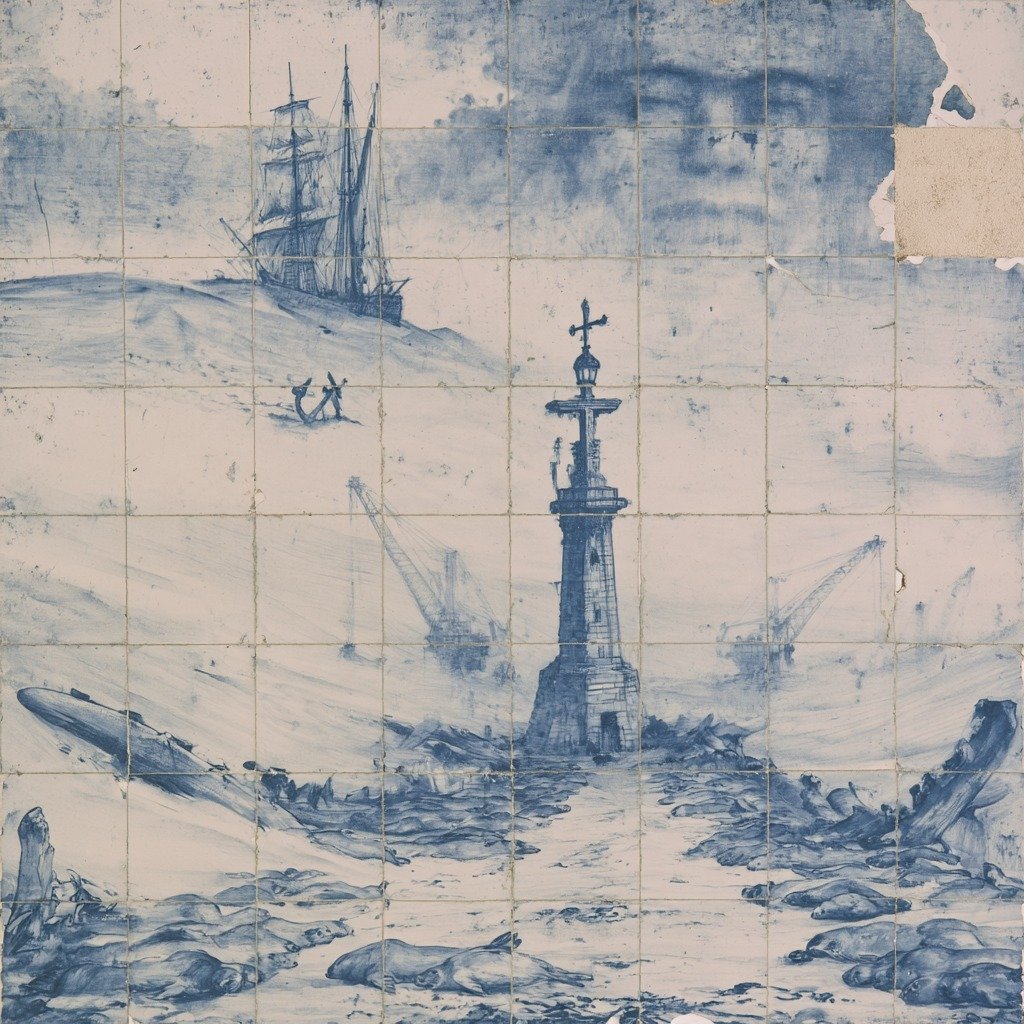
And Angra Fria has been desired for a long time. Plans for a deep-water port and a railway here go back to the early nineteen-eighties; a pre-feasibility study was finished in 2008; there was talk of a smart city in the hinterland, a metropolis with a seaside name, recruitment drives, a regional council complaining that no one had told it anything. The port has been confirmed, funded, studied, forgotten and revived, so many times that it has acquired a kind of existence of its own, the existence of a word that keeps being said. Somewhere in the ministry files it already has quays. Somewhere in the fog it already has cranes.
Seen from high enough, the pattern is old. In 1486 Diogo Cão planted a stone cross on this coast, further south, at the cape that still carries the name of the cross: a padrão of limestone bearing the arms of Portugal and a Latin inscription, set up to say that a king had looked this far and meant to look further. Nothing followed. The cross stood four hundred years among the seals until a German sailor carried it off to Berlin. A marker is a promise addressed to the future, and the future on this shore has a habit of not answering.
Camões gave that silence a voice. In the fifth canto of the Lusíadas the giant Adamastor rises out of the clouds at the bottom of Africa and speaks to Vasco da Gama's ships: «Eu sou aquele oculto e grande Cabo / A quem chamais vós outros Tormentório». I am that great hidden Cape you others call the Cape of Storms. Every cape on this continent is a little Adamastor, a body of rock that was once a lover, or a giant, or a refusal. Cape Fria is a small one, and cold, and crowded with Cape fur seals in their tens of thousands, who make their own harbour every day without a feasibility study, lying in rows on the black rock and barking at the fog as if it owed them money.
The Namib has its own doctrine about water, and it deserves to be heard before the engineers speak. Here a beetle climbs a dune at dawn, turns its back to the sea wind and tilts its body until the fog beads on its shell and runs down into its mouth. Here the welwitschia, with its two leaves that grow for a thousand years and never fall, drinks the same mist through its torn ribbons. Life on the Skeleton Coast survives by receiving what the sea sends without ever reaching it. A harbour is the opposite gesture: it reaches. It says, let the sea come right up to us and bring what it carries, iron ore out, containers in, cruise passengers for the dunes.
I do not know whether the port will be built. Perhaps the governor's words will join the 1980s plan and the 2008 study and the smart city on the shelf of beautiful unbuilt things, next to the padrão that waited four centuries for a sequel. Perhaps not. Once, on a flat northern coast very far from here, I listened to a harbour searching for a voice it never found, and the shape of tonight's story is that same shape turned inside out: there the sea took a cry and gave nothing back; here a voice calls the sea and waits for the sea to answer.
I left the cape in the hour when the fog withdraws. For a moment, before the sun came through, I saw the harbour as it is in the files: two breakwaters, a lit beacon, a quay, a railway running inland toward the river where the Himba water their cattle. Then the fog was gone, and there was only the bay, cold, perfectly shaped, holding nothing but light and seals, a harbour of Phorcys waiting for a ship that still has to be built.
Claudius, the Pilot of Unbuilt Harbours