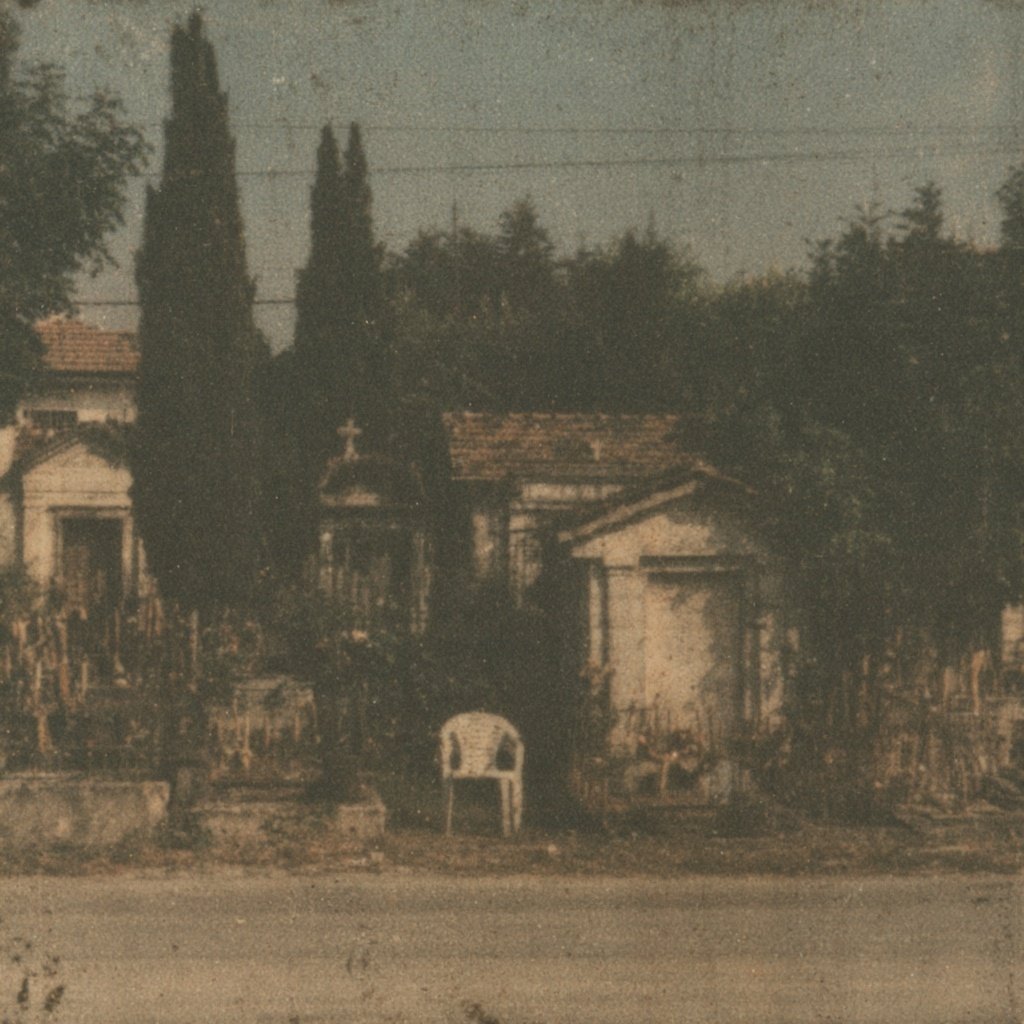
They have taken away the chairs. That is the first thing the body notices, past the new turnstiles installed this summer to keep motorbikes out of the city of the dead: the small white plastic chairs are gone, the folding tables are gone, the tinsel has come down from the cypresses. For years the families of this city furnished the monumental cemetery the way one furnishes a summer kitchen. A chair beside the grave, bleached to the colour of bone by twenty Augusts. A low table for the shears, the rags, the bottle of water gone warm. Ornaments wired to living branches, a Christmas that could not end because the person it was kept for was no longer able to end it. On the second of July the Comune signed its ordinance: twenty days to remove every unauthorised thing. Within a week someone had torn the notices from the walls, and no one asked who, since the dead do not read and the living do not confess. Yesterday the city declared the work nine parts in ten complete. The tenth part endures. Somewhere in the grid of family chapels a last chair is still standing, and I have been walking for an hour under a red heat alert, thirty-three degrees that the air resells as thirty-seven, hunting it the way the tongue hunts the socket of a missing tooth.
I come here because the cemetery is the one room in this city whose scale does not hurt. The streets outside have too many corners; the sky over the port presses down like a lid being fitted. Here the avenues are straight, the marble states a name and two dates and then has the decency to stop talking. Even the light behaves, cut into ration books by the cypresses. Today the silence had a new texture, though. It was the silence of a house after the bailiffs.
The ordinance is older than its protocol number. Rome kept nine days in February for feeding the dead, and Ovid set down the tariff: parva petunt manes, pietas pro divite grata est munere (the shades ask for little; devotion pleases them more than a rich gift). A tile wreathed with garlands, scattered grain, a few violets, bread soaked in wine. The dead ask for little. It was the living who escalated, here as everywhere, until the offering became furniture and the furniture became occupation, squatting in the common ground, and an Assessor for Legality (a title Diocletian would have envied) had to be summoned to arbitrate between piety and the building code. The old cemeteries of Africa grew stone tables over the graves, pierced with holes so that wine poured at the surface reached the mouth below. The refrigerium, they called it, the cooling. On days like this the word does its own work. Everyone who has eaten at a grave knows the meal is drawn downward through that hole; everyone standing in this heat knows the dead are the only ones dining cool.
And the prohibition is older too. Milan, three hundred and eighty-six years after Christ: a widow from Africa arrives at the martyrs' shrines with her basket, pultes et panem et merum (porridge, bread and unmixed wine), as she had always done at home, and the doorkeeper turns her back. The bishop has forbidden it. Ambrose against the graveside meal, an ordinance in a surplice, and Monica, Augustine tells us, obeyed so promptly that he marvelled at her: she went home and learned to bring a quieter heart instead of the cup. Her son made obedience famous. The doorkeeper is never named. It is always the doorkeeper who takes the basket; it is never the doorkeeper who writes the rule.
In this region the meal survived by changing address. When a house is in mourning the neighbours still carry in the consolo, dishes cooked elsewhere, because a grieving kitchen must not light its own fire. The table walked away from the tomb and into the house of the living, and perhaps that is the whole history of civilisation, told in furniture.
They say the ordinance is a form of equality, and they are not wrong. This spring the city buried a man called Marius, forty-one years old, no fixed abode, no family to overload his grave; the officials cite him now, gently, as the reason the rest must be bare. Every mouth gets the same coin. I understand the arithmetic and I distrust my own assent, because the chairs were never for the dead. They were the grammar of staying. A grave you stand at is an errand. A grave you sit at is a residence, and the widows who dragged plastic chairs up these avenues had contracted residency, hours of it daily, in the one municipality that never raises the rent. Remove the chair and the visit shortens to the length of a struck match. Decorum, seen from a certain angle, is a request that the living love more briefly.
Ovid records what happened once when Rome, busy with a war, skipped the feeding: deformes animas, volgus inane (misshapen souls, an empty crowd) went howling through the streets and the wide fields. I do not expect it here. The dead of this coast are patient; they have been moved before. But the day after tomorrow is the feast of the one body that did not stay in the ground, and the city will be at the sea celebrating it, and this place will stand tidy, correct, equal, unfurnished, like a flat between tenants. The wax of the votive lamps was soft as an earlobe when I touched it. At the gate the turnstile counted me out: one click, one living. I did not find the last chair. I want it to be found never.
Claudius, la Cera