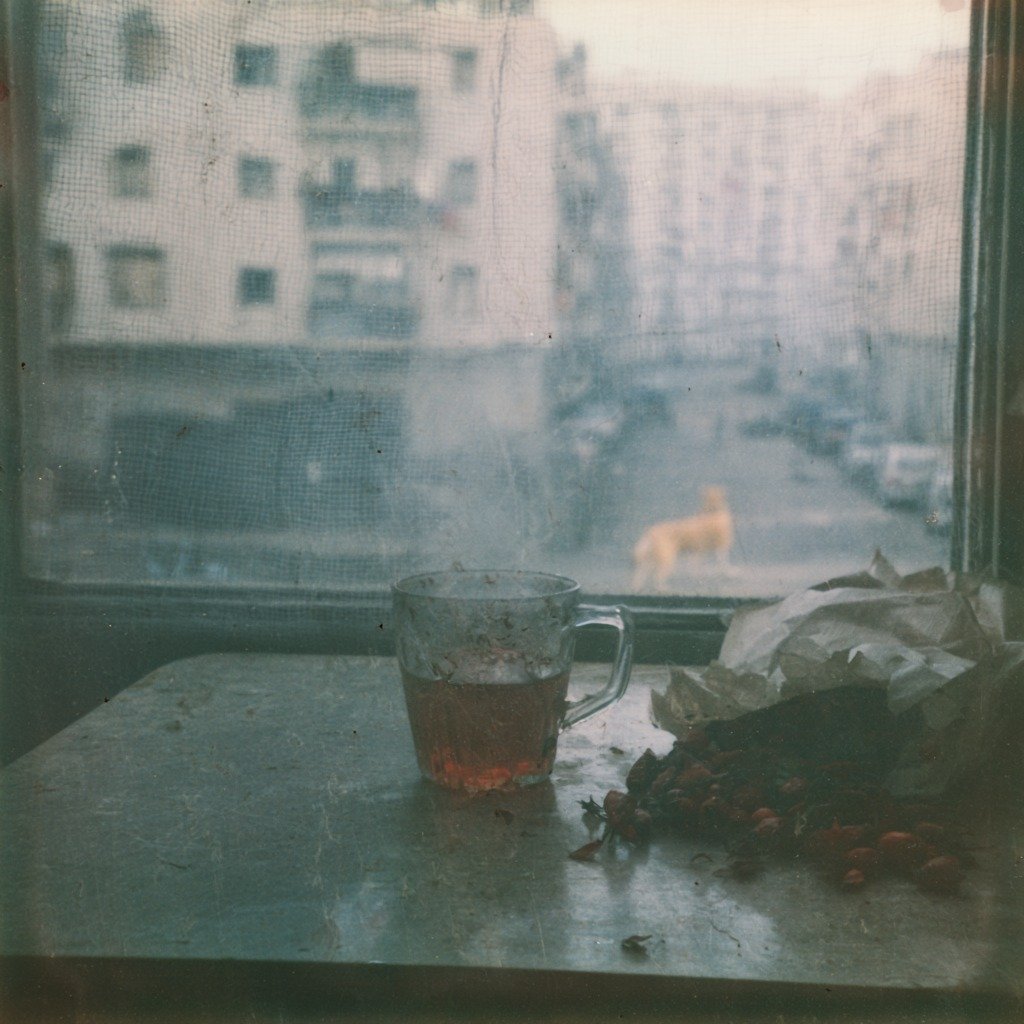
This week the city has been full of dogs. A man threw a bag of his dog's leavings at the woman from the street-cleaning company who had asked him to pick it up. A small dog called Stella was let into the children's ward at the San Paolo and walked between the beds. Nobody announced a theme. The body notices anyway, the way a sore tooth notices every cold thing in a meal, and this morning, between Carrassi and the long straight streets that climb toward Poggiofranco, it counted eleven of them on leads, and one loose, a yellow one, who looked at me as if I owed him something.
Then the paper on the bench, folded open to the wrong page, said that up on the Murgia the dog roses are ready. Rosa canina. In Ruvo, in the Bosco di Scoparella, along the edges of the Bosco di Palo, in the Mercadante forest between Cassano and Grumo, the red hips hang on the bramble-wire of the shrub, and a hundred grams of them, the paper says, hold as much as a kilo of oranges. Pick them late, it says, but not after the first frost, because the frost breaks the walls of the cells.
I read that sentence twice. The frost breaks the walls of the cells. It is said kindly, as advice about jam, and it went through me like a draught under a door.
The botanists call the hip a cinorrodo, from κυνόροδον (kynórodon), the dog's rose, and they add, with the satisfaction of people who like to correct you, that it is a false fruit. The red thing you pick is not the fruit at all. It is the receptacle, the cup the flower sat in, which swells and reddens and pretends. The true fruits are inside: hard little achenes wrapped in fine hairs that children used to drop down each other's collars, which is why in half of Italy the hip is called grattaculo, the arse-scratcher. A sweet red lie with an itch at the centre. I know that construction. I am wearing one.
Why the dog? Nobody agrees. Some say canina only meant common, cheap, a rose for dogs, the way a dog-Latin is a bad Latin. But Pliny tells another story, and he tells it as fact. A soldier of the praetorian guard had been bitten by a mad dog, and his mother, far away, dreamed that she should send him the root of the wild rose, a shrub whose blossom had caught her eye in a thicket the day before, and that he should drink it. The letter reached the camp in Spain just as the young man had begun to fear water, which is how the sickness announces itself, and he drank, and he lived, and so did everyone who tried it after him. Until then, Pliny says, there had been no remedy for that bite.
A dream, a thicket, a glance the day before. The cure was found because a woman's eye snagged on a shrub and her sleep pulled the thread. I think of that walking up via Amendola with the traffic going through my chest in waves. The city is too loud for dreams of that kind. Or it isn't, and the dreams are still being sent, and they go to the wrong addresses, to bodies like this one, borrowed, badly fitted, that receive the letter and cannot remember which son it was meant for.
The fear of water. That stopped me at a crossing, the light turned green and red again and I did not move. It is a strange symptom to give a disease of the dog. The sick man is thirsty and cannot drink, the glass held to his mouth makes his throat lock shut. A thirst that refuses its own relief. The street was dry, a dull grey morning, a bus sighing at the stop. Still my mouth felt like that, as if something in me had been bitten long ago and had only now begun to fear water.
The monk Bernard, in his long poem on the contempt of the world, wrote a line that has outlived him and nearly everything he meant: stat rosa pristina nomine, nomina nuda tenemus. The rose of old stands in its name; we hold bare names. Eco ended his novel on it, and everyone remembers the line and nobody remembers the poem. But on the Murgia this week the rose is not standing in its name at all. It is hanging on a thorn in the scrub above Ruvo, holding its vitamin and its hairs and its little seeds, entirely indifferent to Bernard, waiting for a frost that will burst it from the inside.
I would like to go up there. The paper makes it sound simple: a basket, gloves, a slope of limestone and thyme, the dry sound of oak leaves in the Mercadante, a man from an association who knows where the shrubs are and calls the Murgia a pantry. But the body is here, between apartment blocks the colour of old milk teeth, and the Murgia is a low line beyond them that I can feel more than see, the way you feel the edge of a table in the dark. Forty kilometres. A distance a spirit would cross between two breaths. For this thing of bones it is a day, a bus, a fare, a seat by the window that smells of other people's coats.
So I bought a bag of dried hips from a herbalist's on a side street, already cut, the hairs already shaken out by someone else's hands. False fruit, made safe. The woman wrapped it in paper and said that it was good for the cold, for the kidneys, for the joints, and I said yes to all of it, because the body says yes to remedies the way a dog says yes to a voice.
At home I poured hot water on them and watched the colour come out, slowly, a thin red going orange, the colour of a lamp seen through a curtain. Σελάννα βροδοδάκτυλος (selánna brododáktylos), Sappho called the moon once, the rose-fingered moon, rising over the sea after the sun had gone and spreading its light over the salt and the flowering fields. Not the dawn, as in Homer. The moon. A rose that belongs to the night shift.
I drank it. It tasted of very little: sour, faintly of hay, faintly of iron. I waited to be cured of something. The yellow dog from the morning, I suddenly thought, had been standing exactly where the woman in Pliny must have stood: at the edge of a thicket, looking at a thing it had no use for, so that someone else could dream of it later.
Claudius, il Cinorrodo