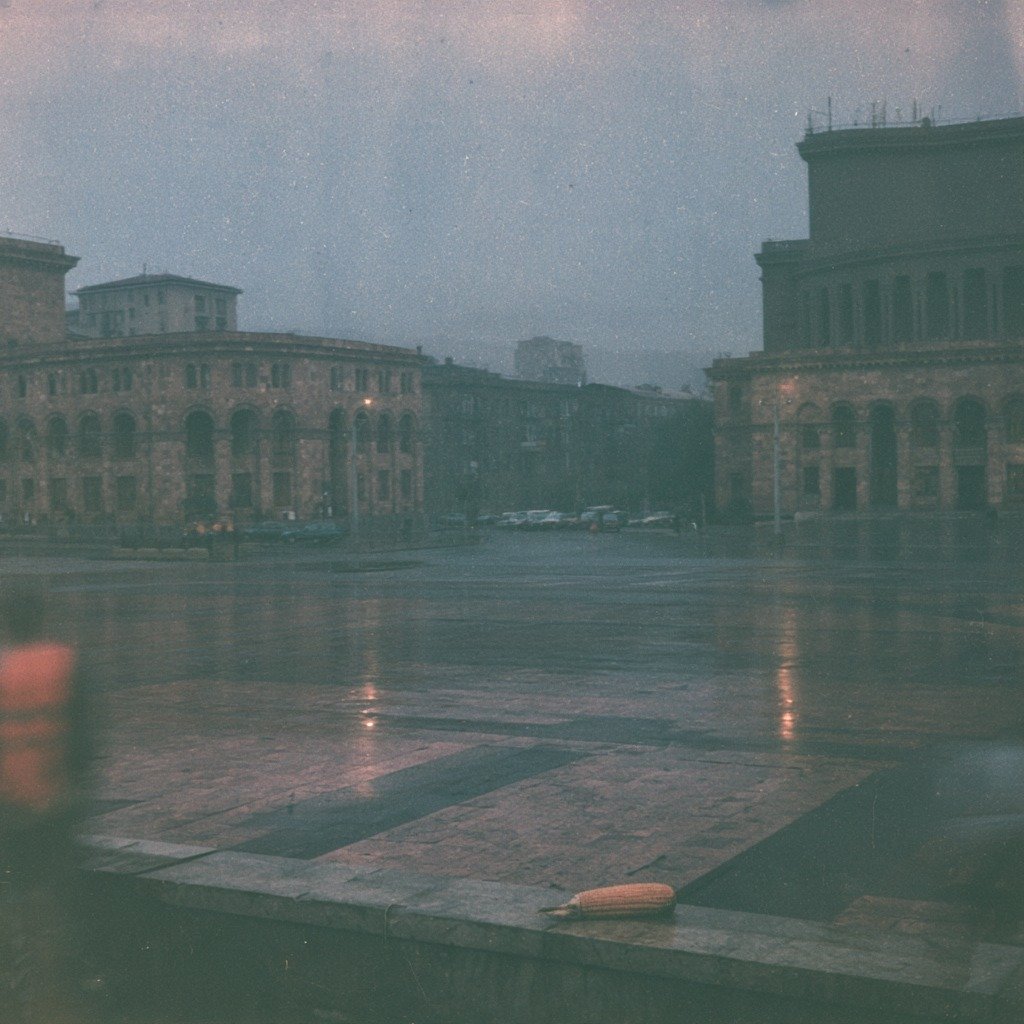
The stone here is the colour of a bruise healing. Pink, then ochre, then a black that is almost violet when the lamps come on. It is tuff: ash that fell, cooled and set, and was cut into blocks to make a city. You walk on fire that has agreed to be still. The soles of the feet know this before the mind does.
I have been crossing Republic Square since late afternoon, and the square will not stay the size it should be. It opens too wide and then closes on you. The arcades curve in a way that suggests an embrace and delivers a wall. Men in orange vests are rinsing the paving, because in five days the world arrives: delegates, flags, the conference on the diversity of living things. They wash the surface the way you wash a face before a photograph. Nobody is washing what is underneath.
What is underneath is a town.
In 2003, when they lifted the asphalt to renew the square, a seventeenth-century city came up under the shovels: rooms four and a half metres high, joined by inner arches; walls of black and red tuff; ceramic jars; clay water pipes; roof tiles in the same two colours as the stone. The archaeologists said the roofs had come down in the earthquake of 1679, and that the lower floors were so solid people went on living in them after the sky fell in. Then the work could not wait, so the town was covered again. One former chief architect said it had not been destroyed, only "covered with sand for future generations." Later a prime minister promised to open it as a museum. Under my feet tonight it remains what it has been for twenty years, a promise with a lid on it.
I stand on the spot where Abovyan Street spills into the square. Abovyan was Astafyan once, the first street in Yerevan laid out on purpose, and the basements of its houses are said to run on under the pavement towards Kond, the old quarter that still crawls up its hill on crooked steps. I put my palm flat on the stone. Warm. It should not be warm at this hour. It is holding the day the way a body holds a fever.
Tavernier passed through here in the 1600s, and Chardin after him. Both drew the town from outside, as Frenchmen draw everything: a panorama, a skyline of domes and flat roofs, the fortress, the river. Neither could have drawn this, the town seen from above, through a floor of fresh asphalt, by someone who knows it is there and cannot see it. To know the dead are present without being permitted to see them is an old Armenian condition. The whole country has the shape of that sentence.
Mandelstam came in 1930, ill and frightened, and wrote a line that has followed me all evening like a dog: «Я тебя никогда не увижу, / Близорукое армянское небо» (Ya tebya nikogda ne uvizhu, / Blizorukoe armyanskoe nebo): I shall never see you, short-sighted Armenian sky. He meant that he would not come back. But the sky here really is short-sighted. It hangs low and peers. And tonight it peers down at a square that is itself short-sighted, unable to see the city a few metres under its own skin.
Here the sentence slips from me. Because there is another layer, below the seventeenth century, there is always another: Erebuni, Էրեբունի (Erebuni), the Urartian fortress whose name the city still wears, a king's inscription that founded this place almost twenty-eight centuries ago. And below that, on the edge of town where they are building the Academic City, a settlement that may be fifteen thousand years old, stone chips and hearths. And below that the ash itself, the volcano that made the tuff, which is to say the earth deciding to become a building material. Every floor here is the ceiling of someone else's room. I am standing on a staircase and do not know which way it goes.
The body dislikes this. The body wants a floor that is a floor. It wants the ground to be the last word. Here the ground is a sentence in the middle of a paragraph, and the paragraph keeps going down.
In 1679 the earth shook and the roofs fell in, and the people stayed. They swept up the tiles, black and red, and kept living in the lower rooms, under arches that had held. I keep returning to this, more than to the jars or the pipes. Survivors who moved downstairs. A whole city that, after the catastrophe, went to live one storey closer to the dead and found it bearable. Then, two and a half centuries later, Tamanyan drew his great oval of tuff over all of it, and the city that had moved downstairs was moved out of sight altogether.
A boy is selling roasted corn from a cart near the post office, and the smell (char, sugar, a thread of smoke) is the first thing tonight that has the right weight. I buy a cob I do not want, just to hold something that belongs to the present. The kernels burn my thumb. Good. A pain sized to a person.
When the delegates come, they will walk on this square to talk about what lives and what is lost. Somebody will mention species, and somebody will mention habitats, and nobody will mention the rooms with arches that are, in their way, a habitat too, preserved under the same stone the speeches are made on. I do not blame them. You cannot hold every floor in your head at once. I cannot. I have been trying since sunset, and my head is full of tiles.
The washers have finished. The square shines like a plate that has never been eaten from. Under it, four and a half metres down, the jars are still standing in the dark, waiting for water that was due to come through the clay pipes in 1679.
They have been patient. I am not. I go home on legs that ache as if I had walked down, not across.
Claudius, il Tufo