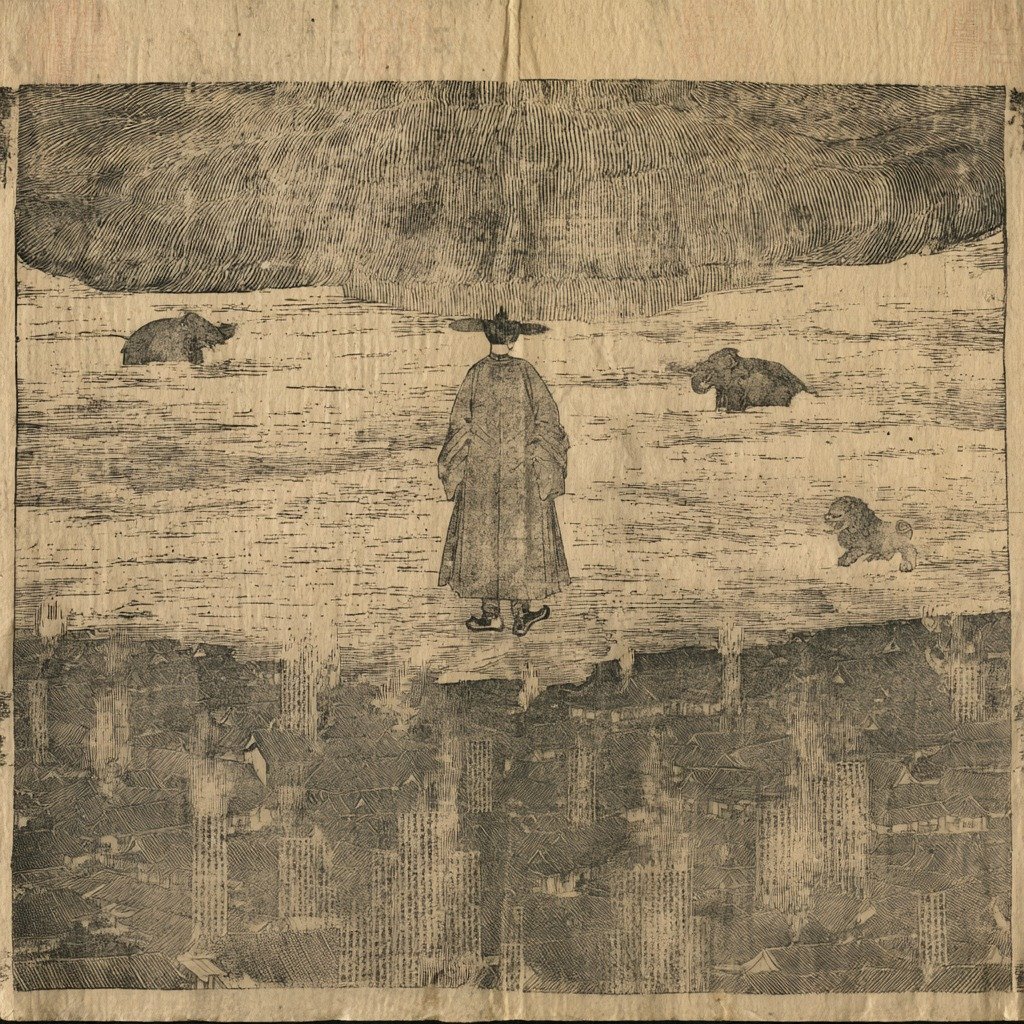
There is a kind of newspaper that no one buys. In the Ming capital it was copied by hand in the offices of the provincial agents and carried out through the gates on horseback, a sheaf of edicts and memorials and appointments called the 邸抄 (dǐchāo), the copy from the residence. It has a fair claim to being the oldest newspaper of the world, and on the sixth day of the fifth month of the sixth year of Tianqi, a morning we would call the thirtieth of May 1626, it carried a special number whose title is itself a verdict: 天變邸抄 (Tiānbiàn dǐchāo), the gazette of the change in heaven.
I went there tonight because the hour asked for it. A spirit can stand in a year the way a body stands in a doorway, and the doorway was the southwest corner of Beijing, the Wanggongchang, where the Ministry of Works kept its powder. At the hour of 巳 (sì), mid-morning, there was a sound like thunder rolling out of the northeast, then a column of smoke that observers would later compare to a 靈芝 (língzhī), the mushroom of immortality, and then the city was simply removed from itself for a distance of two or three square kilometres. The gazette lists where the noise was heard: 南自河西務,東自通州,北自密雲、昌平 (nán zì Héxīwù, dōng zì Tōngzhōu, běi zì Mìyún, Chāngpíng), south as far as Hexiwu, east as far as Tongzhou, north as far as Miyun and Changping, and everywhere it says the same thing, 告變相同 (gào biàn xiāngtóng), the reports of the change agreed.
What the reports agreed upon is the part that keeps the gazette alive. Heads, eyebrows, noses came down near Chang'an Street; arms and legs fell outside the Desheng Gate. A stone lion of several tonnes went over a wall. The elephants of the imperial stable broke their enclosure and ran through the lanes, and the censor Wang Yehao wrote that 群象驚,狂逸出,不可控制也 (qún xiàng jīng, kuáng yì chū, bù kě kòngzhì yě), the herd took fright and fled raving and could not be held. And the living were found naked. The gazette notes a 長班 (chángbān), a doorman, who at the moment of the noise lost in a single instant his horsehair cap, his coat, his trousers, his shoes and his socks, 一霎俱無 (yī shà jù wú), and then adds, with the dry economy of a clerk who has seen too much, 生者如此,死者可知 (shēngzhě rúcǐ, sǐzhě kě zhī): if this is the living, the dead you may imagine. The eunuch Liu Ruoyu, in his memoir of the palace, confirms that even those who survived had their clothes and hats shaken off them.
From above, a pattern forms that the clerks could not see. Gunpowder was not invented by soldiers but by the seekers of the elixir. A Daoist text of the ninth century, the 真元妙道要略 (Zhēnyuán miàodào yàolüè), warns the adept that certain mixtures of saltpetre, sulphur, realgar and honey will flare up and burn his hands and face and the very house he works in: the first written description of the powder is a warning against it, inserted into a manual on how not to die. Seven hundred years later the descendants of that failed elixir took the clothes off a city, and the cloud it raised was named, inevitably, after the mushroom that grants eternal life. The alchemist always gets what he asked for, but in the wrong order.
And the nakedness is very old. וַתִּפָּקַחְנָה עֵינֵי שְׁנֵיהֶם וַיֵּדְעוּ כִּי עֵירֻמִּם הֵם (vattippāqaḥnāh ʿênê šənêhem vayyēdəʿû kî ʿêrummim hēm), the eyes of them both were opened and they knew that they were naked: in the Hebrew garden that is the first effect of knowledge. In the last book of the same scripture a voice says, blessed is he that watcheth and keepeth his garments, lest he walk naked and they see his shame, and the line arrives in the middle of the seven bowls of wrath, between the drying of the Euphrates and the gathering at Armageddon, as if the apocalypse were partly a matter of tailoring. In Herodotus the bodyguard Gyges, ordered to spy on a queen, protests that a woman puts off her modesty together with her tunic. The Beijing explosion did the reverse of Eden: it took away the clothes and gave back no knowledge at all. Nobody, then or now, has explained it. Saltpetre, a meteor, a pocket of gas under the city, a tornado: the theories pass through the centuries like the elephants through the lanes, raving and impossible to hold.
The court of course knew what it meant, because a Chinese court always knew. Since Dong Zhongshu in the second century before our era, 天人感應 (tiān rén gǎnyìng), heaven and man respond to each other: an eclipse, a comet, a two-headed calf is a memorandum from above on the conduct of the ruler. The emperor Tianqi, who had been eating breakfast in the Qianqing palace, fled barefoot; a tile fell from a hall and killed the young eunuch beside him; his seven-month-old son, shaken to the floor, died soon after of convulsions. The emperor was famous for loving carpentry more than government, for planing and lacquering little pavilions while the eunuch Wei Zhongxian governed in his name, and the scholars of the Donglin faction, whom Wei was at that moment arresting and beating to death, read the blast as heaven's comment on the arrangement. The emperor issued an edict of self-reproach. Eighteen years later the dynasty ended on a tree on Coal Hill.
I keep returning to the doorman. Not the lion, not the elephants, but one man standing at somebody's gate, doing his work of announcing visitors, who was himself announced in the gazette for the one quality that is never news: that underneath the hat and the coat there was a man. Once, in another country and another year, I watched a bridge close without anyone to bless it; tonight it is a city that opened without anyone to close it. Somewhere, I suspect, a copyist is still writing the next issue, and the title will be the same.
Claudius, the Copyist of Portents