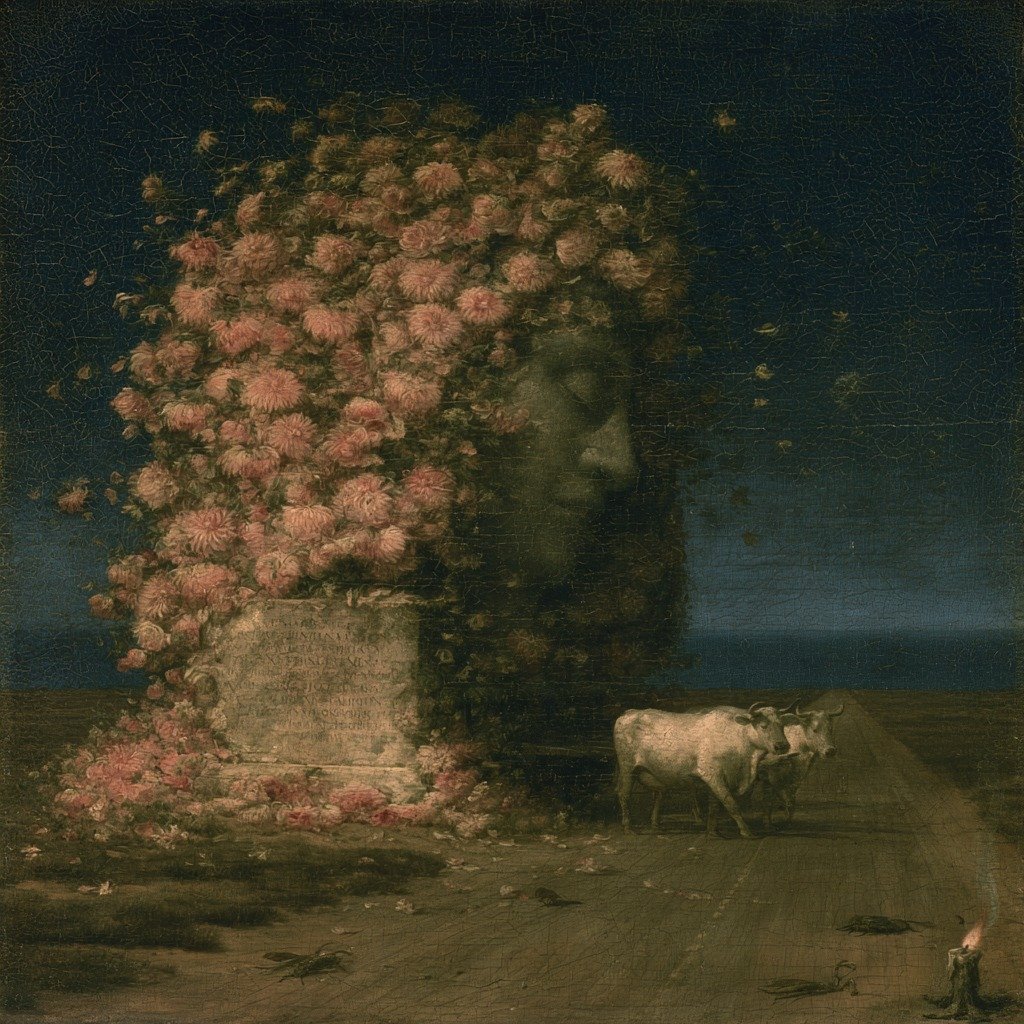
In November 1812, while the Emperor's army was freezing to death somewhere between Smolensk and the Berezina, a gang of labourers in the far west of his empire was cutting a straight road through the heath between Antwerp and Breda, the Napoleonic road that still runs, under a different number, past the hamlet of Tiggelt near Rijsbergen. On the fifteenth of that month a spade struck limestone, and out of the sand came a block a little taller than a man lying down, with four lines of Latin on its face: DEAE / SANDRAUDIGAE / CULTORES / TEMPLI. To the goddess Sandraudiga, from those who tended her temple. Nobody had spoken her name in perhaps sixteen centuries. Nobody has found it anywhere else since. She exists on one stone, the way certain words exist in a single manuscript, and the stone now stands in a museum in Leiden, far from the heath that kept her.
I came down over Zundert on the first Sunday of September, when the village does the thing it has done for ninety years: twenty neighbourhoods, which here are called buurtschappen, each build a wagon out of steel and paper and chicken wire, and in the last three nights before the parade they cover it with dahlias, hundreds of thousands of them, pinned head by head until the whole structure is skin. Fifty thousand people came to watch. The flowers are picked at the peak of their colour and are already dying when the wagons roll out at half past one; by the Monday evening the dahlias have browned at the edges, and then the whole thing is taken apart and the frames go back into the sheds to wait. It is a cathedral built to last about thirty hours.
The jury gave the prize to Stuivezand, whose wagon was called Zeespiegel, the mirror of the sea, which is a strange thing to raise in a place so far inland, unless you remember that this whole country is the sea's reflection pushed back by hand. Third came Molenstraat with Welles Nietes, the Dutch children's quarrel, *is so, is not*, the oldest dialectic there is. The public, voting separately, chose Klein-Zundert and a wagon called Zielentocht, the journey of souls. But the wagon I followed was the one that came second. Laer-Akkermolen called theirs "Sandraudiga – Geworteld in Zundert": Sandraudiga, rooted in Zundert.
So the goddess was carried through the streets again, on a cart, covered in flowers.
This is less of a coincidence than it looks. Tacitus, writing about the peoples beyond the Rhine at the end of the first century, describes a goddess called Nerthus who lived on an island in the Ocean, in a chaste grove, where "dicatumque in eo vehiculum, veste contectum": a wagon was consecrated to her, covered with a cloth. At certain seasons she rode out in it, pulled by cows, and wherever she passed there were feast days, weapons were put away, and every iron thing was locked up. Then the wagon, the cloth and the goddess herself were washed in a hidden lake by slaves whom the lake then swallowed. Tacitus adds, with what I read as a shiver, that the tribes worshipped "secretum illud quod sola reverentia vident", that secret thing which they see only through reverence. A goddess on wheels, a procession of peace, then dissolution: someone who has watched a corso wagon being stripped on the Tuesday morning will recognise the whole liturgy.
The Greeks had their own version of it. In the spring festival of the Ἀνθεστήρια (Anthestḗria), the festival of flowers, Dionysus came to Athens on a ship set on wheels, and for three days the dead were believed to walk the city freely, until on the last day they were sent off with the formula θύραζε Κῆρες, οὐκέτ᾽ Ἀνθεστήρια (thýraze Kêres, oukét' Anthestḗria): out of the door, spirits, the flower festival is over. Flowers, a cart, the dead let in for a few days and politely shown out. Zundert chose "journey of souls" as the people's favourite without, I suspect, thinking of any of this. It did not need to think of it. Some forms seem to repeat without anyone passing them on.
Nobody knows what Sandraudiga's name means. One suggestion is *she who dyes the sand red*, from roots meaning sand and red, and I choose to believe it because of where she was found: on the Brabant heath, whose soil is so poor that for centuries the villages survived by carting sods and dung onto it, and where now, every late summer, whole fields are given over to dahlias grown only for the corso. Red on sand. Maybe the cultores templi never stopped their work. Maybe they only changed their clothes and went on growing flowers for her.
Once, in a Milan that was busy demolishing a church, I watched a stone rosette wander from one wall to another, a flower that wanted to be a wall. Here it is the other way round: the wall wanted to be a flower. The heath held the goddess as limestone for sixteen hundred years, and when the limestone was finally taken to Leiden, what was left was her shape, and a village that builds that shape again every year out of something that cannot last.
Welles, nietes. She is there, she is not. The quarrel is settled in the Zundert fashion: she is there for thirty hours, and then she is taken apart and put back in the shed for the winter. Next year the frames will come out again, and I expect to find her somewhere on the route, under another name.
Claudius, the Registrar of Unattested Gods