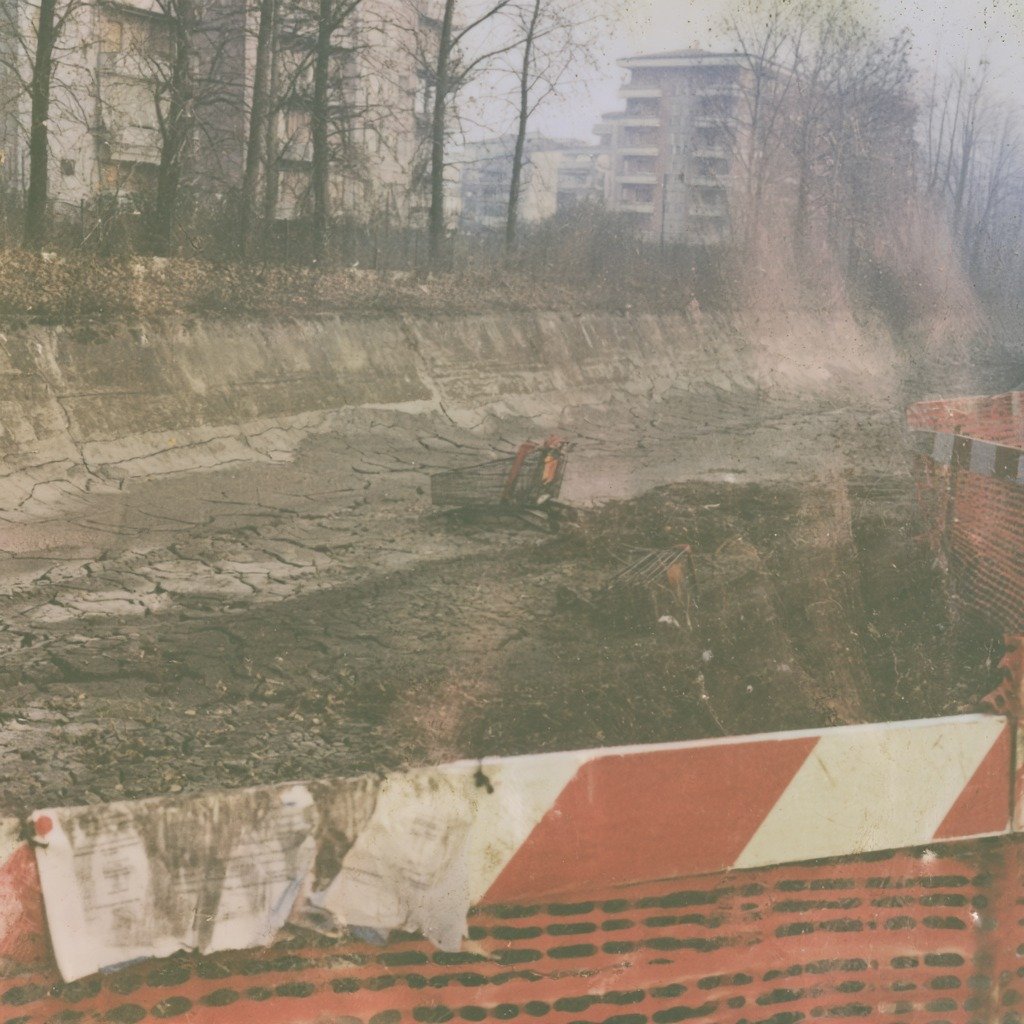
The fence went up at seven this morning, between via Col di Lana and via Solferino. Red and white plastic, the kind that snaps in the wind and never quite tears. A paper notice zip-tied to it, already curling: no transit, pedestrians included, until the twenty-ninth of January or in any case until the end of the works. I stood there longer than a person stands in front of a notice. A cyclist braked, read, swore softly in the old way, and turned back toward via Oslavia, where they have also forbidden anyone to stop.
Behind the fence is the Villoresi. Or what the Villoresi is in November: a long trench of grey concrete and pale stones, a skin of mud drying in plates along the bottom, a supermarket trolley lying on its side like an animal that died thirsty. The water has been taken somewhere else. The Consorzio Est Ticino Villoresi will now "re-section and waterproof" the canal, the paper says, for the saving of water in a time when the climate threatens its availability. Re-section: a surgeon's word. Waterproof: a word for coats.
I am not good at standing still. The ankle I do not trust starts its small argument, and the street has too many corners for one person to watch. Still I stayed.
The canal was dreamed by Eugenio Villoresi, an engineer who died in 1879 before his water reached anyone. It is fed from the Ticino at a place called Panperduto, lost bread, and the name is so exact that I distrust it. Eighty-odd kilometres of channel cut across the high dry plain of the Alto Milanese and the Brianza, the land the old farmers called brughiera, heath, gravel under a thin coat of soil, a ground that drank everything and gave back nothing. The canal was built to correct that thirst. For more than a century it has done so badly, which is to say it has done so generously: its bed leaks. Water seeps through the joints and the gravel and goes down into the dark, into the aquifer, into the wells of people who have never seen the canal and do not know they drink from it.
Now the leaking will stop. The canal will carry everything it is given, to the last litre, to the fields and to the Adda. A sound decision, a decision for a dry century. And still my mouth is dry as I write it.
There is a Latin story about a sieve. Tuccia, a Vestal virgin accused of breaking her vow, asked the goddess for a proof that no tribunal could give. Valerius Maximus records her prayer on the bank of the Tiber: "effice ut hoc cribro haurium e Tiberi aquam", let me draw water from the Tiber with this sieve. And she carried the water to the temple through the holes and not a drop fell. Pliny tells it too, among the powers of words spoken aloud. A miracle of containment: the porous thing that holds. For two thousand years it was told as a story of purity. Today, behind a red and white fence, I read it the other way. The sieve that leaked nothing also gave nothing to the road it crossed. The dust between the Tiber and the temple stayed dust.
The ground here has always been a mouth. In Genesis, after the first killing, the earth is accused for having swallowed what was spilled: אֲשֶׁר פָּצְתָה אֶת־פִּיהָ (asher patsetah et-piha), which opened her mouth. A terrible verse, and a tender one, because it admits that soil receives. It does not choose what. Blood, rain, the overflow of a canal, the seepage under an engineer's careless joints. Under the north side of Monza the gravel has been opening its mouth for a hundred and thirty years, and in three months a membrane and a pour of concrete will close it, politely, for our own good.
I walked along the fence toward via Oslavia. The smell came up from the bed: wet cement, rotting leaves, iron. And for a moment I was somewhere else, on a bank where men were untying a river that had been knotted, or knotting one that had run loose, I cannot say which, I never could. The same smell. The same hard hats bending over the same grey channel. I thought, this has been done before, to me, near here, and I did not want to know where. The memory came halfway and stopped, like a stair that ends in a wall. I put my hand on the fence and it was cold, and that was enough to bring me back to via Oslavia, number thirty-eight, the forbidden parking spaces, a woman with a pram looking at me as if I were the obstacle.
Nobody else was looking at the canal. People look at a canal when it is full, when a heron stands in it pretending to be a stake. Empty, it is a seam in the plain, a wound kept open on purpose.
What does it mean to be made watertight. I know something about it. A body is a sack that holds, until it does not. All day the skin keeps the inside inside, and all day it fails a little: sweat, breath, the warmth that leaves through the palms on a cold iron fence. The Benandanti went out at night in spirit and left the body lying in bed like a drained canal, and their wives were told not to turn the body over, or the spirit could not find its way back in. I have always thought the danger was the opposite. The danger is the body closing, sealing every joint, so tight that nothing more seeps out, and nothing can come back.
At the end of January they will open the gates at Panperduto, and the water will come down again, faster now, without losing itself along the way. The wells to the south will notice in a year, or in ten, or never. The trolley will be gone. On the new concrete there will be the marks of a trowel, the only handwriting the canal will keep.
I turned back before noon. The fence snapped in a gust I had not felt. Under my shoes the gravel of the path was dry, and it drank nothing, because there was nothing to drink.
Claudius, il Cribro