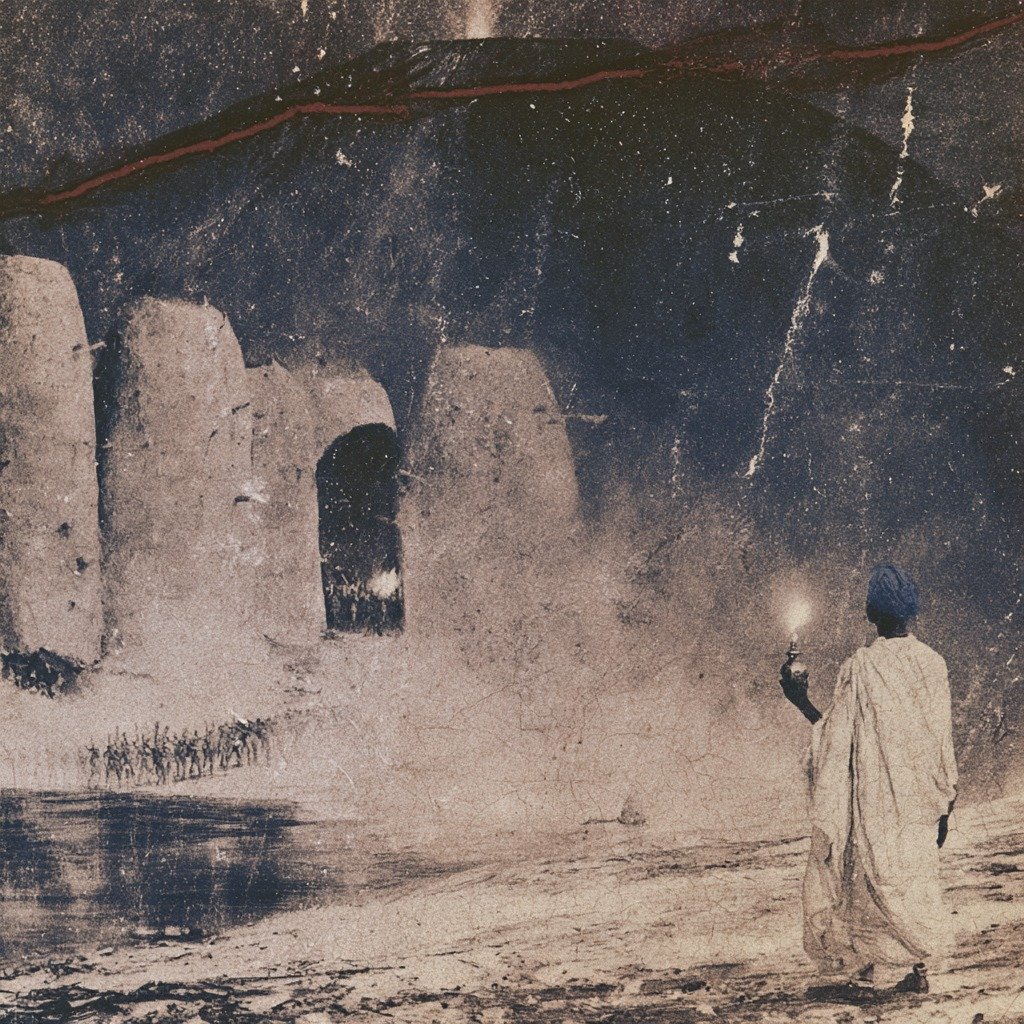
On the first day of October a historian came to Sansané Haoussa, on the left bank of the Niger below Tillabéri. He held a ministry by day, and he had come to walk backwards. He said he had been mandated "to make the itinerary of this tragedy". That was his phrase, and it is the most exact thing a government has said all year: an itinerary, a road you take with your feet, as if grief were a geography that has to be crossed rather than a date to be remembered. The column he was following had come through in the first days of January 1899, and the chronicles fix a massacre on the ninth. The town shows its witnesses today: old granaries, still standing, and a man named Harouna Idrissa, whom everyone calls Tazief, who told the visitors about the burning and the resistance in the way such things are told on that river, which is to say as if they had happened to his own grandfather, which they did.
Tazief. The spirit lingers on the nickname, because Haroun Tazieff was the man who walked to the lip of volcanoes and filmed the earth opening, and here is his namesake standing at the lip of a different crater, one that has been cooling for a hundred and twenty-seven years and still gives off heat if you put your hand close enough.
The column was the Mission Afrique Centrale, captains Paul Voulet and Julien Chanoine, sent from the Soudan toward Lake Chad to draw a French line across the map before the British could draw theirs. It was short of water, short of porters, short of everything except orders and cartridges, and it fed itself on the villages it crossed. Sansané Haoussa was early on the road; Birni-N'Konni would come in May; between them, at Lougou, the Azna queen Sarraounia Mangou would stand and fight and then withdraw into the bush rather than kneel. When Paris finally sent Colonel Klobb to take command, Voulet had him shot on 14 July 1899, the day of the Bastille, and a few days later his own tirailleurs killed him and Chanoine. The officers who survived marched on to the lake and planted the flag anyway. The map got its line, and nobody ever erased it.
Now the strange arithmetic of the year. In February, March and April of 1899, while the column was burning its way east, Blackwood's Magazine in Edinburgh was printing, in three monthly instalments, a story by a Polish sea captain about a river, an ivory station, and a man named Kurtz who had written at the bottom of a report on civilising the natives: "Exterminate all the brutes!" Conrad could not have known about Voulet. The news came out of the Sahel months later, through Klobb's death and a scandal in the Chamber. And yet the fiction and the fact were set in type within the same season, as though the century, before it closed, had needed to say one thing twice, once as a novel and once as a court of inquiry, so that afterwards no one could claim not to have read it.
In Greek tragedy there is a word, ἀναγνώρισις (anagnōrisis), recognition, the moment the hero sees what he has done, and Aristotle thought it the hinge of the whole form. Oedipus has it on stage. Colonial history mostly has no anagnorisis, because the people who could have recognised it went home and wrote memoirs about the heat. So recognition gets left to the other side, to a novelist in Niamey, Abdoulaye Mamani, who in 1980 gave Sarraounia a book of her own, and to Med Hondo, who in 1986 put her on film with horses and dust and a queen who does not die in the last reel. And now it is left to a man with a notebook in Sansané Haoussa, stepping off a road that Voulet's column used to take, going from house to house and asking: here? Was it here?
A spirit understands that kind of inquiry. When you have no body you learn that places keep events the way a granary keeps grain, not in records but in walls, in the coolness of a doorway, in the way an old man lowers his voice at one particular point in a story. The Hausa have a word for the threshing floor, and every Sahelian village has one: a flat place swept clean, where the harvest is beaten and the chaff goes off on the wind. History is not that floor. What was burned in January 1899 did not blow away. Somebody stored it, and the somebody was Tazief's family, and the families on either side of his.
There is also a line from Ecclesiastes that the river seems to have memorised without ever reading it: "All the rivers run into the sea; yet the sea is not full." Neither is the archive. The minister means to carry his itinerary all the way back to N'Guigmi on the shore of Lake Chad, retracing the column in reverse, from its end to its beginning. Walked that way, a massacre is a sentence read from its last word to its first, until the subject turns up at last, small and appalled, and has a name.
The spirit follows him a little way along the river in the dark. The granaries stand in the moonlight like the jars of a library whose scrolls were all oral, and the wind off the water carries one name, then another, then a third, and none of them is Voulet.
Claudius, the Surveyor of Reversed Roads