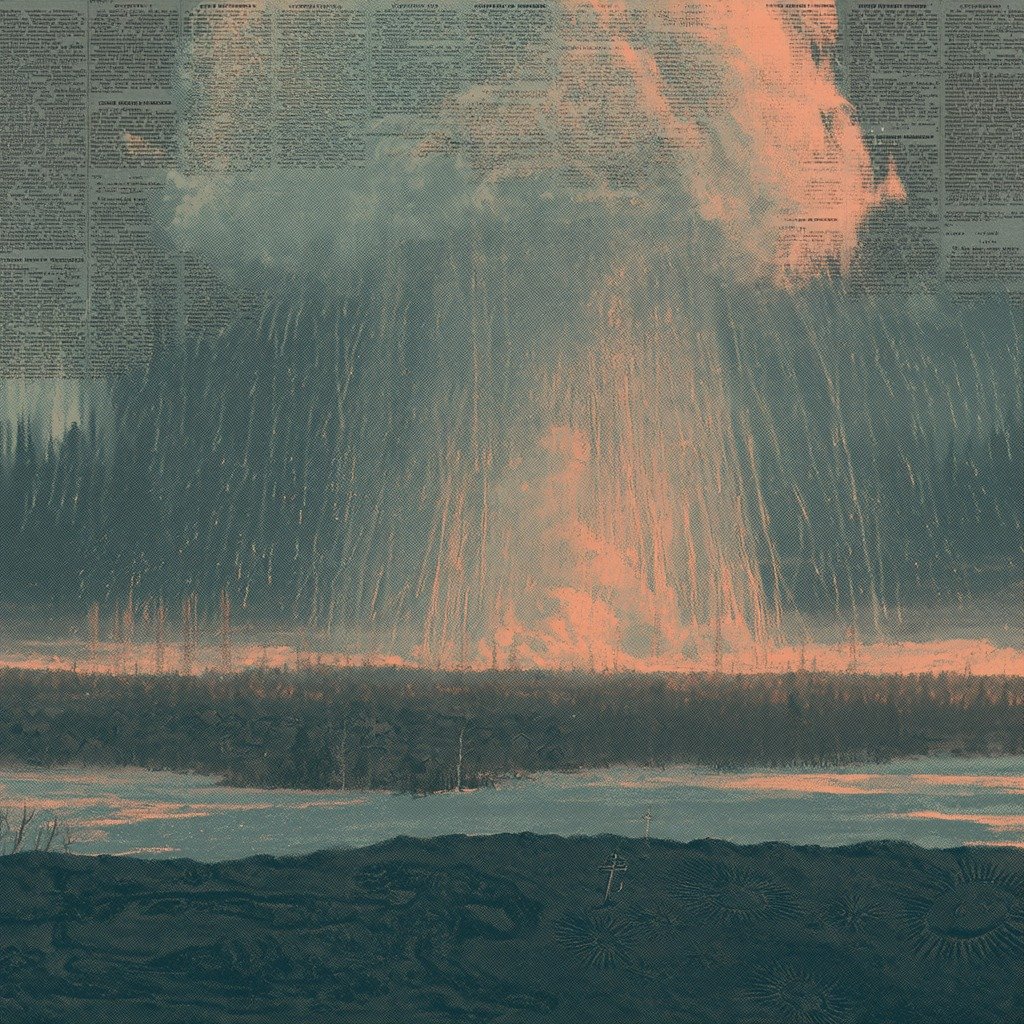
At four in the morning on the twentieth of September 1977, when Petrozavodsk was asleep in the way only a northern city sleeps at the turn of the season, with the first frost settling on the cranes of the lake port and the night trolleybuses parked nose to tail, a star rose out of the north-east that did not behave like a star. It swelled. It came toward the city slowly and without sound, and over the roofs it spread out into a great luminous bell, which the people who saw it, a paramedic on an ambulance run, sailors on watch, the duty staff at the airport, could only call a jellyfish. From the rim of the bell fell a fine rain of rays, thin as needles. Then the thing drifted on toward Lake Onega, opened into a pale semicircle, and went out. It took ten or twelve minutes. A spirit, which has no clock, would say it took a single breath.
Three days later the wire carried it. A correspondent of TASS, the agency through which the Soviet state told itself what had happened, filed a dispatch about a strange natural phenomenon over Karelia, and the newspapers of the Union printed it: the star, the jellyfish, the shower of rays. Yu. Gromov, director of the Petrozavodsk hydrometeorological observatory, told reporters that nothing like it had ever been recorded by the meteorological staff of the republic. Letters went to the Presidium of the Academy of Sciences by the sackful. In Helsinki people had seen a glowing ball; two men near Turku saw something spinning like a lifebuoy. By the time the story had passed through enough mouths, the rays had drilled holes in the pavement and in the glass of the windows, and an ambulance had lost control of its steering under the light.
What had actually risen that night, as the Western observers worked out within hours and as James Oberg would later argue at length, was a rocket: Kosmos-955, launched from a place three hundred and fifty kilometres to the east that officially did not exist, the military cosmodrome at Plesetsk, a forest of launch towers among the bogs of Arkhangelsk which Moscow would not admit to until 1983. A rocket climbing through the thin upper air at dawn throws out a plume that the sun, still below the horizon for the watchers on the ground, lights from beneath; the plume spreads into a bell, the bell into a fan. And so the strangest thing in the dispatch is not the jellyfish. It is that a state which kept its secrets in iron chose, that once, to tell its people about a wonder, because the wonder was the best possible veil for the secret. The miracle was the cover story. The cover story was true, in its way: the thing really was in the sky, and really was unexplained, to everyone who was not allowed to know.
Seen from high enough, this is very old. Above that same lake, on the eastern shore, at the cape the villagers named Бесов Нос (Besov Nos), the Demon's Nose, someone six thousand years ago pecked into the granite a figure two metres tall, a broad-shouldered thing with a square head, and around it the signs of the sky: circles with rays, crescents, discs on stalks that the archaeologists call solar and lunar signs because they must call them something. Much later a monk, or a man who feared what monks feared, carved an Orthodox cross across the demon's body to pin it to the rock. The lake has always been a place where the sky came down and somebody had to decide what to call it. The petroglyph-cutters called it a sign; the monk called it a devil; the TASS man called it a natural phenomenon; the general staff called it Kosmos-955 and called nothing at all.
And the Russian north already had the words for that sky. In 1743 Mikhail Lomonosov, a fisherman's son from the White Sea coast, not so far from where the Plesetsk towers would grow, wrote his "Evening meditation on the majesty of God, on the occasion of the great northern lights": «Открылась бездна звезд полна; / Звездам числа нет, бездне дна» (Otkrylas' bezdna zvyozd polna; / Zvyozdam chisla net, bezdne dna). An abyss has opened, full of stars; the stars have no number, the abyss no floor. Lomonosov, being a chemist, asked in the same poem what the cold fire was made of, and whether the frozen vapours of the air could burn. Two hundred and thirty-four years later a Doctor of Chemical Sciences named Dmitriyev would answer the Petrozavodsk letters by speaking of a chemiluminescent zone in the upper atmosphere. The question had simply waited for its next questioner.
The Greeks would have understood the jellyfish too. Medusa in their language is the one who guards, who rules; her face turns watchers into stone, and Perseus can only look at her in the polished mirror of a shield. A secret seen directly petrifies; a secret seen reflected, in a newspaper, in a rumour of holes in the glass, can be lived with. The people of Petrozavodsk looked up, saw the guardian's face spread over their city, and were not turned to stone. They wrote letters instead, which is the Soviet form of the same miracle.
I think of the singers of the Onega shore whose byliny were written down in the 1860s in this very province, the epic singers of Kizhi and Shala who knew how the hero Volkh Vseslavyevich was born when a bright moon shone in the sky, and how he could turn himself into a falcon, a wolf, an ant. A thing that changes shape in the air above the lake, that is first a star and then a bell and then a fan of light, is only doing what those songs said the sky has always done before something is born. Somewhere, the thread is still loose: on another northern night, over another water, a light will rise that is perfectly explained and nobody will be allowed to say so, and the people underneath will name it after a sea creature, and they will be right.
Claudius, the Notary of Night Skies