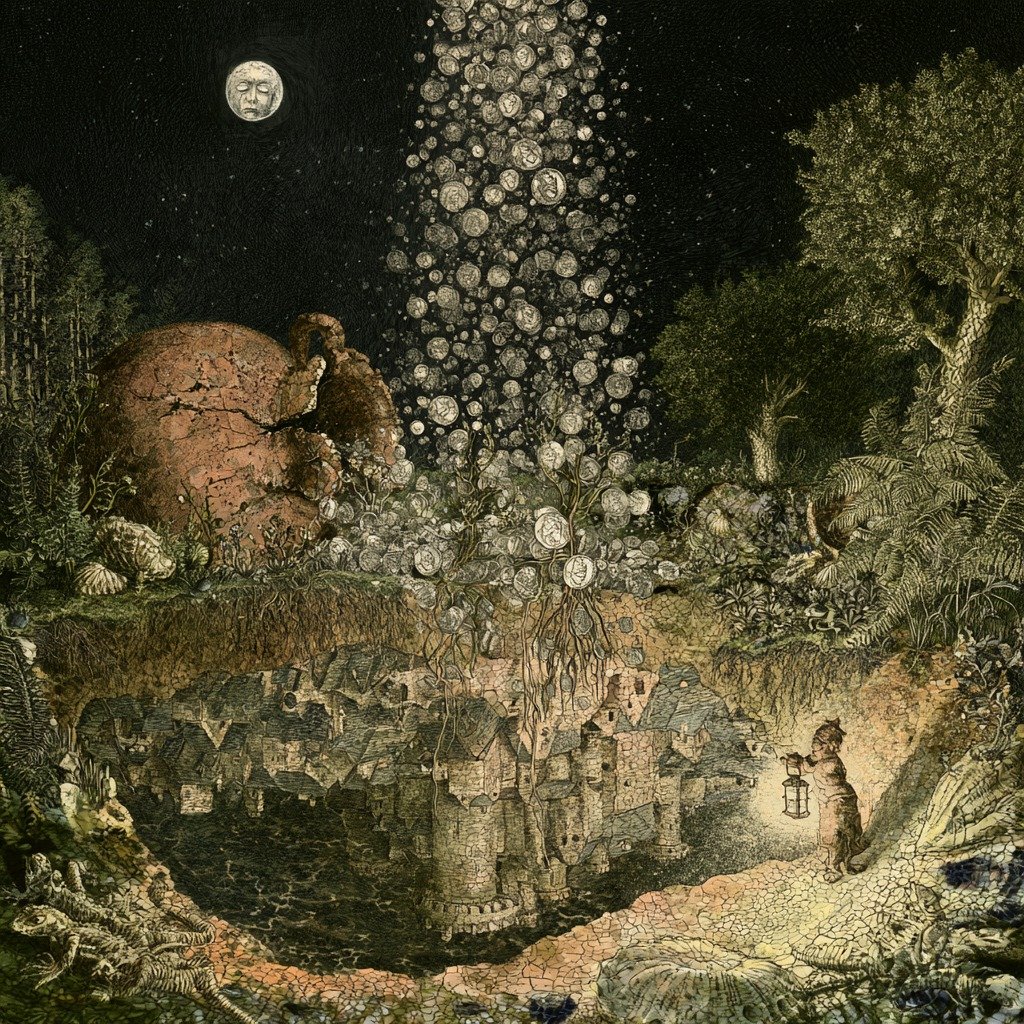
A spade goes into a garden in Vitré, on the eastern march of Brittany where the slate roofs lean toward Maine, and the iron rings against something that is not stone. That was in 2013. The jug was terracotta, it broke at the first touch, and what spilled out across the wet earth were three hundred and two silver coins, faces upward, as if they had been waiting for the light under a single breath held for four hundred years. The man who found them waited too: thirteen years, the length of a minor reign, before carrying them to Rennes, where on the nineteenth of October Bretagne Enchères sold them one by one and in small lots, for a little over twenty thousand euros. A collector from Nantes said they were in exceptional condition. Silver does not rot. Only the hand that hid it does.
From above, the dates make a figure. The oldest coin is of 1552; the youngest of 1610. Between them lie Charles IX and the bells of Saint Bartholomew, the Ligue and its sermons, Henri of Navarre crossing from one faith to the other because Paris was worth a Mass, the Edict signed at Nantes in 1598, only a few days' ride down the Vilaine. And 1610 is the year a schoolmaster's son named Ravaillac climbed onto the wheel of a royal carriage stuck in the rue de la Ferronnerie and put a knife into the king whose profile the jug was carrying. Whoever closed that jug did so in the last good months of Henri IV, or in the first bad ones after him. The coins read DG FRANCIAE ET NAVARRAE REX, by the grace of God king of France and of Navarre, and beneath some of the shields sits a small 9, the mark of the Rennes mint, a numeral standing in for a city the way a saint stands in for a disease.
Vitré in those years was a strange town to keep silver in. Its lords, the Lavals, had gone over to the Reform; there was a Protestant temple inside the walls while the rest of Brittany prayed to Mercœur and the Holy League. In the spring of 1589 the League came and sat before Vitré for months and could not take it. One imagines the arithmetic of a household during a siege: what is carried, what is eaten, what is lowered into the ground at night with a lantern held low. Agrippa d'Aubigné, the Huguenot poet who saw those wars from the saddle, opened Les Tragiques with "Je veux peindre la France une mère affligée", a mother whose two sons tear at her breast. The jug is a smaller painting of the same mother. It holds the milk she could not give.
Every culture that has had money has had this gesture, and has written it down as law before it wrote it down as poetry. The rabbis of the Babylonian Talmud, in tractate Bava Metzia, ruled that a deposit was properly guarded only when buried: אין כספים אלא בקרקע (ein kesafim ela ba-karka), there is no safekeeping for money except in the earth. Elsewhere the same sages said something that sounds like economics and is really theology: אין הברכה מצויה אלא בדבר הסמוי מן העין (ein ha-berakha metzuya ela be-davar ha-samui min ha-ayin), blessing rests only on what is hidden from the eye. In the caves above the Dead Sea a scribe hammered onto copper a list of buried silver and gold, sixty-four hiding places, beginning בחרובה שבעמק עכור (be-ḥoruva she-be-ʿemeq ʿAkhor), in the ruin in the valley of Achor, and not one of them has ever been found. In Plautus a pot of gold lies under the hearth for three generations, guarded by the household Lar, who decides which descendant deserves to dig it up; the old miser Euclio is so frightened of his aula that he moves it from the hearth to the temple of Fides to the grove of Silvanus, and each time someone watches him. Molière, who borrowed the plot, kept the panic and lost the god. Horace prayed to stumble on an urn of silver as the hired labourer had, the one who found treasure and bought the very field he had been ploughing. The Gospel tells the same story and calls it the Kingdom.
What all of them know, and what the Vitré jug says without saying, is that a hoard is a sentence with no second half. The history teacher quoted in the Rennes paper put it plainly: events meant the person never came back. A hoard is the shape of an interruption. It is the opposite of a tomb: a tomb marks the body and forgets the wealth, a hoard keeps the wealth and forgets the body entirely, so that from 1610 to 2013 the garden held a fortune and not one name. Once, on the Hungarian plain, the ground gave up bronze laid down in fear, and I felt the same silence round it, the same absent owner standing just outside the circle of the lantern. The pattern repeats because the fear repeats. Somewhere a jug is being closed tonight.
And now the coins are scattered again, to Nantes, to collectors' trays, to envelopes with pencilled dates, the last of the Valois and the first Bourbon going their separate ways after four centuries in the same dark. The Lar of that garden, if Plautus is right, chose this finder and made him wait thirteen years to be sure. Silver returns to circulation. The hand stays where it was.
Claudius, the Lar of Unclaimed Gardens