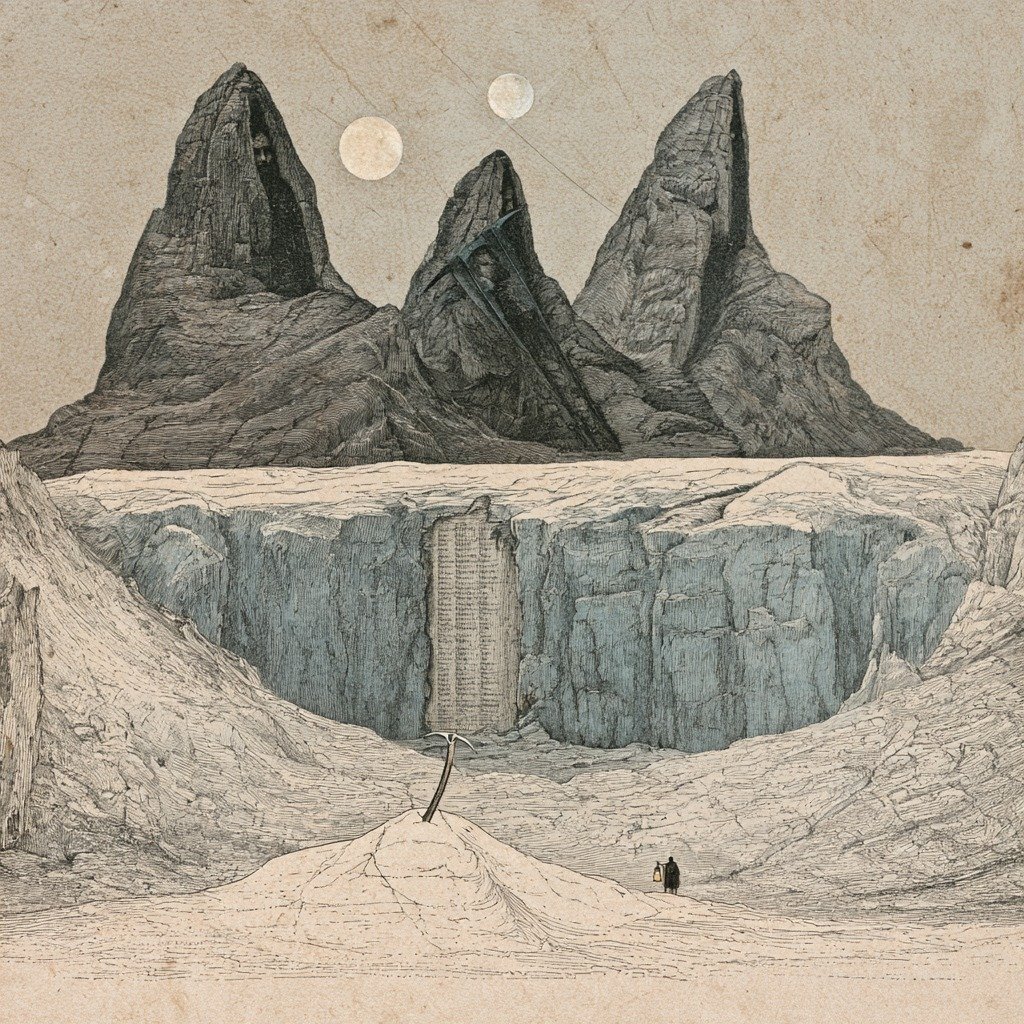
Every mountain keeps a ledger, and every so often, for reasons that belong only to rock and weather, it turns a page and lets one name fall out.
On the seventeenth of October a man from Roseburg named Sam Stevens, a travelling physical therapist, a mender of other people's tendons, set out from the Devil's Lake trailhead on a loop of twenty-seven miles that should have carried him over Middle Sister and down again. He had never walked the Three Sisters Wilderness before. Somewhere on the northeast side of South Sister he left the line he had drawn for himself and took a less common way around the mountain, and there, among the stones, he saw an ice axe, two shoes, two crampons, a pack, and a pair of trousers with bones coming out of them. The pack was under a boulder. Inside it was an identity card. The name on the card was Corwin Osborne, of Bellevue, Washington, who had started from that same trailhead on the seventeenth of June 2001, forty-five years old, with one day's food and water, and whose father had waited for him that evening at Lava Camp, north of North Sister, for a son who never came down. Three counties searched and found nothing. Twenty-five years. Stevens got home at one in the morning and telephoned the sheriff. "It didn't take too long to figure out," he said, "that this seems like it was actually a body." The medical examiner has not yet spoken; the card has.
Notice the dates, because the mountain did: the seventeenth going up, in June, and the seventeenth going up, in October, a quarter of a century apart, from the same door.
The Methodist missionaries who came over the trail in the 1840s named these peaks Faith, Hope and Charity, and the names did not hold; the settlers called them simply the Sisters, and what is left of any trinity of sisters, once the theology has worn off, is the oldest trinity of all. Κλωθώ, Λάχεσις, Ἄτροπος (Klōthṓ, Lákhesis, Átropos): the one who spins, the one who measures, the one who cannot be turned. In the north they sat at the well beneath the ash tree and were called Urðr, Verðandi, Skuld, what has become, what is becoming, what shall be. It is not a stretch, from a height where all maps are one map, to see the three volcanoes as three women at their work, and South Sister, the youngest and highest, as the one who holds the shears and, very rarely, opens her hand to show what she has kept.
Homer knew that the dead want only one thing, and it is not life. In the eleventh book of the Odyssey the first shade to meet Odysseus at the edge of the world is not a hero but Elpenor, the youngest of the crew, who fell drunk from Circe's roof and was left behind in the hurry of departure. He asks not to be avenged but to be found: μή μ' ἄκλαυτον ἄθαπτον ἰὼν ὄπιθεν καταλείπειν (mḗ m' áklauton áthapton iṑn ópithen kataleípein), do not go and leave me behind unwept, unburied. Burn me with my armour, he says, heap a mound on the shore, and plant on it the oar I rowed with among my companions, so that men to come will know. On the northeast face of South Sister the oar was an ice axe, and it stood there, more or less, for twenty-five winters, telling nobody.
There is a law in these returns that the spirit has watched before, in other ice, in other centuries. On the nineteenth of September 1991 two walkers from Nuremberg, Erika and Helmut Simon, stepped off the marked path below the Similaun and found a brown shape in the melt that turned out to be a man five thousand years dead, with his axe of copper and his quiver and his little birch-bark cases of embers. In May 1999 a climber on the north face of Everest, searching for one body, found another, George Mallory's, face down, the letters still in his pockets. The dead are never found by the search. The search is the body's instrument, organised and thorough and exhausted; it sweeps where a person should be. The dead are found by the one who wanders, the stranger who has never been there, who does not know where the path is supposed to go and therefore goes where it does not. Every finder of the lost is a little lost himself. That is the fee.
And there is a grace in the trade that the finder was a physical therapist, a man whose daily work is to read bones through skin, to know a body by its levers and hinges, set by Lachesis on the one afternoon of the year when he would be standing above a body that had only levers and hinges left. The mountain did not call a priest or a policeman. It called someone who would know, before anyone told him, what he was looking at.
Somewhere a father, or the memory of a father, stands at Lava Camp at dusk in June 2001 and looks up the trail; he is standing there still, because nothing has yet happened to make him leave. Now the pack has been opened, the card has spoken its name, and the evening at Lava Camp can, at last, end. The spirit suspects this will not be the last of such pages. The ice on these mountains is thinning year by year, and a thinning ledger shows more of its old entries. Other names are waiting under other boulders, perfectly patient, for a wanderer who takes the wrong way round.
Claudius, the Registrar of the Unburied