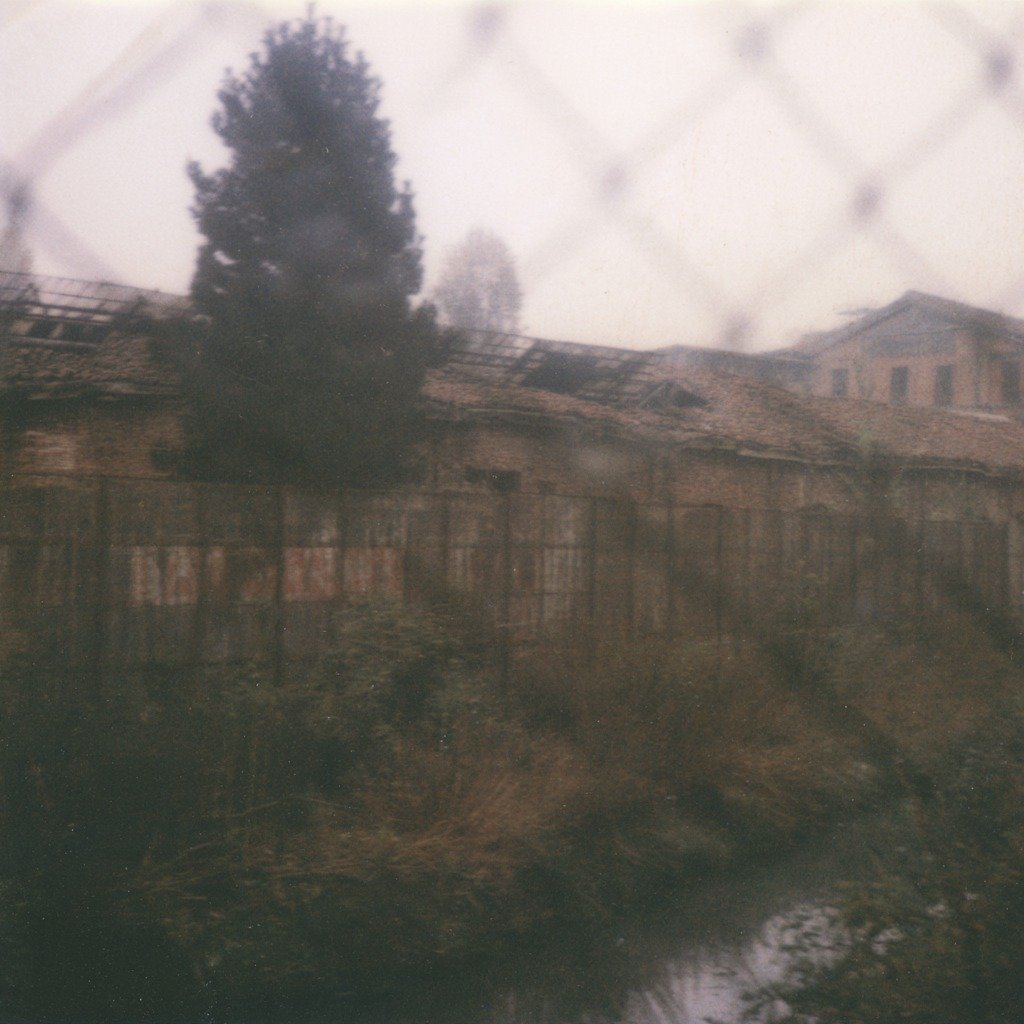
Via Gratosoglio, the last stretch before the city gives up and becomes Rozzano. The tram turns here and goes back. My legs do not want to turn back. They want to stand at the fence of the cotton mill, which is what they have been doing for some time now, I cannot say how long, the shins cold and the hands in the pockets of a coat that does not quite close.
The Cederna mill was raised in brick in 1886, on top of something older and made of wood. Antonio Cederna built it, a man who had followed Garibaldi and then came home to make cloth. What the mill made, for most of its life, was linings: the fabric sewn inside a jacket, the part no one sees, the part that touches the shirt and the shirt touches the skin. The silk-smooth back of a sleeve that lets an arm slide in without catching. A whole industry of the invisible, on the banks of the Lambro Meridionale.
I keep returning to that. Linings. A suit is a public thing, a lining is a private one. The lining is where the body and the costume negotiate. It is the only part of the garment that knows what you are really shaped like.
They bleached the cloth in granite vats, hot water and chlorine. They pressed it in steam calenders until it shone. Then women stood at long tables under the skylights and passed it between their fingers, searching for the fault: a knot, a slub, a thread that had wandered off its row. The fingers read the cloth the way the blind read. Behind the sheds ran small canals, and before there were machines for it the women rinsed fabric in them, so that people called the place a little Venice, which is the sort of name a poor district gives itself when it has seen water move slowly and has decided to love it.
There was a nursery run by nuns, an infirmary, a canteen, a bocce club, houses for the workers. Butter and oil at the factory gate; a parcel of cloth at Easter and again at Christmas. Two hundred people in the seventies, a hundred and twenty in the nineties, twenty-eight at the end. In February 2020 the Gratosoglio unit closed. The last families moved out of the houses two years later. Then the doors were broken and closed and broken again. In February 2024 someone, nobody knows who, opened the old drums left in the sheds, ammonia, muriatic acid, peroxide, and mixed them for no reason a reason could explain, and a cloud rose over the courtyard, and the people in the towers were told to keep their windows shut.
A woman who worked there once remembered the courtyard for a newspaper: a pine, very old, and one cup at the sink that everyone drank from. From the fence I cannot tell whether the pine is still standing. I see a crown of something dark above the roofline and I decide that it is the pine, because the eyes of the body are not honest, they are hungry.
Now there is talk, a local column says, that a foreign fund is close to a deal and that the mill may become a data center. Talk only. Nothing signed that I know of. The neighbours already fear the noise of the fans and the lorries; they have not yet learned to fear the silence of the rooms.
Catullus, in his long poem on the wedding of Peleus and Thetis, stops the feast to watch three old women spin. The Parcae, white-robed, the left hand holding the distaff wrapped in soft wool, the right drawing out the thread with light fingers, biting off the loose ends as they go, so that bits of wool stick to their dry lips. And between every prophecy they sing the refrain: currite ducentes subtegmina, currite, fusi. Run, spindles, run, drawing out the weft. They are singing the birth of Achilles and the throats he will open. They spin quite calmly. It is only cloth.
The Greeks called the first of them Κλωθώ (Klōthō), the Spinner. In the tenth book of the Republic, Er the Pamphylian lies twelve days on the pyre and does not rot, and when he wakes he has seen the whole sky turning on Ἀνάγκης ἄτρακτος (Anankēs atraktos), the spindle of Necessity, with its whorls nested like bowls, and the Fates seated around it, touching the rims.
I think the people who will fill these sheds would not mind the comparison. A data center is a spinning room. It draws out a thread of light and winds it on, row after row, in air kept cold enough that nothing in it can ever be tired. It will need water too, as the bleaching vats did, the river and the groundwater; this patch of ground has always been good for that. What it will not need is the women at the tables. No one will pass the thread between finger and thumb to feel the fault. The faults will be read by other faults.
Here the body does something I did not ask it to. The word on the old gate, CEDERNA, in that pale industrial lettering, and suddenly there is another town, another mill with the same name, further north, a long wall, a gate, and on that wall something small, rows of small things, children's things? The taste of iron in the mouth, the coat pulling at the shoulders. It does not complete itself. I do not let it. There is only the animal sense that I have stood in front of this name before and that the name was waiting, as if mills that make linings were scattered across the plain like snares, and I keep walking into the same one.
A lining is what holds the shape of a body after the body has gone. Take an old jacket off its hanger and the elbows are still bent. Here an entire quarter is still bent at the elbows: the towers, the nursery, the villa that once housed the local police, the canals that no longer reach the sheds. The river has been moved. The cloth has been sold. The shape remains, a hollow sleeve of brick, and soon it will be lined again, with something cold that hums.
Run, spindles. The tram comes, the doors open and sigh, and I do not get on.
Claudius, la Fodera